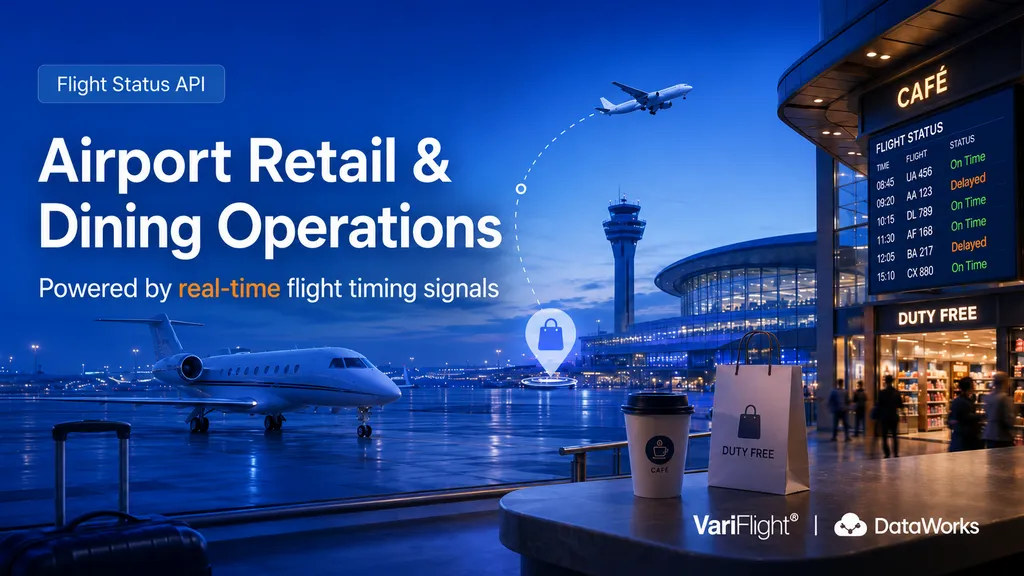
Airport retail and Food and Beverage teams do not operate only around passenger volume. They operate around passenger timing. A delayed departure, cancellation, terminal change, or boarding update can shift when travelers are available for shops, restaurants, lounges, mobile order pickup, and retail media.
A Flight Status API for airport commercial operations provides flight-aware timing signals for retail and Food and Beverage systems. It does not measure actual passenger dwell time, passenger flow, footfall, queue length, or in-terminal location. It supplies the operational flight data layer that helps commercial teams estimate when passenger service windows may extend, compress, or shift.
This distinction matters. Passenger dwell time is influenced by airport layout, security processing, lounge access, boarding behavior, traveler intent, and retail mix. Flight data cannot replace footfall sensors, POS data, Wi-Fi analytics, or passenger-flow systems. It can, however, explain why a commercial window may change before the store, kitchen, staffing desk, or media system reacts.
VariFlight DataWorks provides real-time flight status data sourced from airlines and airports, covering 97% of commercial flights, 10,000+ airports, and 1,200+ airlines. For airport retail and Food and Beverage teams, the value is turning flight movement into a business signal that can feed commercial operations.
Why Do Airport Retail and Food and Beverage Teams Need Flight-Aware Timing Signals?
Flight-aware timing is the use of departure, arrival, delay, cancellation, terminal, and boarding-related flight signals to support airport commercial decisions. It helps teams understand when a planned commercial window may no longer match actual flight movement.
The underlying problem is that commercial systems often run on static schedules while flight operations change throughout the day. A restaurant may begin closing tasks while a departure window is shifting. A pickup counter may keep order messages active after boarding has started. A retail campaign may continue in a terminal zone after flight activity has moved elsewhere.
Example: a late-evening outbound flight is scheduled to depart at 21:15 from Terminal 2. At 20:10, the estimated departure moves to 22:20. The flight status update does not prove that every passenger will shop or dine for another hour. It does tell commercial teams that the planned service window may have changed.
For operations teams, the benefit is reduced friction. They can adjust staffing, order timing, stock readiness, and campaign exposure based on flight signals instead of relying only on static schedules or repeated manual checks.
What Does DataWorks Flight Data Show About Departure Timing at PVG?
In a 30-day observational sample of passenger departures from Shanghai Pudong International Airport (PVG), VariFlight DataWorks analyzed flights from July 16 to August 14, 2026, using local airport time (China Standard Time, UTC+8).
The analysis compared scheduled departure time (STD) with actual off-block time, the time when an aircraft leaves its parking position. This measure was selected because it compares two closely related departure milestones and avoids mixing scheduled departure with actual airborne takeoff time.
The sample contained 22,438 executed passenger departures. Usable actual off-block time timestamps were available for 22,229 flights, representing 99.1% off-block timestamp availability within the analyzed sample.
Within those 22,229 departures:
| Actual off-block time shift from STD | Share of flights |
|---|---|
| At least 15 minutes later | 30.27% |
| At least 30 minutes later | 19.67% |
| At least 60 minutes later | 10.61% |
The median difference between STD and actual off-block time was +2.3 minutes, while the 90th percentile was +63 minutes.
These figures should not be interpreted as an official airport on-time-performance or delay rate. The 15-, 30-, and 60-minute thresholds are used here to illustrate the scale of operational timing shifts relevant to commercial planning.
They also do not measure passenger dwell time. Instead, they show that a material share of scheduled departure windows can change enough to make static commercial assumptions less reliable.
Were PVG Departure Timing Shifts More Common Later in the Day?
The same PVG sample shows a clear difference by scheduled departure period.
| Scheduled departure period | Flights | >=15 min | >=30 min | >=60 min |
|---|---|---|---|---|
| 06:00-08:59 | 4,192 | 11.6% | 5.5% | 2.2% |
| 09:00-11:59 | 4,159 | 27.1% | 15.0% | 6.3% |
| 12:00-14:59 | 3,627 | 34.2% | 21.9% | 11.2% |
| 15:00-17:59 | 3,391 | 33.4% | 22.6% | 13.2% |
| 18:00-20:59 | 3,191 | 41.4% | 30.0% | 17.6% |
| 21:00-23:59 | 2,393 | 38.3% | 28.4% | 17.1% |
In this 30-day PVG sample, the share of flights with an actual off-block time shift of at least 15 minutes was 41.4% between 18:00 and 20:59, compared with 11.6% between 06:00 and 08:59 – about 3.6 times the early-morning share.
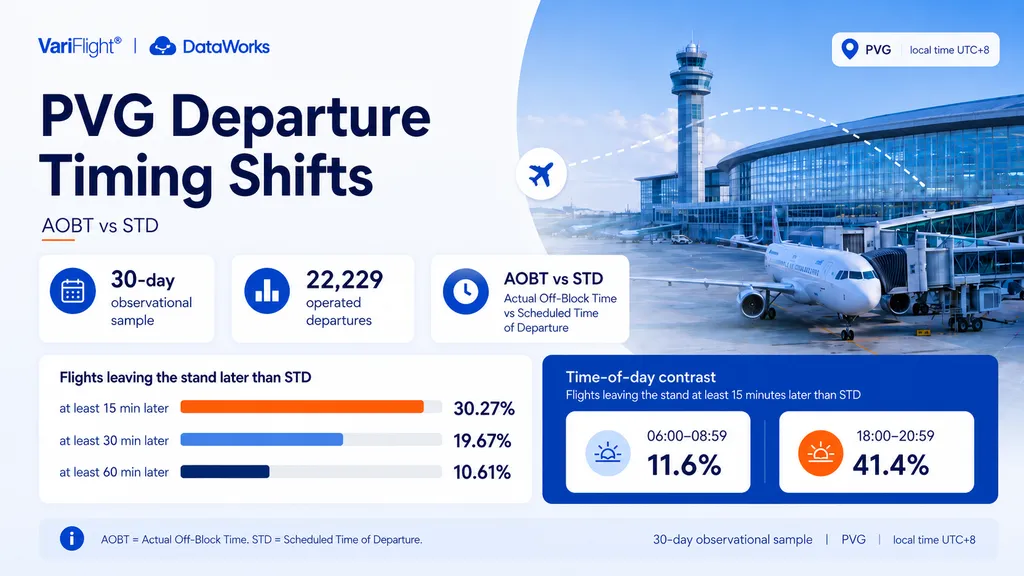
For shifts of at least 60 minutes, the observed share was 17.6% in the 18:00-20:59 period versus 2.2% in the early-morning period.
This does not mean evening flights always create more retail or Food and Beverage revenue. It means the reliability of the original departure schedule varied materially by time of day in this sample. For commercial systems, that strengthens the case for using live flight events rather than treating the published schedule as a fixed operating input.
Which Flight Status API Fields Support Airport Commercial Operations?
Airport commercial workflows need fields that explain passenger timing, route context, terminal location, and disruption state. A single status label is not enough for retail or Food and Beverage planning.
The core fields include:
- Flight number
- Scheduled departure and arrival time
- Official estimated departure and arrival time
- Actual takeoff and landing time
- Real-time departure, arrival, delay, cancellation, return, and diversion status
- On-block and off-block time for selected operational analysis when available
- Terminals
- Airline names
- Origin and destination (OD) airport names and codes
- OD city names
- Flight duration
- Boarding gates when available
- Boarding status when available
- Check-in counters when available
These fields serve different commercial purposes. Scheduled time defines the original operating plan. Estimated time updates the likely opportunity window. Actual off-block time confirms that the monitored flight has left the stand and can provide a final operational event for closing or auditing a pre-departure rule. Actual takeoff confirms the airborne milestone, which should be treated separately from actual off-block time. Terminal fields map flight activity to a physical commercial area. Airline, route, and flight-duration fields add operational context.
| Field | Airport commercial use |
|---|---|
| Estimated departure time | Adjust staffing, kitchen timing, order pickup, and campaign windows |
| Real-time delay or cancellation status | Detect commercial windows that may extend, compress, or disappear |
| Terminal | Route flight-related signals to the relevant commercial zone |
| Actual off-block time when available | Confirm stand departure for post-event audit and rule closure |
| Flight duration | Help classify short-haul and long-haul operating patterns |
| Airline and route | Support route-aware service planning |
| Boarding gate/status when available | Refine location and timing decisions without replacing core status logic |
Optional fields should be treated as supporting context. Core commercial rules should rely primarily on stronger timing, status, terminal, airline, and route signals.
How Do Query and Push APIs Fit Airport Commercial Systems?
Airport commercial systems need both lookup and active monitoring. Query APIs support search, reconciliation, and dashboard review. Push APIs support active monitoring when a flight is tied to a commercial rule.
VariFlight DataWorks Flight Status Query API supports multiple query modes, including flight number with date, origin and destination airport codes with date, OD city codes with date, airport departure or arrival lists, and airport time-window queries.
For airport commercial operations, airport departure and arrival lists and airport time-window queries are especially useful because they allow systems to monitor activity around a specific airport and operating period.
The Flight Status Push API supports subscribing to specific current-day or future flights and receiving flight-status changes through POST updates to a customer receiving address. These events can feed commercial dashboards, staffing alerts, order-cutoff rules, or retail media systems.
A practical data flow looks like this:
| Flight event | Commercial signal | Business system |
|---|---|---|
| Delay detected | Departure window may extend | Food and Beverage staffing, order cutoff, retail media |
| Estimated departure moves earlier | Purchase or pickup window may shrink | Mobile ordering, campaign timing |
| Terminal changes | Relevant commercial zone may shift | Store dashboard, concession planning |
| Boarding starts when available | Can trigger a rule to pause non-urgent messaging | Retail app, media screen, pickup reminder |
| Actual off-block time confirmed | Provides a final operational event for closing a flight-linked pre-departure rule | Audit layer, sales attribution, staffing review |
The important distinction is that flight data enters the commercial system as an event signal. The airport, concessionaire, or retail platform then applies its own rules for staffing, inventory, campaign timing, and service messaging.
How Flight Data Connects to Airport Commercial Systems
An airport commercial architecture connected to real-time flight data integrates operational flight information with business systems without treating flight data as passenger-behavior data.
A practical architecture includes:
- Flight selection: identify commercially relevant flights by airport, terminal, route, airline, or time window.
- Query layer: retrieve airport departure and arrival lists, route context, and current flight state.
- Push layer: subscribe to flights linked to active commercial rules.
- Rule engine: classify delay, cancellation, departure, arrival, boarding context, and abnormal states.
- Commercial action layer: update staffing, order windows, campaign timing, and dashboards.
- Business data layer: combine flight events with POS, orders, staffing, inventory, and campaign data.
- Audit layer: compare flight events with sales, service, and labor outcomes.
This structure keeps the product boundary clear. VariFlight DataWorks supplies the flight-status and timing layer. The customer system owns commercial logic, retail attribution, passenger analytics, and ROI measurement.
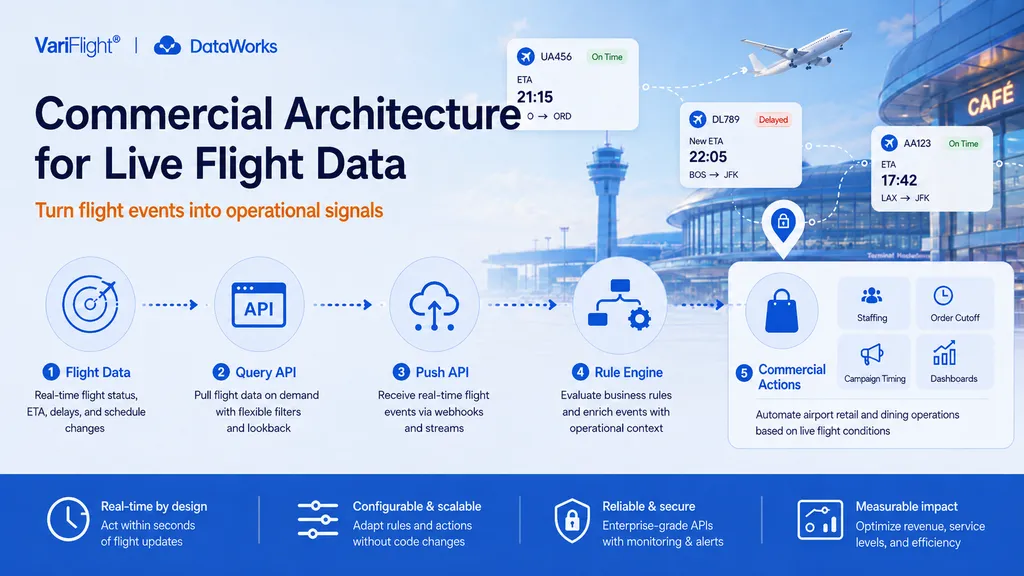
The PVG analysis also illustrates why an event-driven architecture can be more useful than static planning alone. In the sample, the share of departures leaving the stand at least 15 minutes after STD ranged from 11.6% in the early morning to more than 40% during the evening peak. A commercial rule engine can react to the actual flight event rather than assuming the same level of timing stability throughout the day.
What Implementation Details Matter for Airport Commercial Teams?
The most useful airport commercial integrations are not built only around a flight-status label. They also require mapping logic that connects flight events to the commercial environment where an action can occur.
Four implementation details are especially important:
- Terminal-to-zone mapping: connect terminal or gate context, when available, to the correct store cluster, restaurant group, pickup counter, or media screen.
- Flight matching: normalize flight number, date, airline, and route context so commercial systems monitor the correct flight record.
- Time-zone handling: keep scheduled, estimated, actual takeoff, landing, actual off-block time, and arrival timestamps consistent across airport systems, dashboards, and reporting layers.
- Event processing: handle repeated updates, late changes, cancellations, returns, and diversions without triggering duplicate commercial actions.
A delay update is not the business decision itself. It is an event that a rule engine can evaluate against local store hours, staffing rules, campaign windows, inventory readiness, and airport-specific commercial zones.
How Can Airport Food and Beverage Teams Use Flight Status Data in Daily Operations?
Airport Food and Beverage operations depend on service windows. Restaurants, coffee shops, bars, grab-and-go counters, and mobile-order pickup teams need to know when a planned service window may extend, compress, or disappear.
The PVG sample demonstrates why this becomes particularly relevant later in the day. Among departures scheduled between 18:00 and 20:59, 30.0% left the stand at least 30 minutes after STD, compared with 5.5% between 06:00 and 08:59.
That does not prove that passengers remained in restaurants for the same amount of time. It does show that evening operating plans based only on scheduled departure times can be exposed to substantially more timing variation.
In a flight-aware workflow, the Food and Beverage system can read scheduled departure, estimated departure, real-time status, terminal, and actual off-block time when available, then compare flight changes with kitchen cutoff rules, staff scheduling, inventory readiness, and pickup promise times.
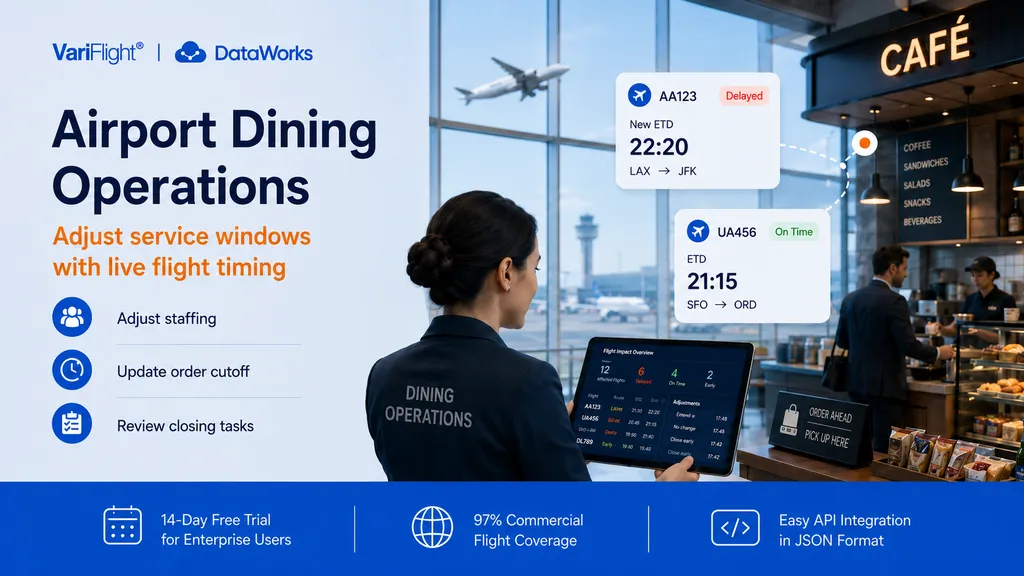
Example workflow:
- A flight is scheduled to depart at 21:15 from Terminal 2.
- The estimated departure moves to 22:20.
- The Food and Beverage dashboard flags a possible extended service window near that terminal.
- The store manager reviews closing tasks and mobile-order cutoff timing.
- When the relevant off-block or departure event is confirmed, the system closes or audits the flight-linked rule.
The API does not choose menu items or labor levels. It provides the operational signal that allows the customer system to avoid relying on outdated flight timing.
How Can Airport Retail and Duty-Free Teams Use Flight Data More Carefully?
Airport retail and duty-free teams can use flight data to align promotions, staffing, and service reminders with the live flight journey.
A retail system can group flights by terminal, route, airline, status, estimated time, and flight duration. Long-haul international flights may create different service patterns from short-haul domestic flights. A delayed flight may create a potential timing window, while boarding status, when available, may indicate that the useful window is closing.
Flight data should therefore be used as a commercial timing signal, not as a complete customer-intent signal.
A delayed or later-off-block flight does not automatically mean higher sales. The commercial outcome depends on passenger mix, store location, terminal design, boarding behavior, basket behavior, and whether the commercial team receives the operational update early enough to act.
The PVG results reinforce this distinction. They demonstrate measurable variation in flight departure timing, but they do not measure whether passengers shop, dine, or remain inside a particular commercial zone.
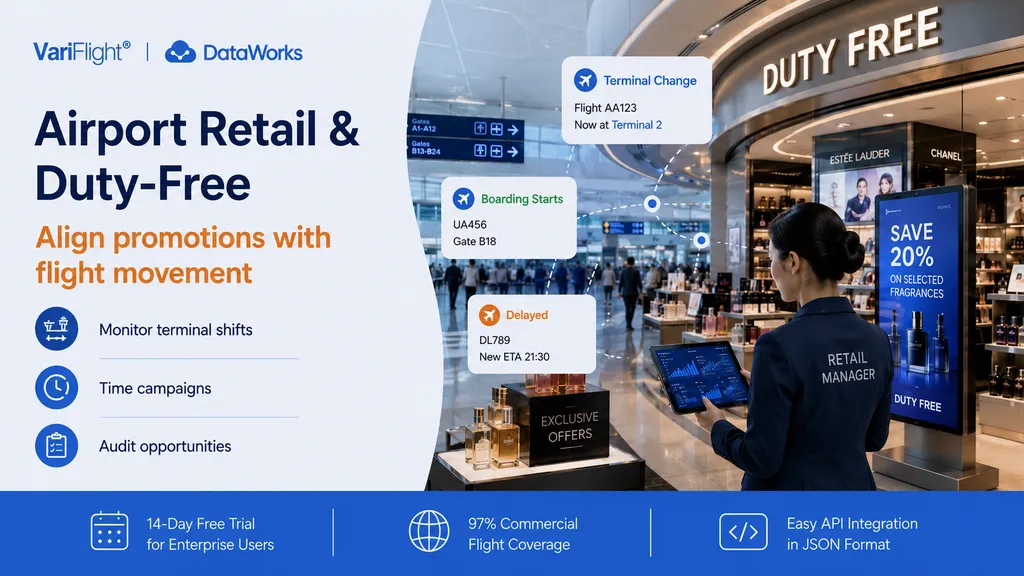
Used within that boundary, flight data can support more disciplined execution: when to review a campaign, when to adjust an order window, and when a flight-linked commercial opportunity may have ended.
What Should Airport Commercial Teams Test During a 14-Day API Trial?
A 14-day API trial should test whether flight-status data improves commercial timing, not only whether the API returns a response.
Teams should test:
- Airport departure and arrival list queries
- Airport time-window queries
- Flight-number lookup for selected commercial flights
- Push subscriptions for monitored flights
- Delay, cancellation, return, diversion, departure, and arrival states
- Terminal-specific Food and Beverage staffing rules
- Retail campaign timing around affected flights
- Optional boarding gate, boarding status, and check-in counter fields where available
- Actual off-block-time-based rule closure or audit logic where the field is available and relevant
- Post-event analysis against sales, order, staffing, inventory, and campaign data
Useful metrics include:
| Metric | What it shows |
|---|---|
| Commercial response time | How quickly teams act after flight-status changes |
| Manual lookup reduction | Whether staff reduce repeated checks of flight screens or airline pages |
| Order timing accuracy | Whether pickup and cutoff windows reflect current flight movement |
| Staffing adjustment accuracy | Whether labor decisions reflect changed service windows |
| Promotion timing quality | Whether campaigns stop or change at appropriate flight stages |
| Revenue-per-flight analysis | Whether flight events can be linked with commercial outcomes in the customer’s own data |
The trial should end with an implementation decision: which flights to monitor, which commercial zones to connect, which fields are mandatory, which optional fields improve the workflow, and which actions require manager approval.
FAQ
Can a Flight Status API measure passenger dwell time?
No. A Flight Status API does not measure actual passenger dwell time, footfall, queue length, or passenger location. It provides operational flight-timing signals that help commercial teams understand when planned service windows may change.
Is Flight Status API useful for airport retail teams?
Yes. A Flight Status API can help airport retail systems align promotions, staffing, and service timing with actual flight movement rather than relying only on static schedules.
What did the DataWorks PVG analysis measure?
The analysis compared scheduled departure time (STD) with actual off-block time for executed passenger departures at Shanghai Pudong International Airport over 30 consecutive days. It measured flight-level departure timing shifts, not passenger dwell time or official airport on-time performance.
How common were departure timing shifts in the PVG sample?
Among 22,229 departures with usable actual off-block time timestamps, 30.27% left the stand at least 15 minutes after STD, 19.67% at least 30 minutes later, and 10.61% at least 60 minutes later.
Were timing shifts more common in the evening?
In this PVG sample, yes. For departures scheduled between 18:00 and 20:59, 41.4% left the stand at least 15 minutes after STD, compared with 11.6% between 06:00 and 08:59.
This result describes the specific 30-day PVG sample and should not be generalized to every airport or season without further analysis.
Which fields matter most for airport Food and Beverage operations?
The most important fields are scheduled time, estimated time, real-time status, terminal, airline, origin-destination airport information, and confirmed operational milestones such as actual off-block time when available for the selected workflow.
Can flight-status data prove retail ROI by itself?
No. Flight-status data explains flight timing and operational events. Retail ROI analysis should combine flight events with sales, order, staffing, inventory, campaign, and passenger data from the airport or commercial operator’s own systems.
Start Building Flight-Aware Airport Commercial Operations
Use VariFlight DataWorks Flight Status API to test airport retail and Food and Beverage workflows with your own terminals, routes, stores, staffing rules, order windows, and retail-media logic.
Start with core status and timing fields, then add terminal, route, flight duration, and optional boarding or actual off-block time context where they improve commercial decisions.
VariFlight DataWorks Analysis Methodology
The PVG analysis used passenger scheduled departures from Shanghai Pudong International Airport between July 16 and August 14, 2026, using local airport time (China Standard Time, UTC+8).
The analysis:
- Included executed passenger flights with an actual operational departure record.
- Removed virtual flights, codeshare duplicates, diversion/return source records, planned pre-schedule data, stopover sectors, and abnormal same-origin/destination records.
- Deduplicated flights using date, departure airport, and flight number.
- Compared scheduled departure time (STD) with actual off-block time.
- Used 15-, 30-, and 60-minute thresholds for this analysis only; these thresholds are not presented as an official regulatory on-time-performance definition.
- Excluded cancelled flights because no actual off-block time timestamp exists for those flights.
The analysis is intended to illustrate operational timing variability. It does not measure passenger dwell time, passenger behavior, retail sales, or commercial conversion. It also should not be read as a global claim about actual off-block time field coverage or data accuracy.

References
- ACI World Airport Economics Report: https://aci.aero/2025/04/28/airports-face-financial-challenges-despite-air-traffic-rebound-aci-world-economics-report-reveals/
- ACI World Insights on airport customer experience and non-aeronautical revenues: https://blog.aci.aero/airport-economics/enhancing-customer-experience-to-boost-non-aeronautical-revenues/
- Aviation Pros, CA+ Supports AIDX Flight Data Format: https://www.aviationpros.com/airport-business/airport-infrastructure-operations/press-release/12279594/concessionaire-analyzer-ca-supports-aidx-flight-data-format
- Journal of Air Transport Management, “Shopping or dining? On passenger dwell time and non-aeronautical revenues”: https://www.sciencedirect.com/science/article/pii/S0969699724000851
- VariFlight DataWorks Flight Status Query API V3.0: https://dataworks.variflight.com/wp-content/uploads/2026/04/Flight-Status-Query_V3.pdf
- VariFlight DataWorks Flight Status Push API V3.0: https://dataworks.variflight.com/wp-content/uploads/2026/04/Flight-Status-Push-API-V3.pdf