Most flight search results compare price, schedule, airline, and stops. That is useful, but it does not always explain cabin comfort.
Flight amenity data adds the product layer. It helps online travel agencies display seat dimensions, cabin layout, Wi-Fi, in-flight entertainment, in-seat power, catering, aircraft information, and cabin visuals before booking.
By integrating these attributes into search results and flight detail pages, OTAs can help travelers compare more than price.
Why Do OTAs Need Flight Amenity Data Beyond Price and Schedule?
Flight amenity data is structured information about the aircraft, cabin, seat, and onboard services attached to a specific flight and cabin class. For OTAs, it turns a flight result from a fare-and-time item into a more complete product comparison.
The commercial problem is simple. A traveler may see two nonstop flights at close prices, but only one shows stronger cabin features. If the booking page cannot show that difference, the OTA loses a chance to explain value.
This matters because airline retailing is moving toward richer product content. IATA describes NDC as a way to support product differentiation and transparent shopping. Industry content products such as ATPCO Routehappy also show that airline product content is now part of flight shopping.
Which Flight Amenity Data Fields Help Build a Comfort-Based Flight Comparison?
VariFlight DataWorks Flight Happiness Index combines two complementary data layers: cabin comfort and onboard amenity data, plus historical flight reliability indicators.
| Data layer | Example fields | OTA use |
|---|---|---|
| Cabin comfort and amenities | Seat pitch, seat width, seat recline angle, Wi-Fi, in-flight entertainment, in-seat power, catering, seat layout, cabin images where available | Help travelers compare the onboard product |
| Aircraft and cabin context | Aircraft type, aircraft age, cabin class, origin and destination (OD), flight number, date | Match amenities to the correct flight option |
| Flight reliability context | Historical on-time performance, average departure delay, average arrival delay, cancellation probability | Add context for ranking, filters, or detail pages |
The important point is separation. Seat pitch data, Wi-Fi, power, catering, and cabin layout answer comfort questions. Historical on-time performance and delay indicators answer reliability questions.
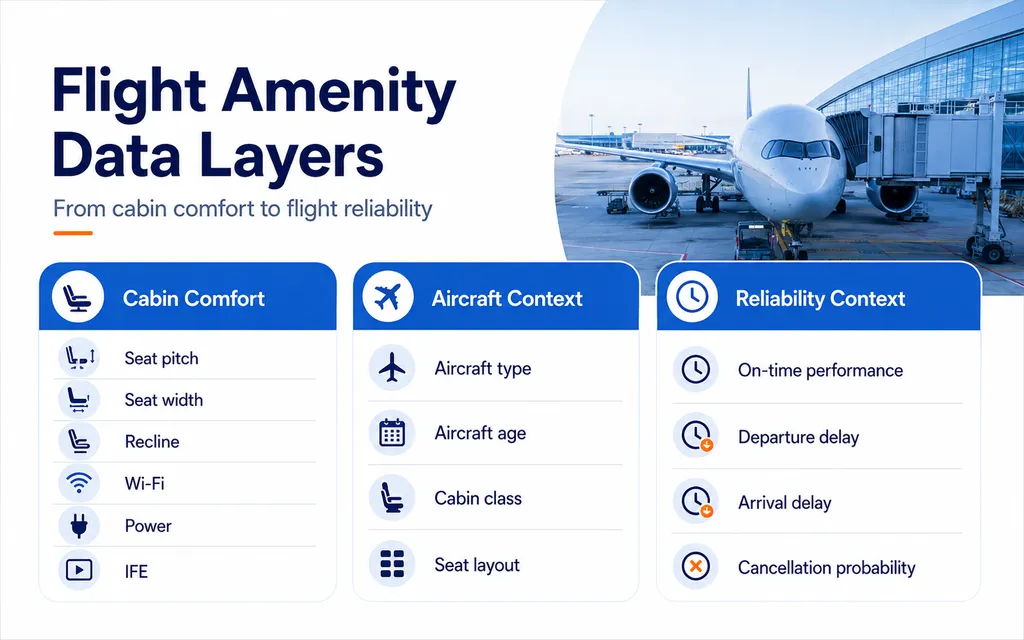
Search results may only need a few badges, while a flight detail page can show cabin class, aircraft type, seat pitch, seat width, seat layout, catering, entertainment, and cabin images where available.
What Does a Same-Route Flight Amenity Comparison Look Like?
A comparison table can make airline amenity data easier to use in an OTA interface. The following example compares two economy-class options on the same route and date. The detail pages were retrieved on August 25, 2026, for American Airlines-marketed AA8898, operated by Cathay Pacific as CX691, and Qatar Airways-marketed QR3459, operated by Cathay Pacific as CX659.
| Comparison field | AA8898 / CX691 HKG-SIN | QR3459 / CX659 HKG-SIN |
|---|---|---|
| Route | HKG-SIN | HKG-SIN |
| Cabin class | Economy | Economy |
| Marketing airline | American Airlines | Qatar Airways |
| Marketing flight number | AA8898 | QR3459 |
| Operating airline | Cathay Pacific | Cathay Pacific |
| Operating flight number | CX691 | CX659 |
| Codeshare status | Codeshare | Codeshare |
| Scheduled time | 08:00-11:45 | 01:45-05:30 |
| Aircraft type | A350-900 | A330-300 |
| Aircraft age | 9.5 years | 13.3 years |
| Seat pitch | 81.3 cm | 81.3 cm |
| Seat width | 45.7 cm | 46.2 cm |
| Seat recline angle | 115 degrees | 110 degrees |
| Seat layout | 3-3-3 | 2-4-2 |
| Wi-Fi | Provided | Provided |
| In-seat power | Power and USB outlet | Power and USB outlet |
| In-flight entertainment | On-demand personal audio and video system | On-demand personal audio and video system |
| Catering | Food provided | Food provided |
| On-time rate | 77% | 83% |
| Average departure delay | 28 minutes | 27 minutes |
| Average arrival performance | 9 minutes early | 7 minutes early |
CX691 offers a newer aircraft and greater listed recline, while CX659 provides a slightly wider listed seat and a 2-4-2 layout. An OTA could surface these differences without declaring one flight universally “better.”
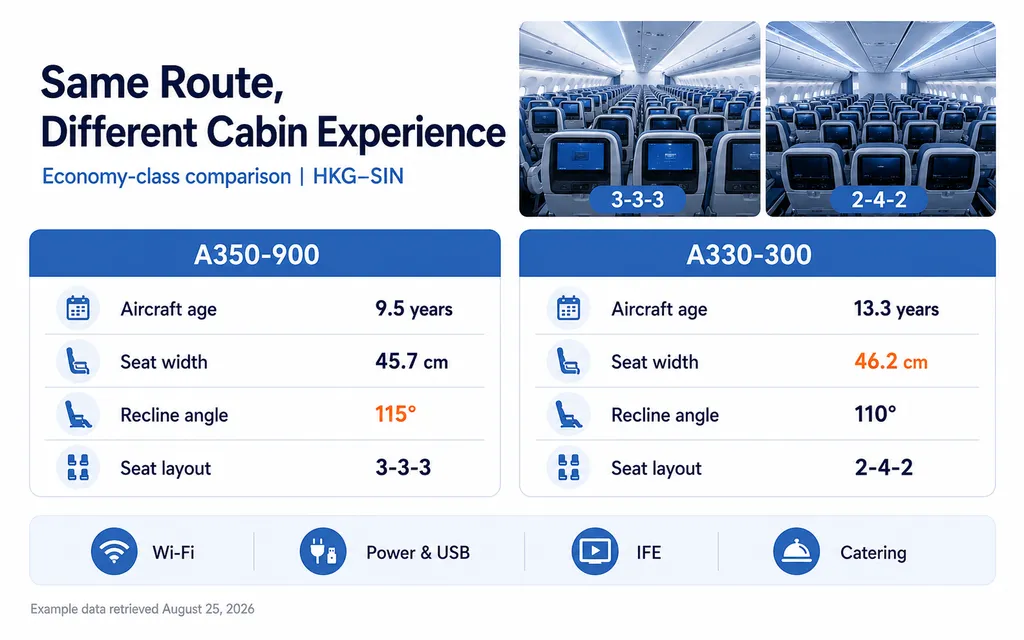
The example reflects data available at the time of retrieval. Aircraft assignments and onboard amenities may change before departure. It also shows why codeshare matching should connect the marketing flight number to the operating flight.
How Can OTAs Use Flight Amenity Data in the Booking Flow?
An OTA can use amenity data as a comfort evidence layer inside flight search, flight detail pages, sorting tools, and upsell modules. The data should support clear decisions, not clutter the page with every attribute.
A practical flow looks like this:
| Shopping moment | Data used | Product action |
|---|---|---|
| Search results | Aircraft type, cabin class, Wi-Fi, in-seat power, key comfort badges | Help users spot meaningful differences quickly |
| Flight comparison | Seat pitch, seat width, seat recline angle, entertainment, catering | Explain value when fares are close |
| Flight detail page | Seat layout, cabin images where available, aircraft context | Give travelers confidence before checkout |
| Premium upsell | Cabin class, seat space, onboard services | Show why a higher cabin may be worth it |
| Business-travel policy | Wi-Fi, power, reliability context | Support work-ready flight recommendations |
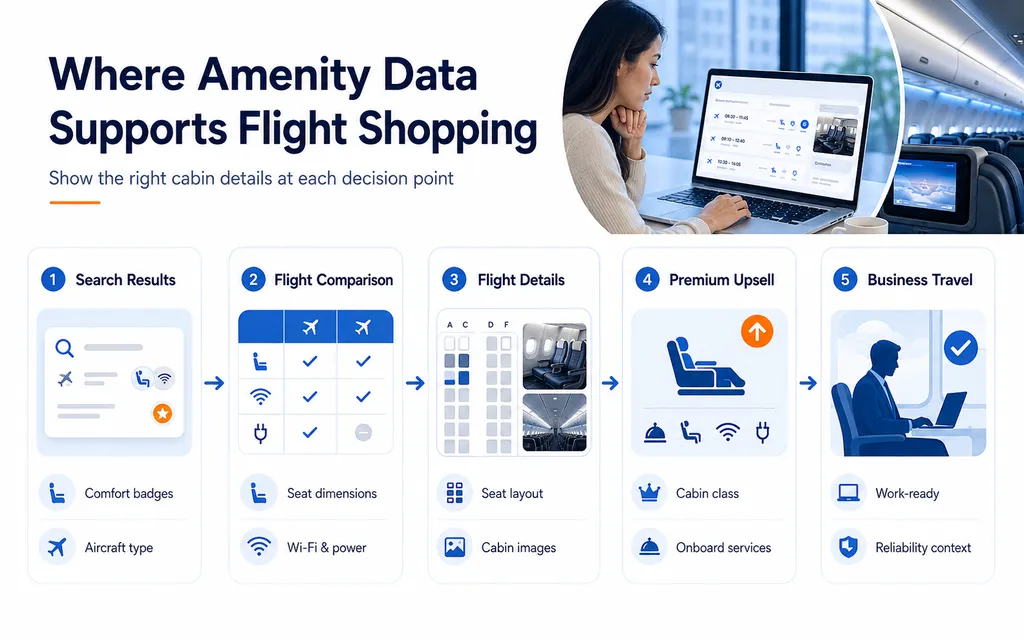
For example, a business traveler may value Wi-Fi, power, and a better seat more than a small fare difference. A leisure traveler on a short route may care more about schedule and price. The OTA can decide what to show by route length, cabin class, segment, and page type.
How Should Flight Amenity Data Fit Into Airline Retailing and Dynamic Offers?
Flight amenity data fits into airline retailing as product content. It gives sellers structured attributes that can support relevant offers, bundles, comparison modules, and booking confidence.
IATA’s airline retailing work describes a shift toward Offers and Orders, while Dynamic Offers focuses on more relevant products and prices. In that context, an airline amenities API is not a replacement for fare rules, availability, or order management. It is the product detail layer that helps the customer understand the offer.
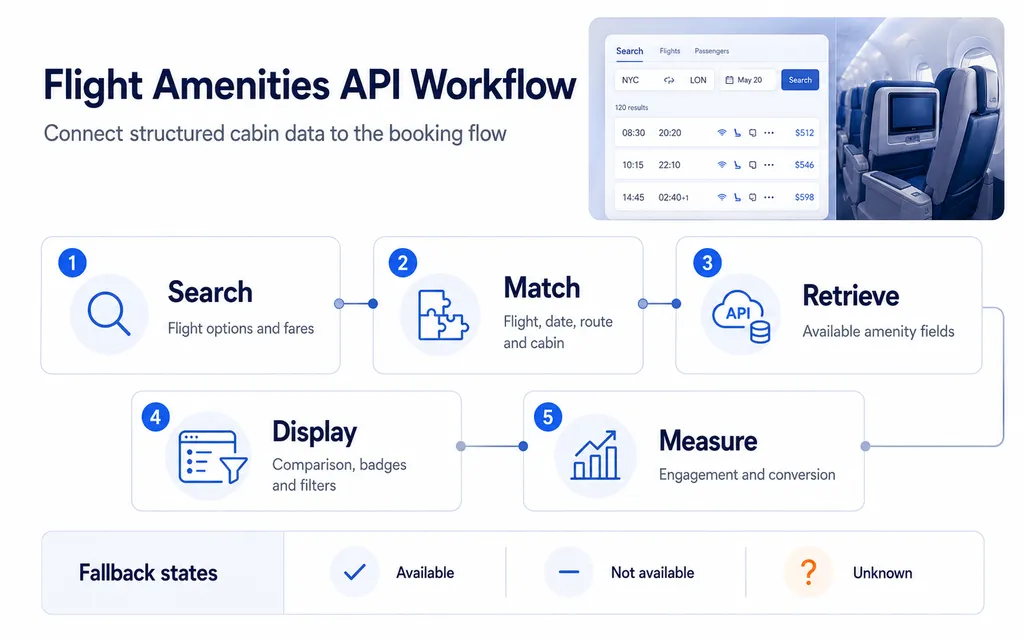
For an OTA, the architecture can be simple:
- Search engine returns flight options and fares.
- Amenity data layer matches flight number, date, route, and cabin class.
- Flight amenities API returns available comfort and service fields.
- Ranking or UI rules decide which attributes to show.
- Booking page stores displayed content for audit and customer support.
This keeps the product boundary clear. VariFlight DataWorks supplies the structured FHI and amenity layer. The OTA owns ranking logic, offer display, supplier rules, and conversion measurement.
How Accurate Is Flight Amenity Data?
Amenity accuracy depends on matching the right aircraft, cabin, date, route, and cabin class. The same aircraft model does not always mean the same cabin configuration. One airline may operate different subfleets, and an aircraft change can alter seats, Wi-Fi, power, entertainment, or cabin layout.
This is why flight amenity data should be treated as an available product content layer, not as a universal guarantee across all flights and cabins. Field availability may vary by airline, aircraft configuration, route, cabin class, and travel date. For lower-availability fields such as cabin or seat map images, show them where available and avoid overclaiming.
Frontend logic should also separate three states: available, not available, and unknown. If a Wi-Fi field is missing, that should not automatically become “No Wi-Fi.” It may simply mean the OTA does not have reliable data for that flight, cabin, or date.
What Matters When Integrating a Flight Amenities API?
Integration should focus on match quality, fallback behavior, and display governance. The goal is not to block shopping when a field is missing. The goal is to show reliable comfort information when it exists.
Important checks include flight-number, date, route, and cabin-class matching; cabin mapping between supplier inventory and amenity records; codeshare flight matching; aircraft-change and cabin-change handling; API response time; error handling; data freshness; and the difference between “not available” and “unknown.”
OTAs that already use operational products such as Flight Status Data or historical reliability products can keep amenity content separate from live movement data. That makes the UI easier to govern and helps avoid turning comfort attributes into operational promises.
How Can OTAs Measure the Business Value of Comfort Data?
The business value of comfort data should be measured through booking behavior, upsell performance, and support reduction. Amenity data does not prove conversion by itself; the OTA needs its own experiment and analytics layer.
Useful metrics include:
| Metric | What it shows |
|---|---|
| Flight detail engagement | Whether users inspect comfort attributes |
| Sort and filter usage | Whether travelers actively compare comfort |
| Premium cabin click-through | Whether amenity content supports upsell |
| Booking conversion by route | Whether comfort information changes decisions |
| Customer support questions | Whether clearer content reduces uncertainty |
| Post-booking complaint rate | Whether displayed cabin data reduces surprises |
The strongest tests compare similar traffic before and after amenity content appears in the booking flow, segmented by route length, cabin class, traveler type, and device.
What Should OTAs Check During a 14-Day Flight Amenities API Trial?
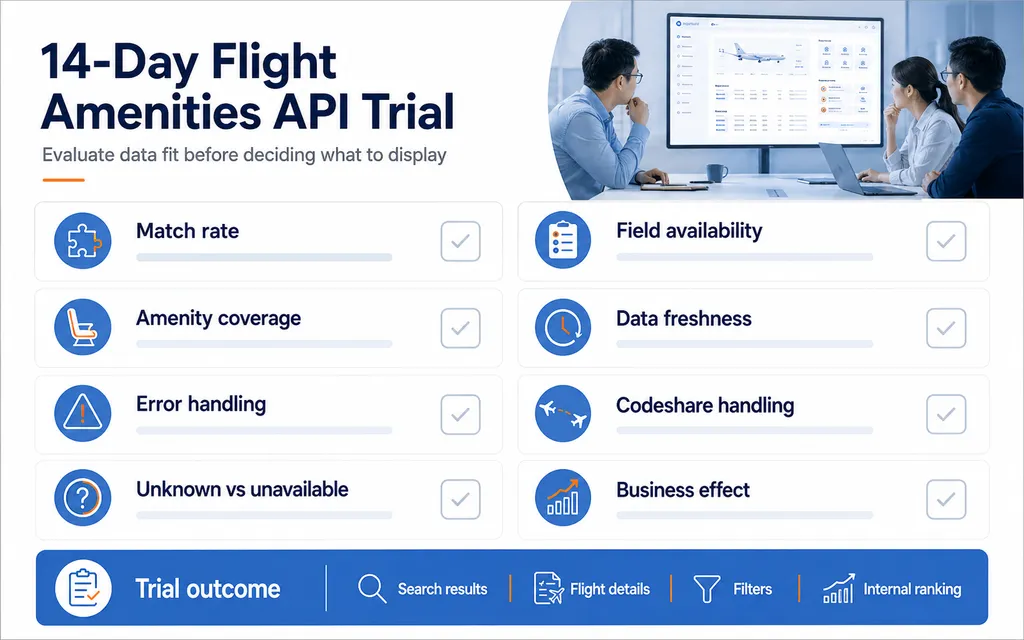
A 14-day trial should test data fit, display logic, and commercial value. It should not only check whether an endpoint returns a response.
Useful evaluation metrics include:
| Trial metric | What the OTA should verify |
|---|---|
| Match rate | Match by flight number, date, route, and cabin class |
| Field availability rate | Availability by airline, route, and cabin |
| Amenity coverage | Differences between short-haul and long-haul flights |
| Data freshness | Whether amenity updates sync with aircraft or cabin changes |
| Error handling | Whether the API response supports stable fallback states |
| Codeshare handling | Whether marketed and operating flights match correctly |
| Unknown vs unavailable | Whether missing data is separated from confirmed absence |
| Business effect | Impact on detail-page engagement, filters, upsell, and conversion |
The trial should end with a display decision: which FHI fields belong in search results, which belong in the detail page, which should support filters, and which should remain internal ranking inputs.
FAQ
What is Flight Happiness Index (flight amenity data) ?
Flight amenity data is structured information about onboard cabin features such as seat dimensions, Wi-Fi, in-flight entertainment, in-seat power, catering, seat layout, aircraft type, and cabin images where available.
How is Flight Happiness Index different from flight status data?
Flight status data explains operational movement, such as delay, cancellation, departure, and arrival. Flight Happiness Index data explains passenger experience attributes, such as comfort, cabin facilities, onboard services, and reliability context.
Can OTAs use flight amenity data for flight ranking?
Yes. OTAs can use amenity data as one input for ranking, filtering, badges, and recommendation logic. The platform should still combine it with fare, schedule, availability, airline rules, and user preference.
Should every amenity field be shown on the booking page?
No. OTAs should show fields that help the traveler decide. Search results may only need a few badges, while flight detail pages can show seat layout, Wi-Fi, in-seat power, catering, and cabin images where available.
How Can OTAs Start Building Comfort-Based Flight Shopping?
Use VariFlight DataWorks Flight Happiness Index data to test comfort-based flight comparison with your own route mix, cabin classes, UI rules, and conversion metrics.
Start with flight number, date, route, cabin class, aircraft type, seat dimensions, Wi-Fi, in-seat power, in-flight entertainment, seat layout, catering, and reliability context. Then decide which fields improve search results, detail pages, filters, and upsell modules.
References
- IATA, Distribution with Offers & Orders (NDC): https://www.iata.org/ndc
- IATA, Airline Retailing: https://www.iata.org/en/programs/airline-distribution/retailing/
- IATA, Dynamic Offers: https://www.iata.org/en/programs/airline-distribution/retailing/dynamic-offers/
- ATPCO Routehappy API announcement: https://info.atpco.net/accessing-routehappy-content-simpler-and-faster
- VariFlight DataWorks Flight Happiness Index: https://dataworks.variflight.com/products/flight-happiness-index/
- VariFlight Happiness detail page, AA8898 HKG-SIN, August 25, 2026: https://happiness.variflight.com/en/info/detail?fnum=AA8898&dep=HKG&arr=SIN&date=2026-08-25&type=1
- VariFlight Happiness detail page, QR3459 HKG-SIN, August 25, 2026: https://happiness.variflight.com/en/info/detail?fnum=QR3459&dep=HKG&arr=SIN&date=2026-08-25&type=1