
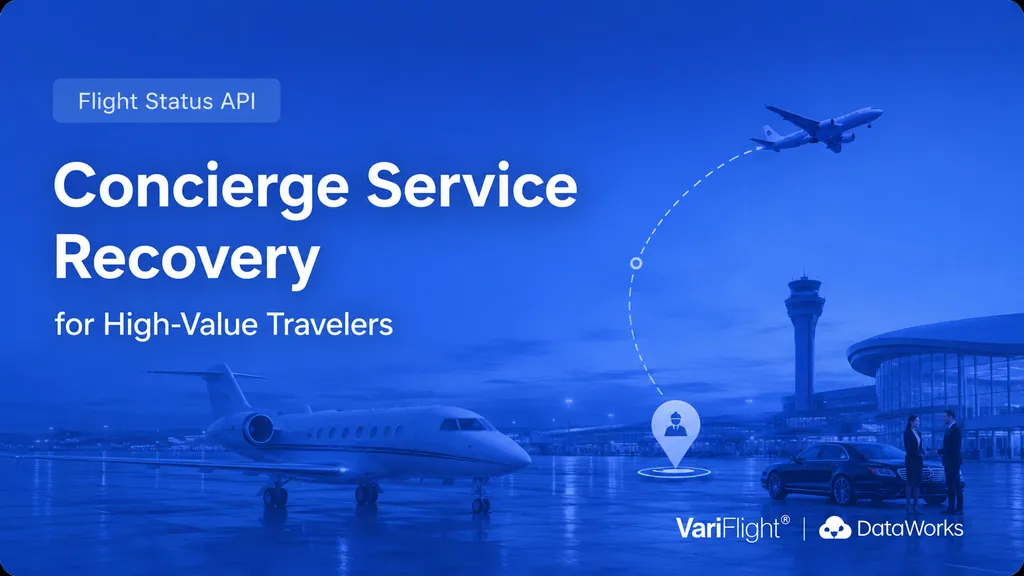
Concierge service breaks down when the team learns about a flight disruption after the traveler does. A premium cardholder, executive traveler, VIP guest, or private client may not care which system failed. They only see that the driver waited too early, the restaurant booking was missed, the airport assistant had the wrong terminal context, or the service desk called too late.
Flight Status API for concierge service recovery is the use of real-time flight status, timing, route, airline, and support-context fields to help concierge teams detect travel disruption and coordinate the next service action. The API does not replace the concierge team, customer policy, airline instruction, or human judgment. It supplies the operational flight data layer that allows those teams to act earlier.
The best concierge workflows are not only about premium service. They are about operational continuity. When a flight is delayed, canceled, returned, diverted, or re-timed, the concierge desk needs the same core facts that airline, travel, transfer, and support systems use: what changed, when it changed, which traveler is affected, and which service owner should respond.
VariFlight DataWorks provides real-time and historical flight status data sourced from airlines and airports, covering 10,000+ airports and 1,200+ airlines. For concierge operations, the value is not simply displaying a flight status. The value is connecting flight movement to traveler support, escalation, and service recovery workflows.
Why Do Concierge Teams Need Real-Time Flight Status Data?
Concierge flight monitoring is the practice of linking a traveler’s flight record to service tasks before, during, and after a flight. It helps concierge teams move from manual checking to event-driven support.
The mechanism starts with flight capture. A concierge platform stores the traveler’s flight number, travel date, airline, scheduled time, and origin and destination (OD) airport names or codes. The system then monitors official estimated time, actual takeoff and landing time, and real-time status.
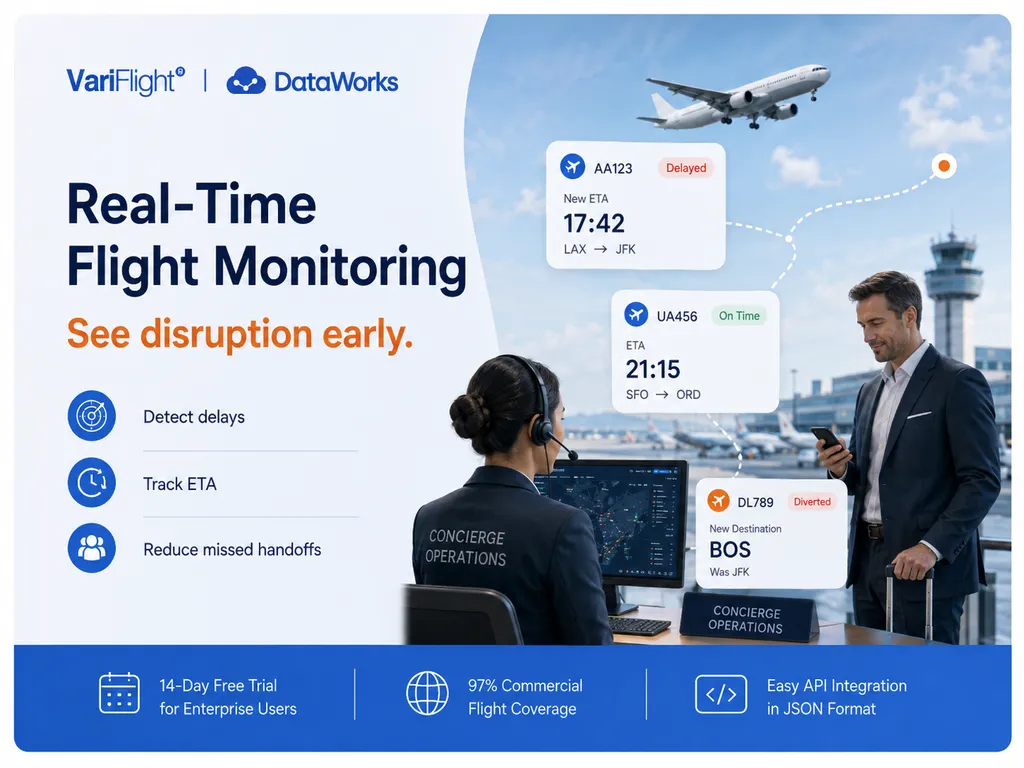
Example: a VIP traveler is expected to land at 18:10 and attend a private dinner at 20:00. At 16:45, the estimated arrival moves to 19:25. A concierge desk that sees the update early can contact the traveler, adjust the driver, notify the restaurant, and decide whether a human service agent should step in.
The business impact is lower service failure. Concierge teams reduce missed handoffs, late customer communication, driver idle time, and last-minute manual searches across airline or airport sites.
Where Does Concierge Service Lose Time and Cost During Flight Disruption?
Concierge service failure is often caused by delayed data flow rather than poor service intent. The team may be capable, but the flight update reaches the service workflow too late.
The hidden inefficiency appears in small operational gaps. Agents manually check flight pages. Drivers wait on old arrival times. Code share flight numbers create matching errors. Airport support teams prepare too early or too late. Customer messages are delayed because no system has classified the flight event yet.
| Inefficiency Type | Operational Cause | Concierge Impact |
|---|---|---|
| Time loss | Agents manually check airline or airport pages | Slower response during disruption |
| Cost loss | Drivers or service partners act on stale ETA | Idle time and unnecessary dispatch |
| Operational risk | Cancellation, return, or diversion is detected late | Service case opens after the traveler is already affected |
| Experience friction | Traveler receives unclear or delayed updates | Premium service feels reactive |
| Data mismatch | Code share flight numbers are not reconciled | The wrong flight may be monitored |
This is why real-time flight data matters in concierge operations. The goal is not to automate every service decision. The goal is to reduce the delay between flight movement and service response.
Which Flight Status API Fields Improve Concierge Service Recovery?
A concierge service recovery workflow needs fields that identify the flight, explain the disruption, and support the next human or automated action.
The core fields include:
- Flight number
- Scheduled departure and arrival time
- Official estimated departure and arrival time
- Actual takeoff and landing time
- Real-time departure, arrival, delay, cancellation, return, and diversion status
- Airline names
- Origin and destination (OD) airport names and codes
- OD city names
- Code share flight numbers
- Historical punctuality rate
- Airline phone numbers when available
- Departure and arrival airport phone numbers when available
- Boarding status and check-in counters when available
These fields should not be used as isolated facts. Scheduled time defines the service plan. Estimated time shows the latest operational expectation. Actual time confirms what has happened. Real-time status identifies the disruption type. Airline and route fields help the concierge desk decide who to contact and how to explain the situation.
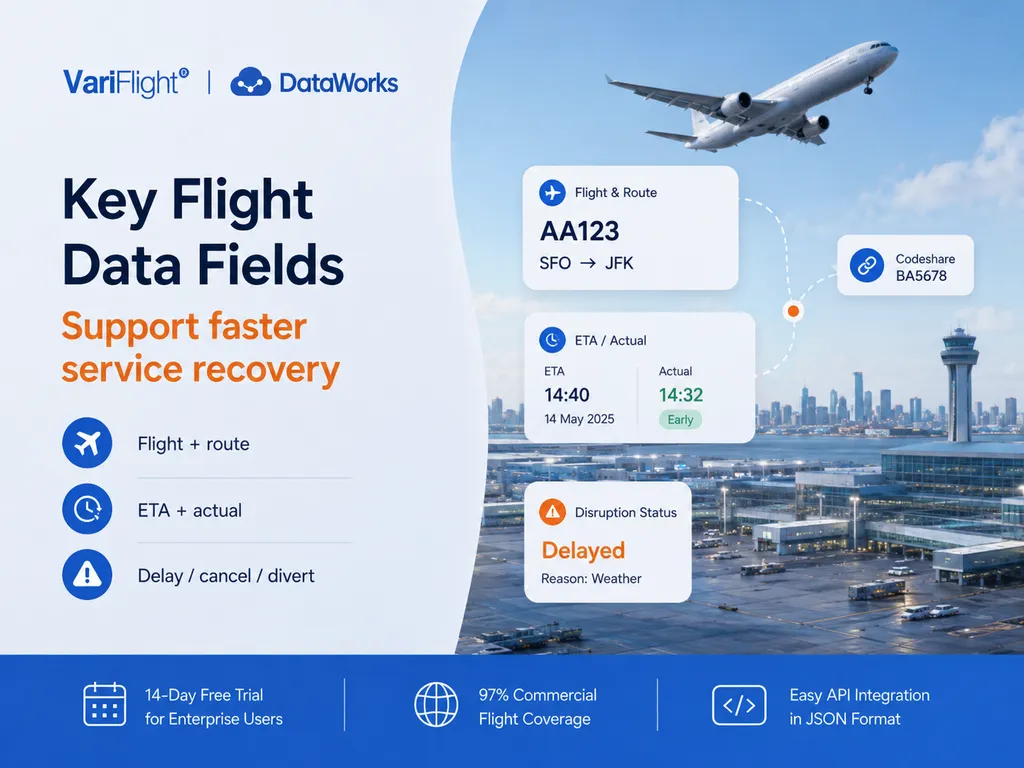
Historical punctuality rate helps teams decide which trips need closer monitoring before disruption occurs. Code share flight numbers reduce mismatch when travelers provide a marketing flight number instead of the operating flight number.
| Field | Concierge Workflow Use |
|---|---|
| Flight number | Match flight data to traveler profile, trip, or service case |
| Real-time status | Detect delay, cancellation, return, diversion, departure, or arrival |
| Estimated arrival time | Adjust driver, restaurant, hotel, or meeting support |
| Actual landing time | Confirm that the flight has entered the arrival phase |
| Code share flight numbers | Reduce mismatch when travelers provide a marketing flight number |
| Historical punctuality rate | Flag flights that may need closer monitoring |
| Airline and airport phone numbers | Support escalation when available |
The key is not to over-automate. A concierge system should use flight data to identify the case and prepare the agent. The team still owns the service decision.
How Can Concierge Service Teams Prioritize High-Value Travelers During Disruption?
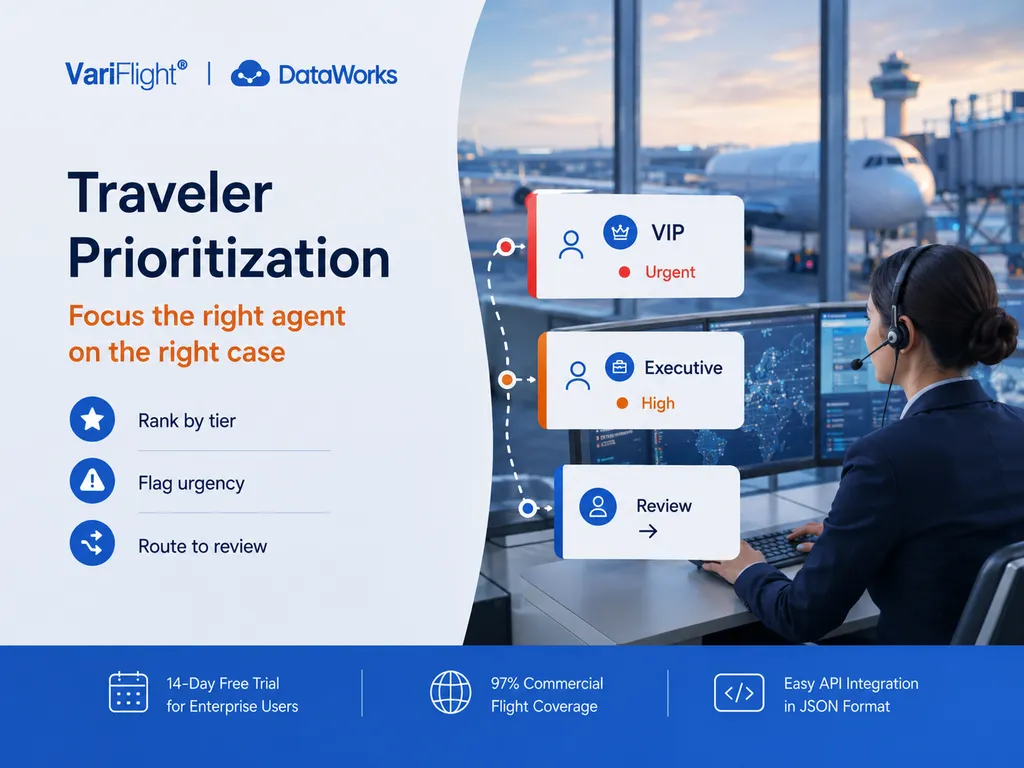
Concierge prioritization is the process of ranking affected travelers by service urgency, customer tier, trip purpose, disruption severity, and operational deadline. Flight status data supplies the trigger; customer rules decide priority.
The mechanism is event classification. The system receives flight updates and maps them to service rules. A 25-minute delay may require no action for a leisure traveler with no connected service. The same delay may require immediate action for a board member with a timed ground transfer and a meeting window.
| Flight Event | Concierge Priority Signal | Possible Action |
|---|---|---|
| Estimated arrival slips by 60 minutes | Dinner, event, or meeting may be missed | Open service case and notify agent |
| Cancellation status appears | Traveler may need re-accommodation | Escalate to travel support team |
| Return or diversion status appears | Arrival city may no longer be valid | Move to disruption recovery workflow |
| Actual landing confirmed | Arrival service should start | Notify transfer or destination support |
| Code share mismatch appears | Traveler identity may be unclear | Reconcile flight number before messaging |
The business impact is better use of human attention. Concierge teams cannot treat every flight update as a manual emergency. Flight data helps them identify which travelers actually need action.
How Can Flight Data Improve Concierge Communication?
Concierge communication should separate confirmed flight facts from service promises. Flight data helps the team explain what changed without making claims that belong to airlines, insurers, or travel policies.
The mechanism is message staging. When the API reports a delay, cancellation, return, diversion, departure, or arrival state, the concierge platform prepares a message based on confirmed data. The message can then be sent automatically, reviewed by an agent, or routed to a premium support channel.
Examples include:
- “Your flight is now estimated to arrive at 19:25. We are reviewing your ground arrangements.”
- “Your flight is marked canceled. A concierge agent is checking your itinerary options.”
- “Your flight has landed. Your arrival support team has been notified.”
- “Your flight status has changed. Please follow airline instructions while we review your service plan.”
This is where product boundaries matter. VariFlight DataWorks supplies the flight data layer. The concierge platform controls the wording, approval logic, customer tiering, and policy rules.
The commercial value is trust. High-value travelers expect the service team to know what is happening before they need to explain it themselves.
How Can Query and Push APIs Support Concierge Monitoring?
Concierge monitoring needs both lookup and active event delivery. Query APIs support search, reconciliation, and dashboard review. Push APIs support active monitoring when a traveler or flight requires closer attention.
VariFlight DataWorks Flight Status Query API supports multiple query modes, including flight number with date, OD airport codes with date, OD city codes with date, airport departure or arrival lists, and airport time-window queries. These modes allow a concierge platform to search trips by itinerary, route, city pair, airport, or service window.
The Flight Status Push API supports subscribing to specific current-day or future flights and receiving status changes through POST updates to a customer receiving address. This is useful when a concierge desk needs to monitor a high-value traveler without repeatedly checking the same flight manually.
A practical concierge architecture looks like this:
- Trip capture: collect flight number, date, airline, traveler ID, service tier, and linked services.
- Query layer: validate the flight and retrieve current state.
- Subscription layer: subscribe to flights that need active monitoring.
- Rule engine: classify delay, cancellation, return, diversion, arrival, and departure states.
- Agent queue: route cases to concierge, travel support, ground service, or escalation desk.
- Communication layer: send approved messages or require agent review.
- Audit trail: store status changes and service actions for later review.
The business impact is fewer manual checks. Concierge teams can spend more time resolving the service case and less time refreshing airline websites.
How Can Concierge Teams Coordinate Ground Transport, Hotels, and Airport Assistance?
Concierge service recovery often depends on third-party service timing. A flight update may affect a chauffeur, airport greeter, hotel desk, restaurant, meeting host, security provider, or destination support partner.
The mechanism is service dependency mapping. Each flight record is linked to downstream tasks. When flight status changes, the concierge system checks which services are affected and which team owns the next step.
| Linked Service | Flight Data Trigger | Concierge Action |
|---|---|---|
| Chauffeur pickup | Estimated arrival changes | Adjust pickup time or pause dispatch |
| Airport meet-and-assist | Terminal or arrival timing changes | Reconfirm staff readiness when available |
| Hotel or residence arrival | Cancellation or late arrival | Notify destination support |
| Restaurant or event | Delay threatens reservation window | Ask agent to renegotiate timing |
| Airport support | Airline or airport contact needed | Use contact fields when available |
The article should not imply that every support field is always available. Some fields, such as airline phone numbers, airport phone numbers, boarding status, and check-in counters, should be treated as optional context when available. Core workflow decisions should rely on stronger operational fields such as status, timing, airline, and route data.
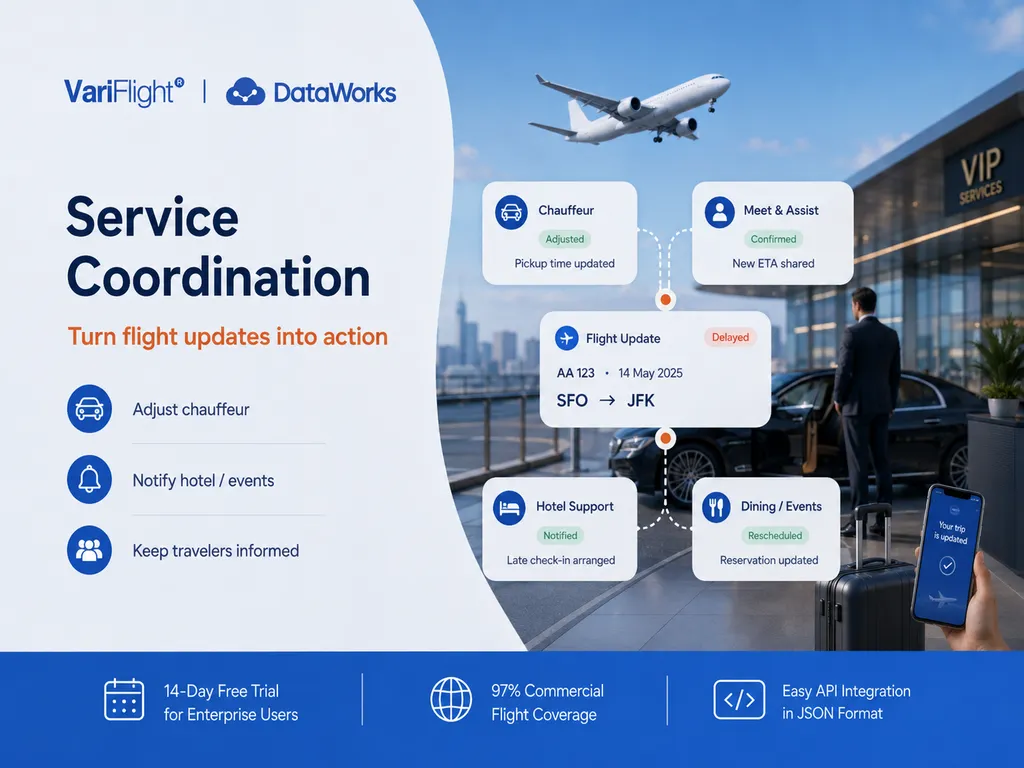
The business impact is coordination quality. Concierge teams can notify the right partner earlier and reduce avoidable service waste.
What Should Enterprises Look for in a Flight Data Provider for Concierge Workflows?
A flight data provider for concierge workflows should be evaluated by how well its data supports high-value traveler service operations, not only by whether it can display a flight board.
Procurement, product, and operations teams should test whether the provider can support flight lookup, active monitoring, exception handling, route matching, code share reconciliation, and service escalation.
| Provider Requirement | Why It Matters |
|---|---|
| Real-time operational status | Detect delay, cancellation, return, diversion, departure, and arrival states |
| Scheduled, estimated, and actual times | Compare the original service plan with updated flight movement |
| Query and push access | Support both manual lookup and active monitoring |
| Code share support | Reduce errors when travelers provide different flight numbers |
| Route and city context | Help agents understand the trip without aviation shorthand |
| Historical punctuality rate | Identify flights that deserve closer pre-trip monitoring |
| Clear field boundaries | Avoid overpromising optional fields such as contact numbers or check-in context |
| Historical records | Support service review, customer complaints, and operational analysis |
The real-world example is a premium traveler who provides a code share flight number. If the concierge platform cannot reconcile the flight, the service team may monitor the wrong record. If the platform can connect code share numbers, airline context, route, and timing fields, the case becomes easier to verify.
The business impact is better service governance. A strong provider helps concierge teams standardize support without removing the human judgment that premium service requires.
What Should Teams Test During a 14-Day Flight Status API Trial?
A 14-day API trial should test concierge service recovery as a workflow, not only as a connection test. The goal is to see whether flight data can reduce manual checking and improve high-value traveler support.
Teams should test:
- Flight lookup by flight number, route, airport, city, and airport time window
- Push subscription for current-day and future flights
- Code share flight matching
- Delayed, canceled, returned, diverted, departed, and arrived flights
- Trips linked to chauffeur pickup, airport assistance, hotel arrival, or event timing
- Traveler tiering rules
- Agent review queues
- Message templates that distinguish confirmed data from service promises
- Historical punctuality rate for pre-trip monitoring
Useful trial metrics include:
| Metric | What It Shows |
|---|---|
| Manual lookup reduction | Whether agents spend less time checking flight status manually |
| Case detection speed | How quickly disruption enters the concierge workflow |
| Message accuracy | Whether traveler communication stays factual and policy-safe |
| Service adjustment rate | Whether linked services update before failure occurs |
| Code share match quality | Whether traveler-provided flight numbers resolve correctly |
| Agent workload impact | Whether the system reduces noise instead of creating more alerts |
The trial should end with a clear decision: which fields are mandatory, which traveler tiers require push monitoring, which services should be linked, and which cases must remain agent-reviewed.

FAQ
Is flight status API useful for concierge teams?
Yes. A flight status API helps concierge teams monitor traveler flights, detect disruption, adjust linked services, and route service cases before the traveler has to explain the problem.
Can flight data replace a concierge agent?
No. Flight data supports the concierge workflow, but it does not replace human judgment, traveler preferences, airline rules, or customer service policy.
Which flight fields matter most for concierge service recovery?
The most important fields are flight number, real-time status, scheduled time, estimated time, actual takeoff and landing time, airline names, OD airport names and codes, OD city names, and code share flight numbers.
Should concierge platforms use push updates or query endpoints?
They should use both. Query endpoints are useful for lookup and reconciliation. Push updates are useful when a high-value traveler or active service case needs closer monitoring.
How should concierge teams handle optional fields?
Optional fields such as airline phone numbers, airport phone numbers, boarding status, and check-in counters should be used as supporting context when available. They should not be the only trigger for critical service decisions.
Start Building Flight-Aware Concierge Service Recovery
Use VariFlight DataWorks Flight Status API to test concierge service recovery with your own traveler tiers, support queues, ground service rules, and communication workflows. Start with core status and timing fields, then add code share matching, route context, historical punctuality rate, and optional support fields where they improve agent readiness.
References
- IATA Passenger Developer Portal: https://developer.iata.org/en/passenger/
- EU Regulation 261/2004: https://eur-lex.europa.eu/legal-content/EN/TXT/?uri=CELEX%3A32004R0261
- U.S. Department of Transportation Refunds: https://www.transportation.gov/individuals/aviation-consumer-protection/refunds
- VariFlight DataWorks Flight Status Query API V3.0: https://dataworks.variflight.com/wp-content/uploads/2026/04/Flight-Status-Query_V3.pdf
- VariFlight DataWorks Flight Status Push API V3.0: https://dataworks.variflight.com/wp-content/uploads/2026/04/Flight-Status-Push-API-V3.pdf