
Flight Status API for Diversion Recovery Workflows
A diverted flight is not just a delayed flight with a different landing point. For travel platforms, TMCs, airport transfer providers, insurers, and passenger support teams, diversion creates a messy operating question: where is the traveler now, where were they supposed to arrive, and what should the service workflow do next?
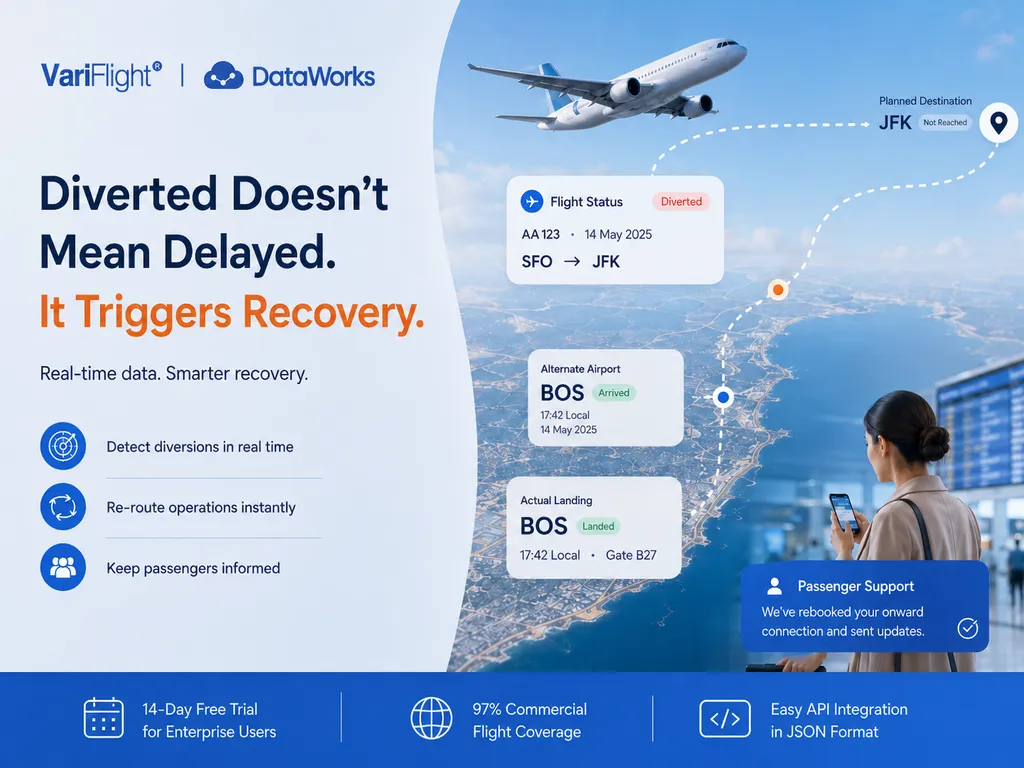
The answer cannot come from a flight number alone. A diversion recovery workflow needs real-time status, scheduled time, official estimated time, actual takeoff and landing time, diversion details when the event occurs, airline context, origin and destination (OD) airport names and codes, city names, and arrival airport coordinates.
Flight Status API for diversion recovery is the use of structured flight data to detect a diversion event and route it into customer communication, re-accommodation, ground transfer, duty-of-care, refund, or claims workflows. VariFlight DataWorks does not decide whether a traveler should be rebooked, compensated, refunded, or moved by ground transport. It provides the operational data layer that enterprise systems use to recognize the event earlier and act with better context.
That makes diversion recovery a useful test case for enterprise API selection. A provider may look adequate when every flight departs and arrives normally. The difference appears when the status changes, timestamps update, and downstream systems need a clean exception workflow through both query and push data access.
VariFlight DataWorks provides real-time and historical flight status data sourced from airlines and airports, covering 10,000+ airports and 1,200+ airlines. For diversion recovery, the value is not simply knowing that a flight has become abnormal. The value is connecting that abnormal event to the teams and systems that must respond.
Why Do Diverted Flights Need a Separate Recovery Workflow?
Diversion recovery is different from ordinary delay management because the flight may land at an airport that is not the planned destination. A traveler can be physically on the ground, but still far from the city, terminal, transfer desk, meeting, cruise port, or connecting flight they expected to reach.
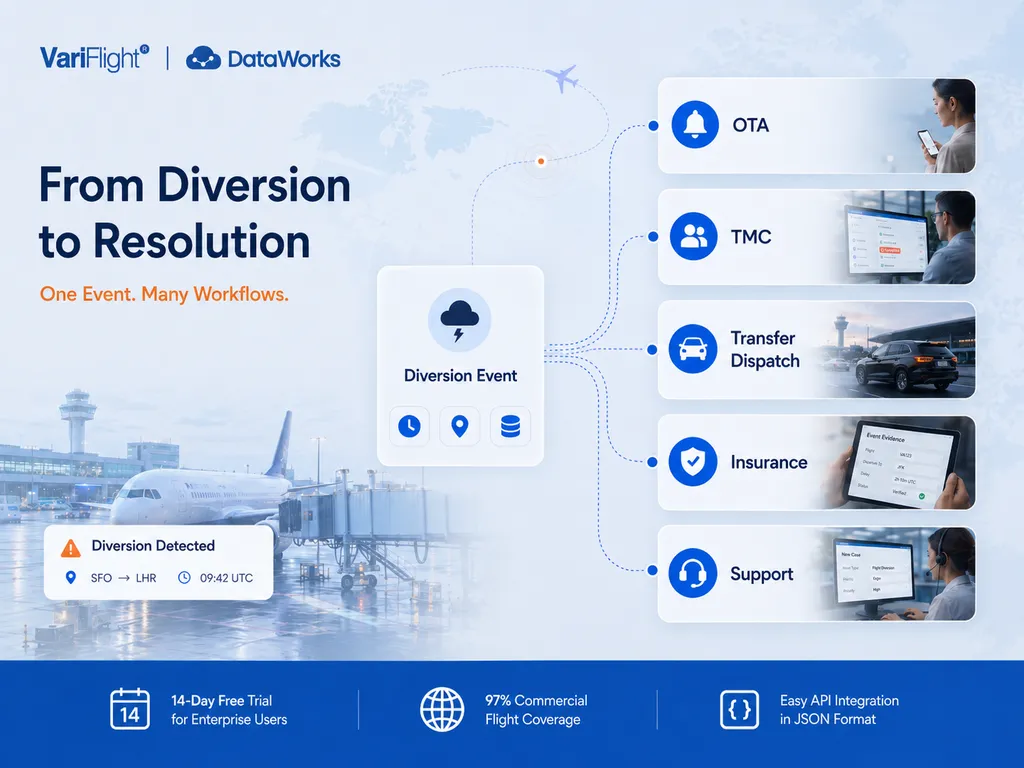
That creates a data problem. If a platform only displays “arrived,” the passenger may assume the trip is complete. If a TMC only sees a delay, the duty-of-care team may not realize the traveler has landed in another city. If an airport transfer system only reads the original destination airport, it may keep a driver waiting in the wrong place.
EUROCONTROL describes aviation disruptions as events that can negatively affect normal operations and require rapid, informed, coordinated response. That principle applies directly to customer-facing travel platforms. A diversion should become a structured recovery event, not a confusing status line.
The business impact is practical:
- OTAs need to explain the event without creating false certainty.
- TMCs need to identify travelers who may require urgent support.
- Airport transfer providers need to stop or reroute pickup plans.
- Insurers may need verified event evidence for assistance or claims workflows.
- Customer service teams need the right flight context before opening a case.
In other words, diversion is not only an aviation event. It is a workflow trigger.
Which Flight Status API Fields Support Diversion Recovery?
A diversion recovery workflow needs fields that identify the flight, compare plan versus reality, and explain where the aircraft actually moved.
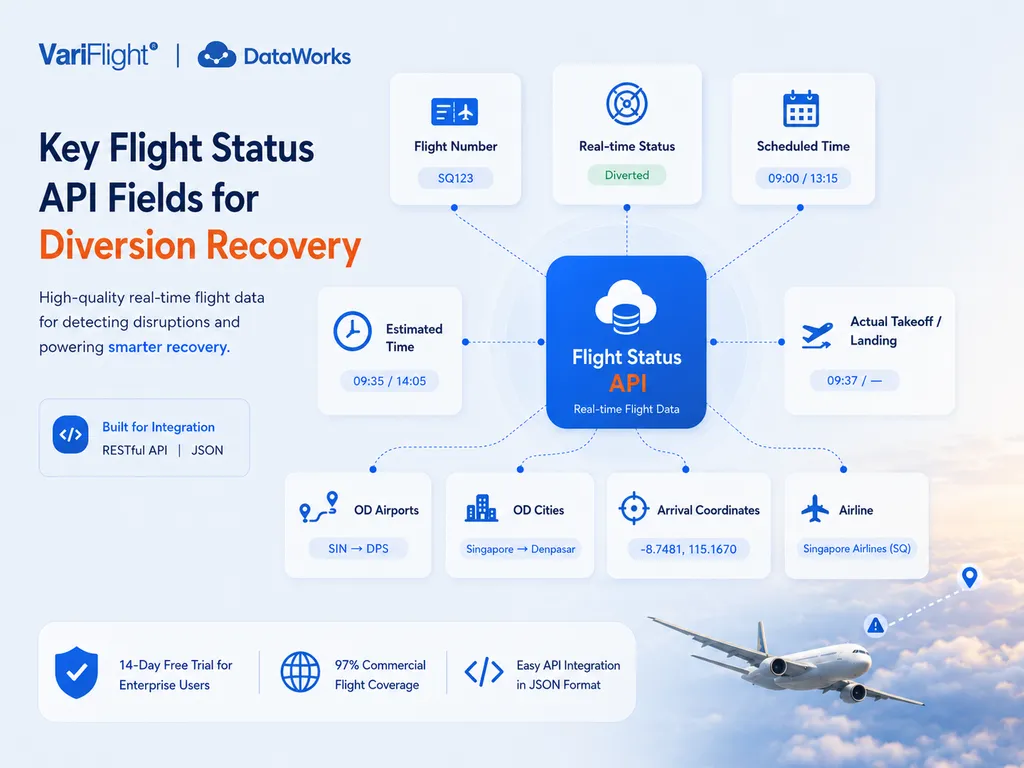
The core fields include:
- Flight number
- Scheduled departure and arrival time
- Official estimated departure and arrival time
- Actual takeoff and landing time
- Real-time departure, arrival, delay, cancellation, return, and diversion status
- Diversion details when the event occurs
- Origin and destination (OD) airport names and codes
- OD city names
- Coordinates of arrival airport
- Airline names
These fields play different roles. Scheduled time defines the original itinerary. Estimated time shows the latest operational expectation. Actual takeoff and landing time confirms movement. Real-time status tells the system whether the flight is delayed, canceled, returned, diverted, or arrived. Diversion details help mark the event when applicable. OD fields preserve the planned route context. Arrival airport coordinates help downstream systems map the physical location of the aircraft or arrival airport.
Example data model:
| Field | Diversion Recovery Use |
|---|---|
| Flight number | Match the event to booking, trip, claim, transfer, or support records |
| Real-time status | Detect diversion, return, cancellation, delay, or arrival state |
| Scheduled arrival time | Preserve the original customer expectation |
| Estimated arrival time | Track latest official operational expectation |
| Actual landing time | Confirm that the aircraft has landed |
| Diversion details(if occurs) | Trigger diversion-specific review when available |
| OD airport names/codes | Compare planned route with the abnormal event context |
| OD city names | Help non-aviation teams understand affected locations |
| Coordinates of arrival airport | Support maps, distance logic, and transfer feasibility checks |
| Airline names | Route customer support or escalation to the correct carrier context |
The key is to avoid treating one field as a complete answer. A diversion event becomes reliable when status, timing, route, and location fields are read together.
How Can OTAs Use Flight Diversion API Data in Passenger Communication?
For OTAs and travel apps, diversion communication is a trust problem. Passengers do not only ask, “Is my flight late?” They ask, “Where am I going now, what happens after landing, and should I change my plan?”
The mechanism starts with flight number matching. The OTA links a booking or saved trip to real-time flight status data. When diversion status or diversion details appear, the OTA creates a disruption state in the user journey. The passenger-facing message can then separate confirmed data from unknown next steps.
For example:
| API Signal | Passenger Communication Logic |
|---|---|
| Diversion status appears | Notify that the flight is no longer operating exactly as planned |
| Actual landing time is present | Confirm that the aircraft has landed |
| Arrival airport differs from planned expectation | Ask the traveler to check airline instructions before leaving the airport |
| Estimated time changes again | Update the disruption timeline |
| Cancellation or return status appears | Move the case into a separate service workflow |
This does not mean the OTA should promise rebooking, compensation, or ground transport automatically. Those decisions depend on airline policy, ticket conditions, geography, and regulation. The OTA’s system should use the flight status API as an evidence layer, then route the traveler to the right next action.
The commercial value is lower confusion during high-stress events. Passengers receive a clearer explanation, support teams receive better context, and the platform avoids oversimplified messages such as “arrived” when the trip may still be unresolved.
How Can TMCs Manage Duty-of-Care During Flight Diversions?
For TMCs, a diverted flight can turn into a duty-of-care event. A business traveler may land in a different city, miss a meeting, lose a connection, or require overnight accommodation. The problem is speed: the travel manager needs to know which travelers are affected before they contact support.
The mechanism is trip-risk matching. The TMC connects the flight number and route data to traveler profiles, company policies, destination cities, arrival deadlines, and support escalation rules. When the API reports diversion status, changed timing, or actual landing away from the original route plan, the system can flag the traveler for review.
Example workflow:
- A traveler is booked on a flight from City A to City B.
- The TMC stores the flight number, airline, scheduled arrival, OD airport codes, and traveler profile.
- The flight status API reports diversion status and later confirms actual landing.
- The TMC dashboard opens a duty-of-care task.
- The support team checks carrier instructions, traveler location, overnight support needs, and meeting impact.
EU Regulation 261/2004 sets out passenger rights for cancellations, long delays, assistance, and re-routing in the EU context. U.S. DOT guidance also explains refund rights when flights are canceled or significantly changed and the traveler does not accept alternatives. These rules are not identical across markets, and a data provider should not turn them into universal promises. But they show why disruption evidence and timing records matter.
For enterprise travel teams, the flight status API helps answer the first operational question: which travelers need attention now?
How Can Ground Operations React to a Diverted Flight?
Diversion can break ground operations because the planned arrival airport may no longer be the correct pickup point. A driver may be waiting at the original destination while the aircraft lands somewhere else. A destination service team may keep a local arrival plan open even though the traveler cannot reach the intended city yet.
The mechanism is operational cancellation and re-planning. Transfer systems, destination service teams, and dispatch partners can use real-time status, actual landing time, OD airport codes, OD city names, and arrival airport coordinates to decide whether a planned pickup should continue, pause, or escalate to manual review.
Example:
| Flight Event | Ground Workflow Risk | Possible Internal Action |
|---|---|---|
| Diversion status received | Pickup airport may be wrong | Pause automated dispatch and open review |
| Actual landing confirmed at another airport | Driver should not wait at original airport | Notify dispatcher and customer service |
| Estimated arrival changes repeatedly | Pickup timing is uncertain | Hold assignment until the route stabilizes |
| Return status appears | Passenger may not reach destination city | Cancel transfer according to policy |
Arrival airport coordinates are useful here because non-aviation systems often think spatially: drive time, service area, driver availability, and pickup feasibility. The API does not replace dispatch rules. It supplies the flight movement data that helps dispatch rules avoid acting on stale assumptions.
The business impact is reduced idle cost and better service recovery. A transfer partner does not need to learn about the diversion from an angry traveler standing in the wrong place.
Why Use VariFlight DataWorks for Diversion Visibility?
VariFlight DataWorks is built for enterprise systems that need real-time flight status, route context, timing fields, and historical records across a broad global aviation network. For diversion recovery, the differentiator is the ability to combine core operational signals with supporting route and location fields.
DataWorks provides structured fields such as flight number, scheduled time, official estimated time, actual takeoff and landing time, real-time delay/cancel/return/diversion status, diversion details when the event occurs, airline names, OD airport names and codes, OD city names, and arrival airport coordinates.
That combination matters because diversion recovery is cross-functional. The same event may affect passenger messaging, customer support, corporate travel duty-of-care, airport transfer dispatch, destination service planning, and insurance assistance. A shared flight data layer allows each system to respond to the same event with its own business rules.
DataWorks does not replace airline operational control, travel policy, insurance adjudication, or customer service judgment. It makes the flight event visible in a structured format so those systems can respond sooner and with less manual checking.
For teams evaluating a Flight Status API, the question should not be “Can the API show a flight status?” The better question is “Can the API help our system understand abnormal flight movement well enough to trigger the right recovery workflow?”
What Should Enterprises Look for in a Flight Status API Provider?
A flight status API provider should be evaluated by how well its data supports operational decisions during abnormal flight events. For diversion recovery, the provider must do more than return a status label. It must provide timing, route, location, airline, and exception context in a format that enterprise systems can trust.
The mechanism is a provider-readiness checklist. Procurement teams, product managers, and engineering teams should test whether the API can preserve the original itinerary, detect the latest operational state, expose relevant timestamps, and feed a downstream workflow without forcing agents to manually search airline or airport pages.
Provider selection should also cover access patterns. VariFlight DataWorks Flight Status Query API supports multiple query modes, including flight number with date, OD airport codes with date, OD city codes with date, airport departure or arrival lists, and airport time-window queries. The Flight Status Push API supports subscribing to specific current-day or future flights and receiving flight status changes at a customer-specified receiving address.
For a diversion recovery use case, enterprises should look for:
| Provider Requirement | Why It Matters in Diversion Recovery |
|---|---|
| Real-time status coverage | Detect delay, cancellation, return, diversion, and arrival states early enough for action |
| Scheduled, estimated, and actual times | Compare the original itinerary with the latest operational movement |
| Route and airport identifiers | Keep the planned OD context visible when the aircraft movement changes |
| Event-specific fields | Use diversion details when the event occurs instead of treating all disruption as delay |
| Location data | Support maps, transfer feasibility, service-area checks, and support triage |
| Query and push access | Use query endpoints for lookup and push updates for subscribed flights that need active monitoring |
| Stable integration model | Reduce manual work caused by inconsistent payloads, unclear field semantics, or missing error handling |
| Historical records | Audit past events, customer cases, service failures, and disruption patterns |
| Clear product boundaries | Separate data delivery from customer-owned decisions such as refund, rebooking, or compensation |
The real-world example is simple. If a travel platform receives only a final “arrived” status, customer service may close the case too early. If the same platform receives scheduled destination, updated status, actual landing time, airline, OD airport codes, and arrival airport coordinates, it can open a diversion case and route it to the correct team.
The business impact is lower operational ambiguity. A strong provider helps enterprise systems classify the event, preserve evidence, and move the case into the correct workflow. A weak provider leaves teams with status labels that are technically true but operationally incomplete.
This is where VariFlight DataWorks fits the buying conversation. DataWorks supplies the flight data layer for enterprise workflows; the customer system applies policy, automation, and service logic on top of that layer.
What API Architecture Keeps Diversion Recovery Reliable?
Reliable diversion recovery requires more than displaying the latest label from a single lookup. The architecture should preserve the original plan, track state changes, and route exceptions into the right workflow.
A practical architecture includes:
- Flight capture: store flight number, airline, scheduled time, date, and OD airport codes from booking or trip input.
- Query layer: use flight number, route, airport, city, or airport time-window queries for lookup, reconciliation, and support dashboards.
- Push layer: subscribe to monitored flights and receive flight status changes through POST updates to a specified receiving address.
- Status synchronization: refresh real-time status, estimated time, actual time, and diversion-related updates.
- Route comparison: compare the planned origin and destination with the latest operational event context.
- Location enrichment: use city names and arrival airport coordinates for human-readable support and spatial workflows.
- Event classification: separate delay, cancellation, return, diversion, arrival, and unknown states.
- Business-rule routing: send the event to passenger messaging, TMC support, transfer dispatch, destination service operations, or claims intake.
- Audit trail: preserve timestamps and status history for customer service review and post-event analysis.
The architecture should also include confidence boundaries. For example, actual landing time does not necessarily mean the traveler has exited the aircraft, cleared border control, collected baggage, or reached ground transport. A diversion status does not automatically define the final passenger outcome. The system should show what is known, what has changed, and what still requires airline or human confirmation.
Time handling is another architecture detail. Flight status responses include local flight times, so enterprise systems should normalize local-time semantics before comparing routes, deadlines, traveler messaging, and downstream service rules.
EUROCONTROL’s network operations model emphasizes the importance of balancing demand, capacity, and accurate operational information. Enterprise travel systems need a smaller version of the same discipline: keep data current, classify the event correctly, and avoid letting stale assumptions drive customer-facing actions.
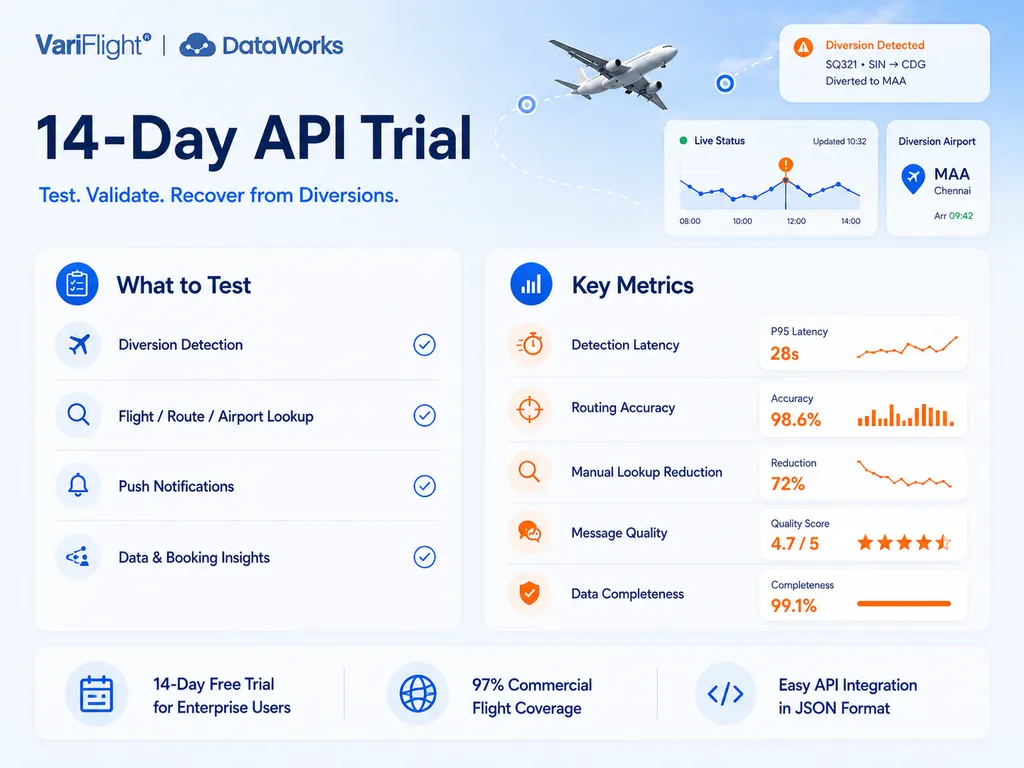
What Should Teams Test During a 14-Day Flight Status API Trial?
A 14-day API trial should test diversion recovery as an operational workflow and provider evaluation exercise, not only as a technical response payload. The goal is to learn whether the API gives your team enough context to detect, classify, and route abnormal flight events.
Teams should test:
- Flights with normal arrival, delay, cancellation, return, and diversion outcomes
- Domestic and international routes
- Query API lookup by flight number, route, airport, city, and airport time window
- Push API subscription for monitored current-day or future flights
- Routes with strict arrival deadlines
- Traveler profiles linked to TMC duty-of-care rules
- Airport transfer bookings tied to arrival airport and landing time
- Customer service cases that need airline and route context
- Mapping workflows that use arrival airport coordinates
- Historical review of disruption-heavy periods
Useful trial metrics include:
| Metric | What It Shows |
|---|---|
| Detection latency | How quickly the system notices an abnormal event |
| Workflow routing accuracy | Whether the right team receives the case |
| Query-to-push consistency | Whether lookup results and pushed status changes support the same workflow state |
| Manual lookup reduction | Whether support teams spend less time checking flight status manually |
| Passenger message quality | Whether communication avoids vague or misleading status labels |
| Transfer cost avoidance | Whether dispatch avoids unnecessary waiting or wrong-airport pickup |
| Audit completeness | Whether event records support later review |
The trial should end with a clear integration decision: which fields are mandatory, which exception states require manual review, which systems should receive alerts, and which customer messages are safe to automate.
It should also end with a provider decision. The team should know whether the API supports the abnormal cases that matter to the business, not only whether a normal flight can be queried successfully.
FAQ
Is a diverted flight the same as a delayed flight?
No. A delayed flight is late against its planned schedule. A diverted flight may land somewhere other than the planned destination, which can create additional recovery work for travelers, travel managers, transfer providers, destination service teams, and customer support teams.
Can a Flight Status API automatically decide passenger compensation?
No. Compensation and refund decisions depend on airline policy, ticket conditions, jurisdiction, and event details. A Flight Status API can provide operational evidence and event context, but customer systems should apply their own legal, policy, and service rules.
Which field matters most for diversion recovery?
No single field is enough. Teams should combine real-time status, scheduled time, official estimated time, actual landing time, diversion details when the event occurs, OD airport data, city names, airline names, and arrival airport coordinates.
Why do arrival airport coordinates matter?
Coordinates help downstream systems understand the physical location of the arrival airport. This is useful for maps, transfer feasibility, service-area checks, distance logic, and human support workflows.
What should OTAs tell passengers during a diversion?
OTAs should separate confirmed flight data from next-step guidance. They can explain that the flight has been diverted or landed, but should avoid promising rebooking, compensation, or transport unless those actions are confirmed by the airline or platform policy.
Start Building Diversion-Aware Travel Operations
Use VariFlight DataWorks Flight Status API to test diversion recovery workflows with your own routes, traveler segments, transfer rules, support queues, and disruption policies. Start with core timing and real-time status fields, then connect diversion details, OD airport data, city names, airline context, and arrival airport coordinates to the systems that handle customer recovery.
References
- EUROCONTROL Disruption and Crisis Management: https://www.eurocontrol.int/disruption-and-crisis-management
- EUROCONTROL Network Operations: https://www.eurocontrol.int/network-operations
- EU Regulation 261/2004: https://eur-lex.europa.eu/legal-content/EN/TXT/?uri=CELEX%3A32004R0261
- U.S. Department of Transportation Refunds: https://www.transportation.gov/individuals/aviation-consumer-protection/refunds
- VariFlight DataWorks Flight Status Query API V3.0: https://dataworks.variflight.com/wp-content/uploads/2026/04/Flight-Status-Query_V3.pdf
- VariFlight DataWorks Flight Status Push API V3.0: https://dataworks.variflight.com/wp-content/uploads/2026/04/Flight-Status-Push-API-V3.pdf