
Flight operations data is structured information about how a scheduled flight actually operates. It includes flight number, schedule, status, estimated time, actual takeoff and landing time, route, aircraft, delay, cancellation, return, and diversion signals.
Airlines can use this data in their own route performance analysis and review workflows. DataWorks provides aviation data through API and data feeds. It does not provide ticketing, booking, PNR, payment, or traveler identity records.
The useful question is: “What flight-level evidence can airline teams feed into their own planning, reporting, BI, and operational review systems?”
Why Do Airlines Need Flight Operations Data for Route Performance Analysis?
Route performance analysis is a customer-side process for comparing planned schedules with actual flight execution. It helps airline teams see whether a route, airport pair, aircraft type, or time window operates close to plan.
A route may look stable in a timetable but behave differently in daily operations. Repeated arrival variance can pressure turnaround planning. Frequent departure delay may reduce same-day aircraft utilization. Seasonal airport delay may affect schedule buffers.
FAA performance materials show that aviation performance work relies on scheduled, actual, gate, and runway event times. EUROCONTROL delay reporting also separates schedule delay, arrival punctuality, reactionary delay, airline-related delay, airport delay, weather, and air traffic flow management factors. A data provider does not need to decide the route action. It needs to supply consistent event data so airline systems can perform their own review.
Which Data Fields Support Airline Route Performance Analysis?
A route review workflow needs a consistent flight record. The record should identify the flight, define the planned schedule, show actual execution, and add route and aircraft context.
| Data group | Example fields | Customer-side use |
|---|---|---|
| Flight identity | Flight number, airline, date, origin and destination (OD) airport codes | Match records across internal systems |
| Planned schedule | Scheduled departure and arrival time | Define the baseline |
| Live and actual execution | Estimated time, actual takeoff and landing time, flight status | Measure variance in the customer’s system |
| Route structure | Flight distance, flight duration, OD city names | Group records by airport pair or distance band |
| Aircraft context | Aircraft type and aircraft age | Segment records by fleet assignment |
| Reliability context | Historical punctuality rate | Compare a current record with normal behavior |
| Ground timing | On-block and off-block time, where available | Support gate or turnaround review where data exists |
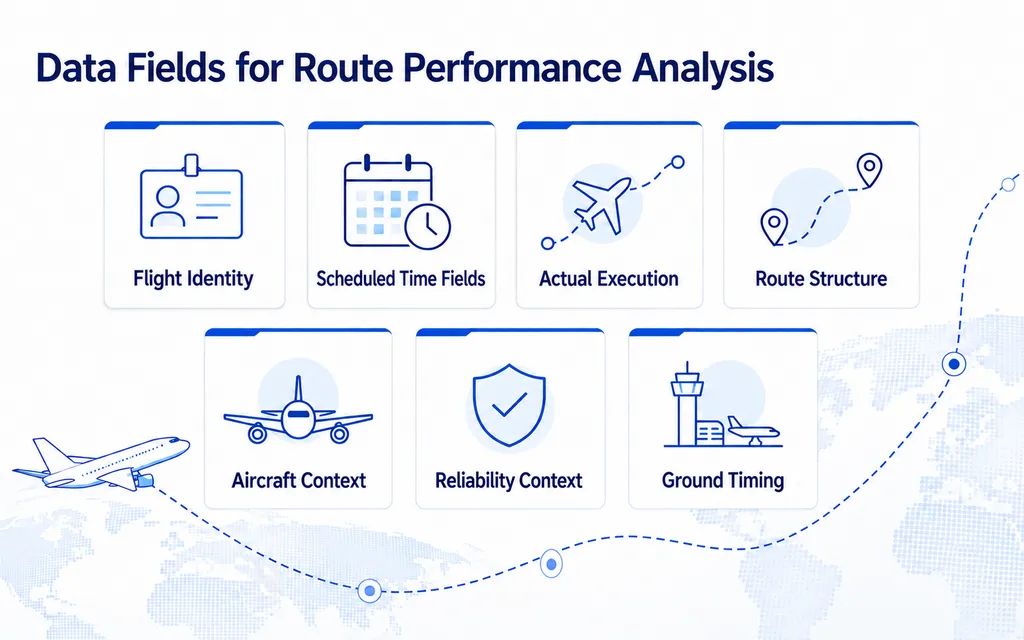
These fields describe flight operations. They do not describe the passenger, the order, the ticket, the payment, or airline commercial strategy.
What Does a Practical Route Data Sample Look Like?
A useful route performance trial does not need to start with the airline’s whole network. A focused sample is easier to validate and easier to connect with internal BI rules.
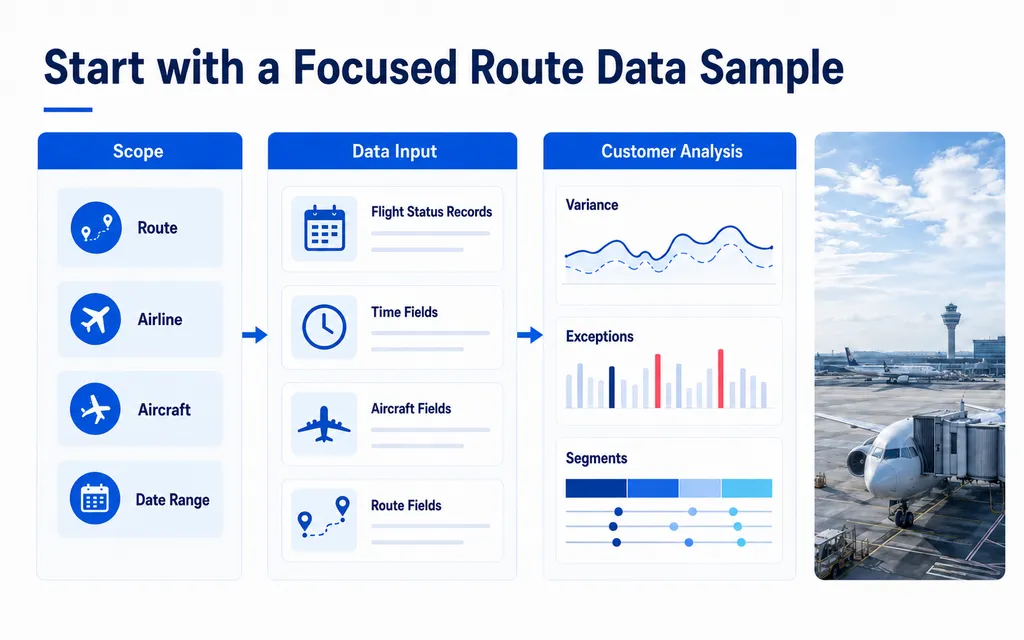
For example, an airline can select one route group, one operating airline, one aircraft family, and a short date range. DataWorks can provide the operational flight records. The customer’s system can then calculate its own variance, completion, grouping, and reporting metrics.
| Trial sample element | DataWorks data input | Customer-side processing |
|---|---|---|
| Route scope | Origin and destination airport codes, OD city names | Group records by airport pair |
| Flight identity | Flight number, airline, flight date | Match with internal flight records |
| Planned baseline | Scheduled departure and arrival time | Define the comparison baseline |
| Execution record | Estimated time, actual takeoff, actual landing, status | Calculate departure or arrival variance |
| Exception record | Delay, cancellation, diversion, return status | Apply customer-defined exception rules |
| Aircraft context | Aircraft type, aircraft age, flight duration, distance | Segment records by aircraft or route length |
| Historical context | Historical punctuality rate | Compare current operation with normal patterns |
This kind of sample adds more value than a generic API test because it checks whether the same flight data can support route grouping, time variance, exception handling, and aircraft segmentation in the customer’s own environment.
How Does Flight Operations Data Flow Into Airline Systems?
A flight operations data API sits between aviation data sources and the airline’s own systems. The API standardizes records before they enter planning tools, operations dashboards, BI tables, or reporting pipelines.
A practical workflow looks like this:
- The airline queries flights by route, airport, airline, flight number, or date range.
- DataWorks returns scheduled, estimated, actual, route, aircraft, and status fields.
- The customer’s system calculates departure variance, arrival variance, cancellation flags, or diversion events.
- The customer’s dashboard groups results by route, fleet, airport, or time window.
- Airline teams decide what the data means for schedule, fleet, or operational review.
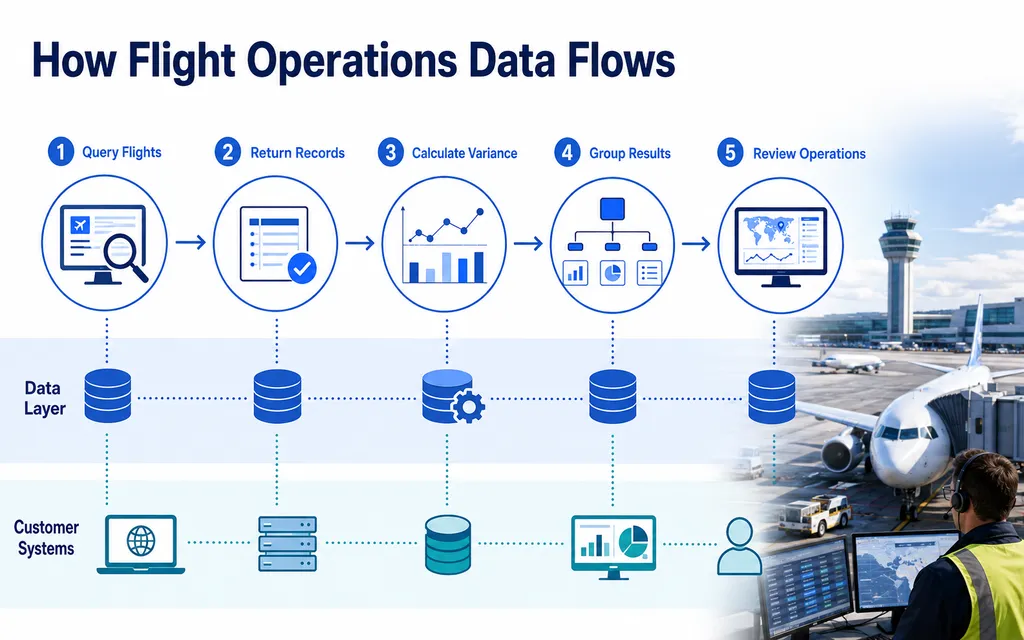
This workflow keeps the boundary clear. DataWorks provides the data layer. The airline owns rules, formulas, dashboards, KPIs, review logic, and decisions.
How Can Airlines Use Delay and Aircraft Data Together?
Delay data becomes more useful when it is connected to route and aircraft context. A 35-minute delay on a short-haul rotation may affect the next sector, gate allocation, or aircraft utilization. The same delay on a long-haul route may be reviewed differently by the airline.
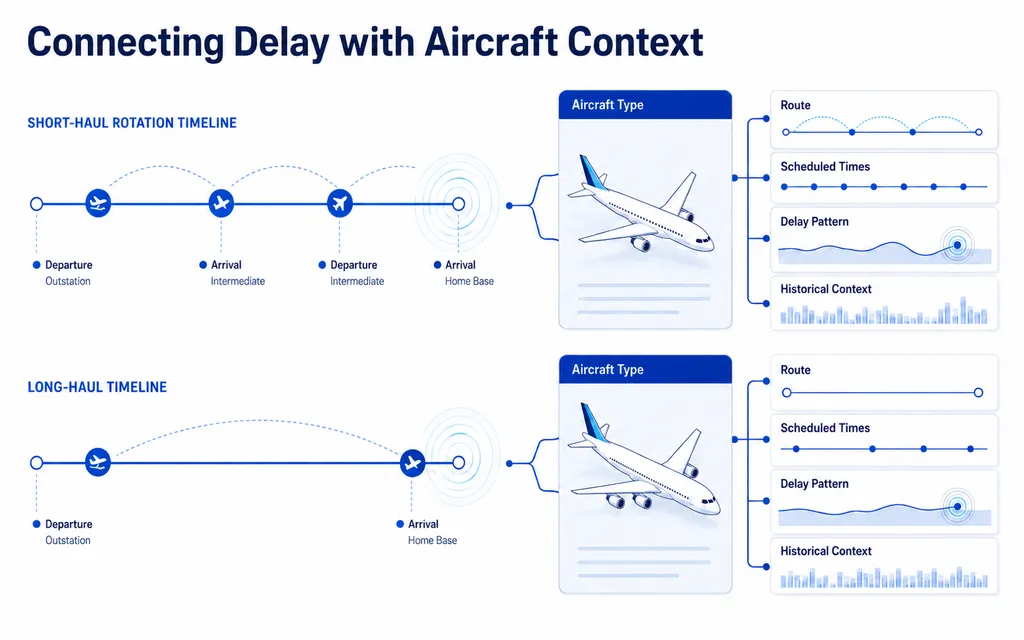
Aircraft fields add another layer. If a route often changes from one aircraft type to another, the airline’s system can separate schedule behavior from fleet-assignment patterns. Historical punctuality rate can show whether today’s operation is normal, seasonal, or unusual.
Those timestamps and aircraft fields do not produce a business conclusion by themselves. They are input data. The customer decides how to score, filter, and interpret them.
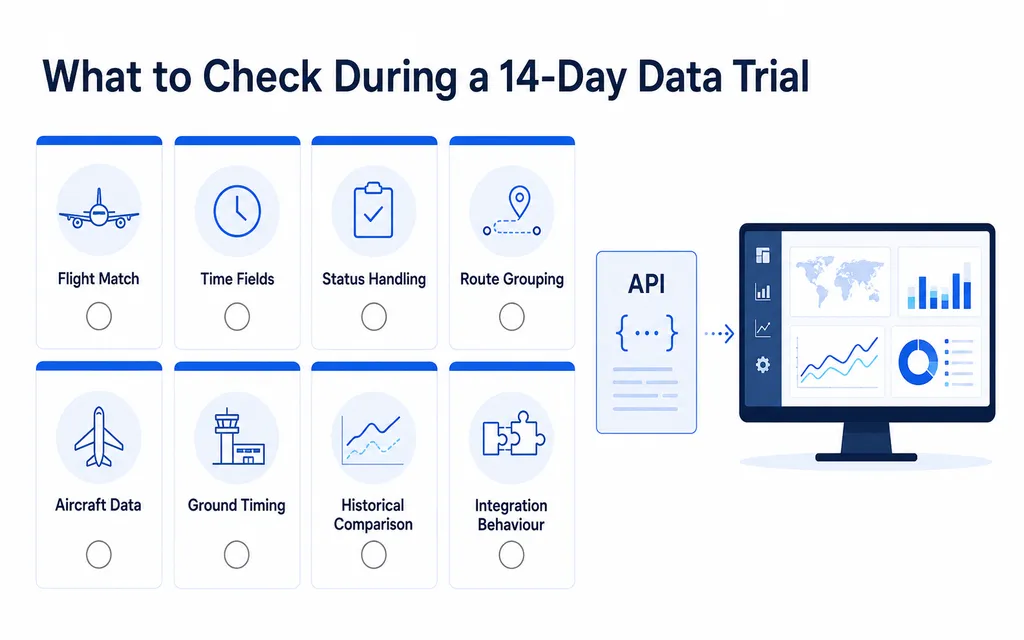
What Should Airlines Check During a 14-Day Data Trial?
A 14-day trial should test whether the data can enter the airline’s own workflow cleanly. The goal is to verify data match quality, field availability, and integration behavior.
| Trial check | What to verify |
|---|---|
| Flight match rate | Match by flight number, date, airline, and route |
| Time-field completeness | Scheduled, estimated, actual takeoff, and actual landing fields |
| Status classification | Delay, cancellation, return, and diversion handling |
| Route grouping | Distance and duration by airport pair |
| Aircraft segmentation | Aircraft type and age for fleet comparison |
| Ground-time availability | On-block and off-block fields where available |
| Historical comparison | Historical punctuality rate by route or airline |
| Integration behavior | Query API, push alerts, error handling, and fallback logic |
Teams should also define missing-field rules. A missing off-block time should be flagged as unavailable and excluded from calculations that depend on gate timing.
How Can VariFlight DataWorks Provide Route Performance Data Inputs?
VariFlight DataWorks Real-Time Flight Status Data provides current operational fields such as schedule, estimated time, actual time, status, airport context, and aircraft information. Historical Flight Status Data can support retrospective customer-side review.
DataWorks covers 97% of commercial flights, with data sourced from 1,200+ airlines and 10,000+ airports. That breadth helps customers build consistent data coverage across airport pairs, regions, and aircraft assignments.
The best implementation is usually a data feed into the customer’s existing tools. DataWorks supplies aviation data. Customers use that data in their own models, dashboards, review workflows, and decision processes.
FAQ
What flight data is needed to analyze airline route performance?
Airlines usually need flight identity, scheduled time, estimated time, actual takeoff and landing time, flight status, route, aircraft, and historical reliability fields. These fields let customer-owned systems compare planned schedules with actual operation.
Can historical flight data be used to compare route reliability?
Yes. Historical flight status data can help customer systems compare airport pairs, aircraft groups, departure windows, and seasonal operating patterns. DataWorks provides the historical flight data; customers define their own reliability rules and reporting views.
How can airlines compare scheduled and actual flight performance?
Airlines can ingest scheduled departure and arrival time, estimated time, actual takeoff and landing time, and flight status fields into their own BI or operational systems. The customer’s system can then calculate variance and group results by route, fleet, airport, or time window.
Can flight operations data be integrated into airline BI systems?
Yes. A flight operations data API can feed records into airline-owned data warehouses, dashboards, planning tools, or operational review workflows. Integration should test field completeness, match quality, update behavior, and missing-field rules.
Can airlines combine DataWorks data with internal models?
Yes. Airlines can combine DataWorks operational fields with their own schedule, fleet, KPI, and planning rules inside customer-owned systems.
Does DataWorks provide ticket, passenger, or route performance score data?
No. DataWorks provides aviation data through APIs and data feeds. It does not provide ticketing, booking, PNR, payment, traveler identity records, route performance scores, cost calculations, or customer-side business decisions.
How Can Airlines Start Testing Route Performance Data?
Start with one route group, one fleet group, and one data question, such as: “Which airport pairs have the largest arrival-time variance for this aircraft type?”
Use the trial to test match quality, timing completeness, aircraft segmentation, historical comparison, and fallback behavior before expanding the workflow.
References
- FAA, Performance Databases: https://www.faa.gov/about/office_org/headquarters_offices/ato/service_units/systemops/perf_analysis/perf_data
- FAA, Aviation System Performance Metrics overview: https://aspmhelp.faa.gov/index/Aviation_System_Performance_Metrics_%28ASPM%29.html
- EUROCONTROL, All-Causes Delays to Air Transport in Europe – Annual 2024: https://www.eurocontrol.int/publication/all-causes-delays-air-transport-europe-annual-2024
- EUROCONTROL, Data Snapshot #44 on the causes of flight delays: https://www.eurocontrol.int/publication/eurocontrol-data-snapshot-44-causes-flight-delays
- VariFlight DataWorks Real-Time Flight Status Data: https://dataworks.variflight.com/products/flight-status-data/
- VariFlight DataWorks Historical Flight Status Data: https://dataworks.variflight.com/products/flight-status-data/historical-flight-status-data-api/