

A resort stay does not begin at the front desk. For many guests, it begins when their flight leaves the origin airport, lands late, changes terminal, or gets canceled before they ever reach the property.
For integrated resorts, luxury hotels, destination resorts, and MICE venues, flight disruption can affect more than check-in time. It can change airport transfer plans, room readiness, welcome amenities, restaurant reservations, spa appointments, event check-in, and VIP service recovery.
Flight status API for resort guest arrival experience is the use of real-time flight status, timing, airline, airport, and route fields to support hospitality arrival workflows. The API does not replace the property management system, concierge dashboard, or transfer dispatch system. It supplies the operational flight data layer that those systems use to prepare before guests arrive.
VariFlight DataWorks provides real-time and historical flight status data sourced from airlines and airports, covering 10,000+ airports and 1,200+ airlines. For resort operators, the value is not simply showing flight information. The value is turning flight movement into guest-service readiness.
Why Do Resorts Need Flight Status Data Before Guests Arrive?
Resort arrival intelligence is the process of using flight data to prepare guest services before the guest reaches the property. It helps hospitality teams move from reactive check-in handling to proactive arrival coordination.
The mechanism starts when a guest shares a flight number during booking, concierge communication, airport transfer reservation, or VIP service planning. The resort system monitors scheduled arrival, official estimated arrival, real-time status, and actual landing time. It then matches those updates to guest profiles, room assignments, transport bookings, dining reservations, and staff tasks.
Consider a VIP guest expected to land at 18:20. If the official estimated arrival moves to 20:05, the airport transfer team should not send the driver at the original time. The restaurant team may need to hold or adjust the dinner reservation. The guest relations team may need to update the welcome plan.
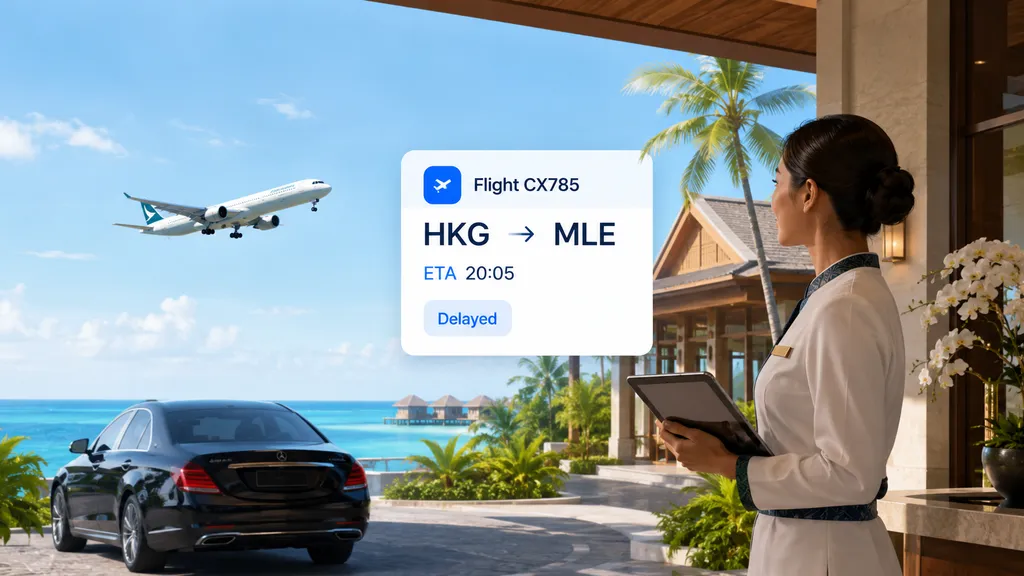
The business impact is practical. Resorts can reduce front-desk congestion, driver waiting time, room-readiness mismatch, missed reservations, and service gaps for high-value guests.
Which Flight Status API Fields Support Guest Arrival Workflows?
A guest arrival workflow needs more than a flight number. It needs fields that explain identity, timing, status, airport context, and route context.
The core fields include:
- Scheduled departure and arrival time
- Official estimated departure and arrival time
- Actual takeoff and landing time
- Real-time departure, arrival, delay, cancellation, return, and diversion status
- Flight number
- Airline names
- Terminals
- Boarding gates and baggage carousel when available
- Origin and destination (OD) airport names and codes
- OD city names
- OD time zone
The mechanism is a service trigger model. Scheduled time defines the original plan. Estimated time shows the latest operational expectation. Actual time confirms what happened. Status explains whether the flight is delayed, canceled, returned, diverted, or arrived. Airport fields help the resort understand where the guest will exit the airport journey.
Example arrival input:
| Field | Resort Workflow Use |
|---|---|
| Flight number | Match flight data to guest booking or transfer request |
| Estimated arrival | Adjust driver dispatch and front-desk preparation |
| Actual landing time | Confirm the guest has entered the arrival phase |
| Terminal | Guide pickup, meet-and-assist, or concierge instructions |
| Baggage carousel | Support arrival staff when available |
| OD time zone | Compare flight movement with local service hours |
The commercial value is service alignment. Flight data becomes an operating input for hospitality teams, not just a line of information in a guest app.
How Can Resorts Coordinate Airport Transfers with Flight Status API?
Airport transfer coordination is one of the clearest resort use cases for flight status data. It connects flight movement with driver timing, pickup location, guest communication, and service recovery.
The mechanism is straightforward. The transfer system receives or stores the guest’s flight number. It then syncs estimated arrival, actual landing, real-time status, airline, terminal, and OD airport information. The resort defines its own dispatch rules, such as when to send the driver, when to hold the vehicle, and when to open a manual review.

Example workflow:
- Guest books a suite and adds airport pickup.
- The resort stores the flight number in the transfer workflow.
- The flight status API updates estimated arrival from 17:40 to 18:35.
- The driver dispatch rule delays departure to the airport.
- The concierge team receives a task to update the guest if the delay affects dinner or event timing.
VariFlight DataWorks does not directly decide dispatch actions. It provides the operational data layer. The resort or its transport partner applies business rules based on service level, guest tier, vehicle availability, airport distance, and pickup policy.
The business impact is lower idle time and fewer arrival failures. Drivers are less likely to wait too early, and guests are less likely to land without a coordinated pickup plan.
How Can Front Desk and Concierge Teams Use Real-Time Flight Data?
Front desk and concierge teams use real-time flight data to prepare service before the guest reaches the lobby. The purpose is not to monitor aviation for its own sake. The purpose is to know which arrivals need action.
The mechanism connects flight status to the PMS, CRM, guest messaging system, or concierge dashboard. When the flight is delayed, canceled, diverted, or confirmed as arrived, the system updates the arrival queue and triggers tasks for the right team.
Examples include:
- A family flight is canceled, so the concierge team contacts the guest before the room sits blocked all night.
- A premium guest lands earlier than expected, so the front desk prepares express check-in.
- A group arrival shifts by two hours, so the MICE team adjusts event registration staffing.
- A delayed international arrival risks missing a late check-in window, so guest relations prepares after-hours instructions.
The business impact is guest confidence. The resort appears prepared because staff already know the travel context. Teams spend less time asking, “Has the guest landed?” and more time solving the next service step.
How Can Resorts Protect Dining, Spa, Entertainment, and Event Revenue?
Flight disruption can affect resort revenue beyond the room. Dining, spa, entertainment, private events, meeting agendas, children’s activities, and premium packages all depend on guest arrival timing.
The mechanism is reservation-risk detection. The resort connects flight status updates to same-day guest services. If a flight delay threatens a dinner booking, spa appointment, show ticket, or event check-in, the system can route a task to the service owner.
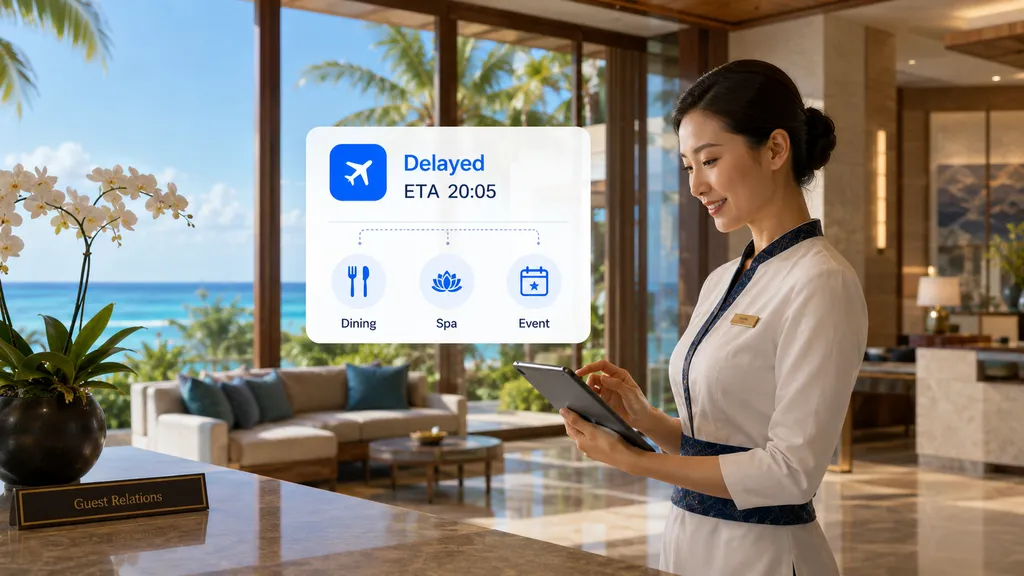
Example:
| Flight Event | Resort Service Risk | Possible Internal Action |
|---|---|---|
| Arrival delayed by 90 minutes | Dinner reservation at risk | Hold table, offer later slot, or notify restaurant |
| Flight canceled | Room and transfer may become unused | Contact guest, adjust arrival date, review deposit policy |
| Actual landing confirmed | VIP welcome sequence should begin | Notify concierge and transport desk |
| Diversion status received | Guest may not reach destination airport | Escalate to guest relations team |
This is not automatic revenue recovery. The resort defines the rule logic and service policy. The flight status API supplies the reliable trigger.
The commercial value is reduced no-show leakage and better ancillary protection. Resorts can preserve high-margin services by acting before the guest misses the appointment.
Why Use VariFlight DataWorks for Resort Arrival Intelligence?
VariFlight DataWorks is built for enterprise systems that need operational flight data across timing, status, airline, airport, and route fields. For resort arrival intelligence, the key advantage is connecting aviation movement with hospitality workflows.
DataWorks provides structured fields such as scheduled time, estimated time, actual takeoff and landing time, disruption status, flight number, airline names, terminals, OD airport codes, OD city names, and OD time zones. Resorts can connect these fields to transfer, front desk, concierge, guest messaging, CRM, and service reservation systems.
This matters because resort operations often span many teams. Transport, front desk, housekeeping, restaurants, event teams, and guest relations may all depend on the same arrival update. A shared operational flight data layer reduces manual checking and keeps teams aligned.
DataWorks does not replace the PMS, booking engine, or resort service rules. The customer system decides what action to take. DataWorks supplies the flight data that helps the action happen at the right time.
The business impact is faster implementation of arrival-aware guest service, especially for resorts with international guests, airport transfers, VIP programs, and tightly scheduled experiences.
What API Architecture Works for Resort Guest Arrival Operations?
A reliable resort arrival workflow needs flight capture, data sync, guest matching, service rules, and task routing. Without those layers, flight data may remain isolated from the teams that need it.
The mechanism should treat each flight update as a state change linked to a guest or group arrival. The system stores the flight number, airline, scheduled time, estimated time, actual time, status, terminal, airport, time zone, guest booking, and service package.
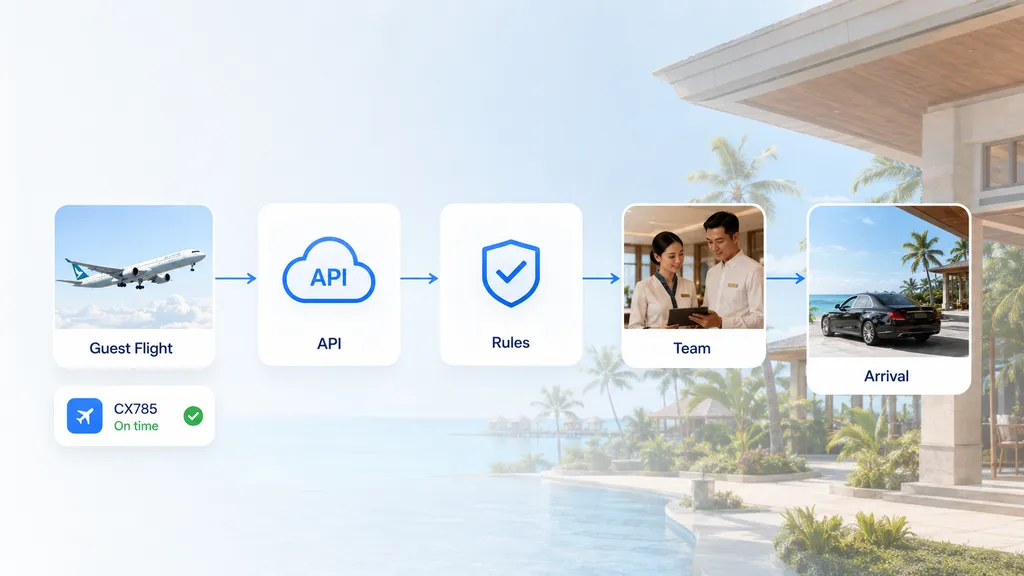
A practical architecture looks like this:
- Guest itinerary capture: stores flight number from booking, concierge, or transfer forms.
- Flight status sync: refreshes timing, status, airline, terminal, and airport fields.
- Guest profile matching: links flight records to room bookings, VIP status, transfer orders, and service reservations.
- Service rule engine: applies customer-defined rules for transfer, front desk, dining, spa, events, and concierge.
- Staff dashboard or task queue: routes tasks to the right team.
- Post-stay analysis: reviews how flight disruption affected service timing, no-shows, and recovery actions.
IATA describes passenger touchpoints from booking through baggage collection as part of the broader travel journey. For resorts, the guest journey continues beyond the airport, and flight data helps connect aviation events with hospitality operations.
The commercial value is workflow continuity. A flight delay becomes a structured service update, not a surprise at the lobby.
What Should Resorts Test During a 14-Day API Trial?
A resort API trial should test operational fit, not only technical connectivity. The goal is to see whether flight status data can improve real arrival workflows.
Teams should test:
- Domestic and international guest flights
- Peak arrival windows
- VIP and standard guest segments
- Delayed, canceled, returned, diverted, and early arrivals
- Different terminals and airport pickup points
- Flights linked to dinner, spa, entertainment, and event bookings
- Cross-time-zone arrivals
The mechanism is controlled comparison. Teams can select a small group of bookings, monitor flight updates, and compare the API-driven workflow with the current manual process.
UN Tourism data shows continued global travel demand, with international arrivals and spending remaining central indicators for tourism destinations. As travel volume grows, resorts need arrival operations that scale beyond manual flight checking.
The business impact is a clearer integration case. Resorts can test whether flight data reduces driver waiting, missed guest contact, front desk uncertainty, and service no-shows before committing to a larger rollout.
FAQ
Is flight status API useful for resorts without their own airport transfer fleet?
Yes. Resorts can still use flight data for front desk preparation, concierge outreach, room readiness, dining reservations, event staffing, and guest messaging.
Can hotels use flight data without replacing their PMS?
Yes. A flight status API can feed a PMS-adjacent workflow, CRM, concierge dashboard, transfer system, or staff task queue. The PMS does not need to be replaced.
Which flight field matters most for guest arrival planning?
No single field is enough. Resorts should test scheduled time, official estimated time, actual landing time, real-time status, flight number, airline, terminal, and OD airport information together.
How does flight data reduce no-shows for resort services?
Flight data helps teams identify guests who may miss a dining, spa, entertainment, or event booking because of delayed, canceled, diverted, or returned flights. Staff can then contact the guest or adjust the reservation before the service slot is lost.
What should hospitality teams test during an API trial?
Teams should test real guest arrivals, airport transfers, VIP cases, group arrivals, delayed flights, canceled flights, terminal differences, and bookings tied to same-day resort services.
Start Building Arrival-Aware Resort Operations
Use VariFlight DataWorks Flight Status API to test guest arrival workflows with your own routes, guest segments, transfer orders, and resort service rules. Start with core timing and status fields, then connect airline, terminal, airport, city, and time zone data to your hospitality systems.
References
- IATA Passenger Developer Portal: https://developer.iata.org/en/passenger/
- IATA Passenger Behavior & Insights: https://www.iata.org/en/services/data/passenger-insights/
- IATA passenger operational notifications FAQ: https://portal.iata.org/faq/s/article/For-what-purposes-will-the-airline-use-the-passenger-s-contact-1448977338184
- UN Tourism World Tourism Barometer: https://unwto-web-preprod.rhone.un-icc.cloud/un-tourism-world-tourism-barometer-data