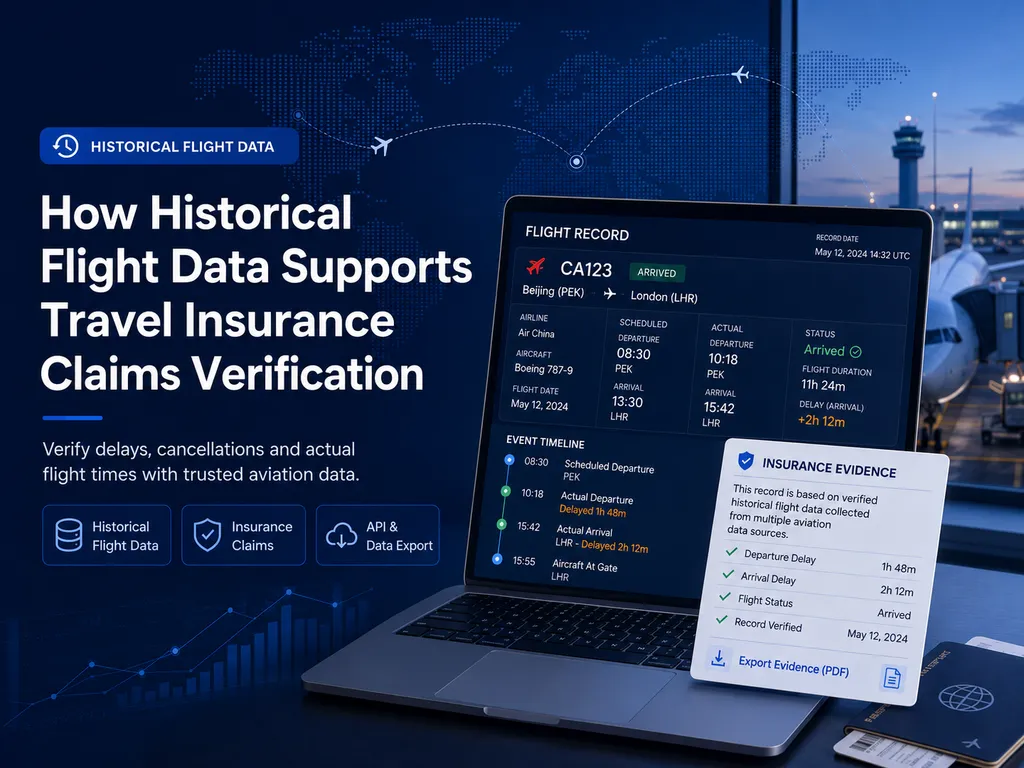
Historical flight data shows how a flight ran after the event. It includes delays, cancellations, diversions, returns, and planned versus actual departure and arrival times. For travel insurers, these records can provide flight evidence for flight-related claims verification.
VariFlight DataWorks provides these aviation records through API or data export for customer-owned claims workflows. Policy interpretation, passenger verification, claim decisions and payouts remain within the insurer or claims platform.
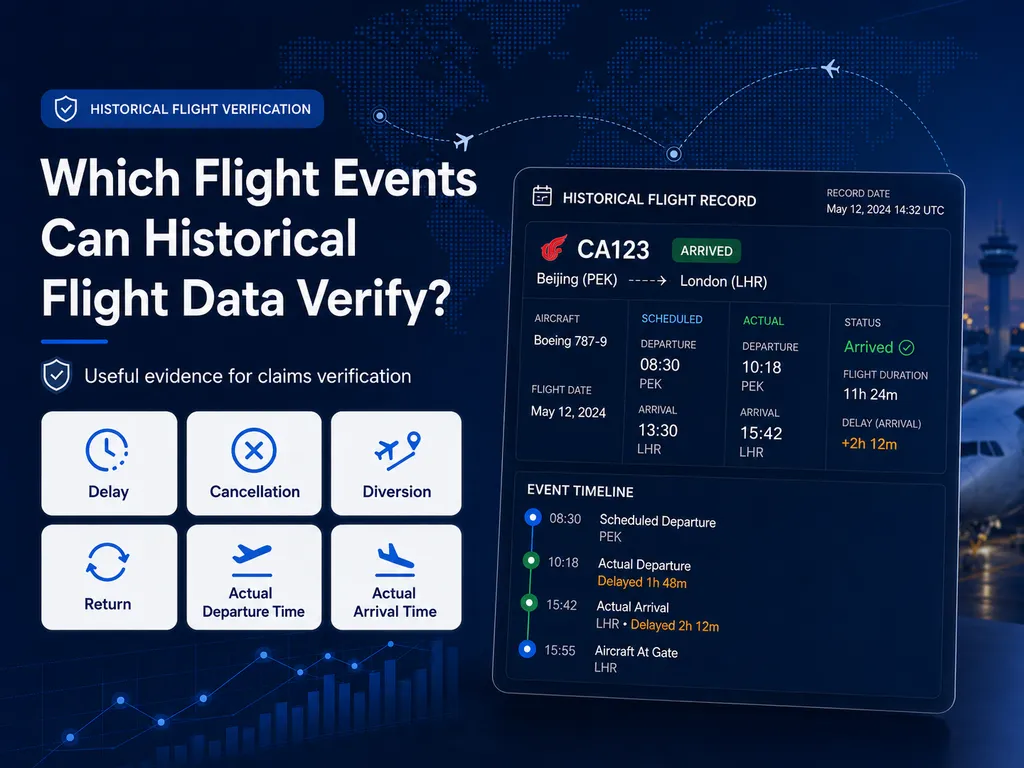
Which Flight Events Can Historical Flight Data Verify?
Historical flight data is a flight-event record after the flight has operated. It can help claims platforms verify recorded flight events when a traveler submits a claim after travel.
NAIC describes travel insurance As coverage for travel risks like trip cancellation, interruption, and delays, but conditions and exclusions vary by product.
Useful claim evidence often includes:
- Delay status
- Cancellation status
- Diversion status
- Return status
- Actual departure time
- Actual arrival time
- Route and airport changes where available
- Codeshare or operating flight number records where available
A traveller may report a delay, cancellation, diversion or missed connection. Historical flight data can confirm the key flight events.
The insurer uses its own trip, booking, and policy data.
This helps decide if a missed connection occurred under the rules.
Historical flight data can show that a flight event happened.
It does not determine whether a claim qualifies for coverage or payment.
What Does DataWorks Historical Data Show About Flight Disruption Frequency?
VariFlight DataWorks reviewed global commercial passenger flight records from January 1 to June 30, 2026. It examined how often delays, cancellations, diversions, and other flight disruptions occurred. This supported claims verification.
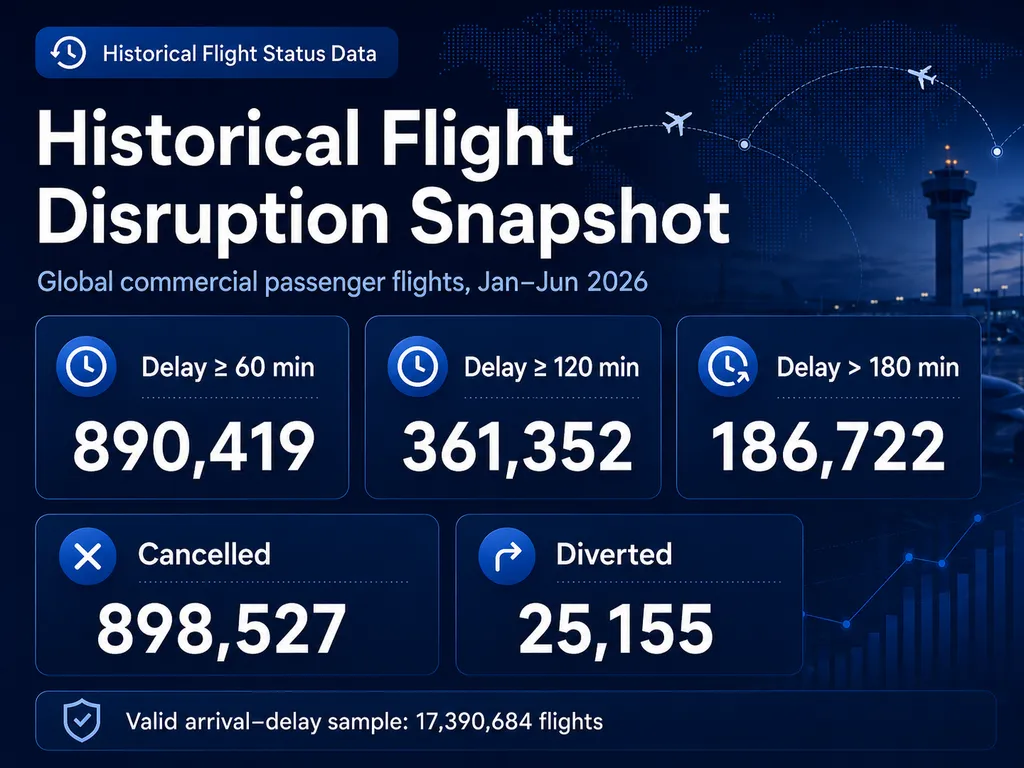
The sample counted passenger flights from January 1 to June 30, 2026. For arrival delay assessing, the query used records with valid scheduled arrival time and actual arrival time. For the final status assessing, the query grouped records by date, flight number, and departure airport. This reduced duplicate counting from diversion or return records.
| Metric | DataWorks aggregate result |
|---|---|
| Valid sample for arrival delay assessment | 17,390,684 flights |
| Arrival delay of more than 180 minutes | 186,722 flights |
| Share of valid sample delayed by more than 180 minutes | 1.07% |
| Arrival delay of at least 60 minutes | 890,419 flights |
| Arrival delay of at least 120 minutes | 361,352 flights |
| Arrival delay of at least 240 minutes | 112,524 flights |
The same internal review classified 18,293,043 determinable flight instances by final flight status:
| Final flight status | Flight instances | Share of determinable sample |
|---|---|---|
| Normal / arrived | 14,464,509 | 79.07% |
| Delayed | 2,864,397 | 15.66% |
| Cancelled | 898,527 | 4.91% |
| Diverted | 25,155 | 0.138% |
| Returned | 3,675 | 0.021% |
| Departed with incomplete arrival conclusion | 36,780 | 0.201% |
These numbers should be used with clear methodology notes. The arrival-delay calculation uses actual arrival time minus scheduled arrival time. It does not use a civil aviation punctuality standard based on off-block or door-close time. Do not compare cancellation rates across regions without caution, because data sources may record advance cancellations differently.
For insurers, the business value is practical. Long arrival delays, cancellations, diversions and returns are uncommon enough to require reliable evidence, but common enough to appear regularly in claims operations. A structured history record lets the customer system route cases in a consistent way. It avoids asking handlers to search airline or airport pages by hand.
Which Historical Flight Fields Support Claims Verification?
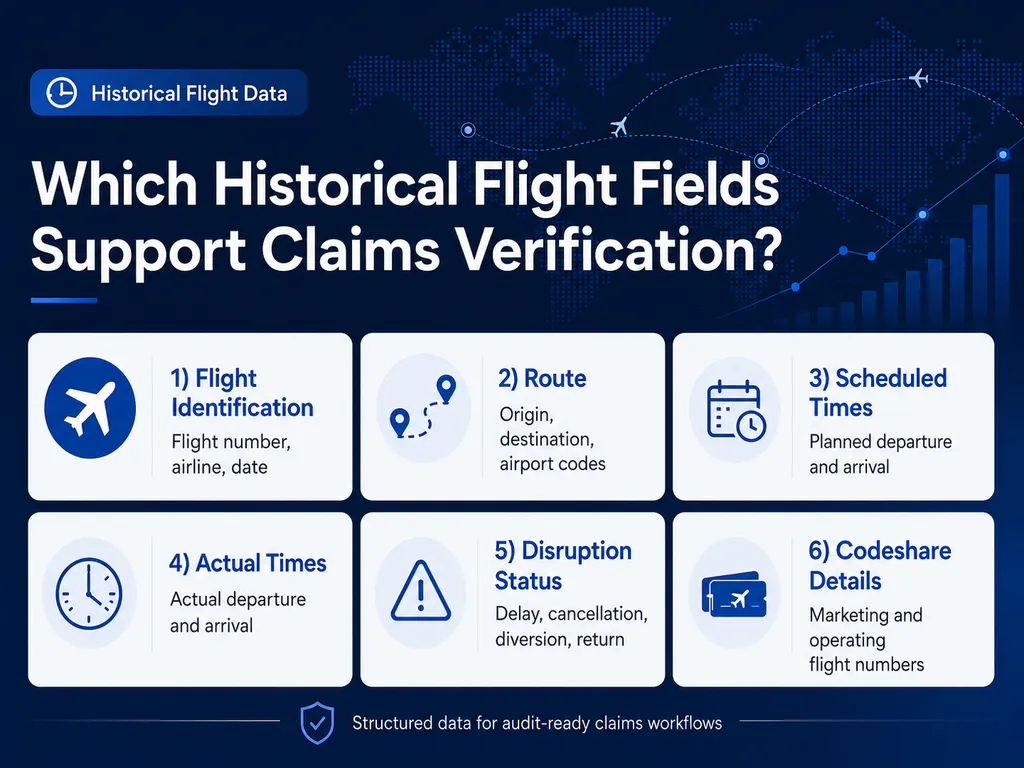
A claims verification workflow needs fields to identify the flight. It also needs fields to show the flight event. It must keep enough context for an audit. The core evidence usually starts with identity, route, scheduled times, actual times and disruption status.
| Data group | Example fields | Claims workflow use |
|---|---|---|
| Flight identification | Flight number, airline, flight date | Match a claim to the correct flight |
| Route | Origin, destination, airport codes, airport names | Confirm the operated route |
| Scheduled times | Scheduled departure and arrival time fields within operational flight records | Establish the comparison baseline |
| Actual times | Actual departure and arrival times | Calculate time differences in the customer system |
| Disruption status | Delay, cancellation, diversion, return, departure and arrival status | Identify the recorded flight event |
| Codeshare details | Marketing and operating flight numbers where available | Reduce incorrect flight matching |
| Supporting context | Distance, duration, stops, stopover airports, diversion details where applicable | Support special review or route-specific workflows |
These fields describe flight operation. They do not confirm that a traveller boarded, bought a ticket, paid for insurance or qualifies for a benefit.
Which Timestamp Should Insurers Use for Flight Delay Verification?
Timestamp selection is a customer-side policy question. Historical flight data can show scheduled and actual operation times.
But the insurer decides which time applies to a specific claim rule.
For example, a delay benefit may cover a delayed departure. It may also cover a delayed arrival or a late arrival. It may cover other events defined by the policy. The claims platform should map each rule to the relevant returned field instead of treating all timestamps as interchangeable.
| Timestamp field | What it can support |
|---|---|
| Scheduled departure time | Planned departure baseline |
| Scheduled arrival time | Planned arrival baseline |
| Actual departure time | Departure comparison |
| Actual arrival time | Arrival comparison |
| Estimated departure or arrival time | Review of changing time expectations where available |
For claims verification, do not replace actual arrival time with a landing timestamp.
Only do so if the API field clearly represents the landing event. A safer wording is to compare scheduled and actual arrival times using the flight timestamps from the API.
How Should Insurers Match Codeshare Flights?
Codeshare matching is one of the most common sources of flight verification error. A traveller may submit a marketing flight number, while the aircraft operated under another airline’s flight number.
A more reliable matching process uses the flight number, date, and route. It then checks marketing and operating flight numbers when available. This reduces the risk of matching the claim to a different physical flight.
Example workflow:
- The claim record contains the traveller-reported flight number.
- The claims platform queries historical records by flight number and date.
- The platform cross-checks origin and destination airport codes.
- The platform reviews marketing and operating flight numbers where available.
- Unclear matches move to manual review.
DataWorks can provide aviation records and codeshare fields where available. The insurer decides how those fields interact with its own trip, booking and policy records.
What Happens When Historical Flight Fields Are Missing?
Missing data is not the same as a claim failure. A data state that the customer’s claims platform should route according to its own rules.
Some events naturally create incomplete fields. A cancelled flight may not have an actual arrival time.
A diversion may have an actual arrival airport that differs from the scheduled destination. A returned flight may depart and then return to the origin. A codeshare record may require review of both marketing and operating flight numbers.
| Scenario | Data handling implication |
|---|---|
| Cancelled flight | Actual arrival time may be unavailable |
| Diversion | Actual arrival airport may differ from scheduled destination |
| Return | Departure occurred, but the flight returned to origin |
| Codeshare | Marketing and operating numbers may differ |
| Partial record | Manual review may be safer than automated routing |
The customer system should define whether each case becomes rule-matched, rule-not-matched, data-unavailable or manual-review. Final claim decisions and payouts remain within the insurer’s claims platform.
What Does a Claims Verification Workflow Look Like?
A claims verification workflow connects a customer-owned claim record with a historical aviation record. The workflow should make the matching logic visible enough for audit and review.
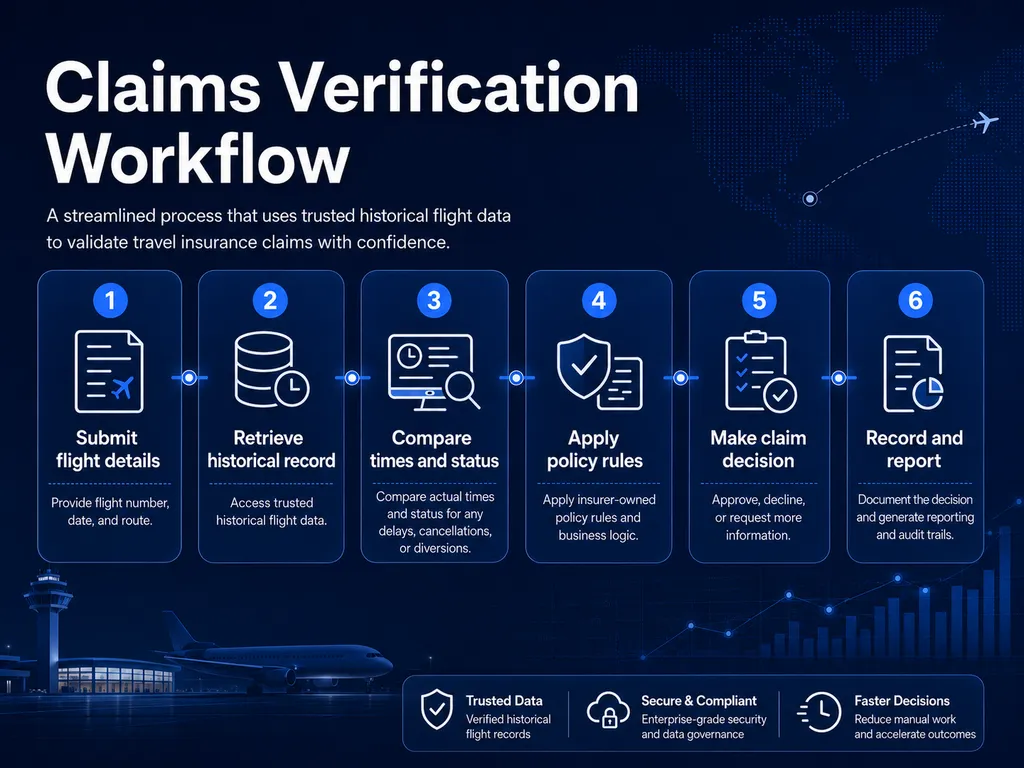
A practical flow looks like this:
- The customer submits flight number, date and route from its own claim or trip record.
- The claims platform queries the DataWorks API or historical data export.
- DataWorks returns the matching historical flight record where available.
- The customer system compares the returned event with predefined claims rules.
- Unclear matches or missing fields are sent to manual review.
- The insurer makes the final claim decision inside its own claims platform.
This structure keeps responsibilities clear. DataWorks provides historical aviation data. The insurer owns the policy, claim file, claimant identity, supporting documents, fraud controls, approval status and payout.
How Does Historical Flight Data Differ From Real-Time Monitoring?
Real-time flight data supports active monitoring while a flight is operating or about to operate. Historical flight data supports claim review after the event has already happened.
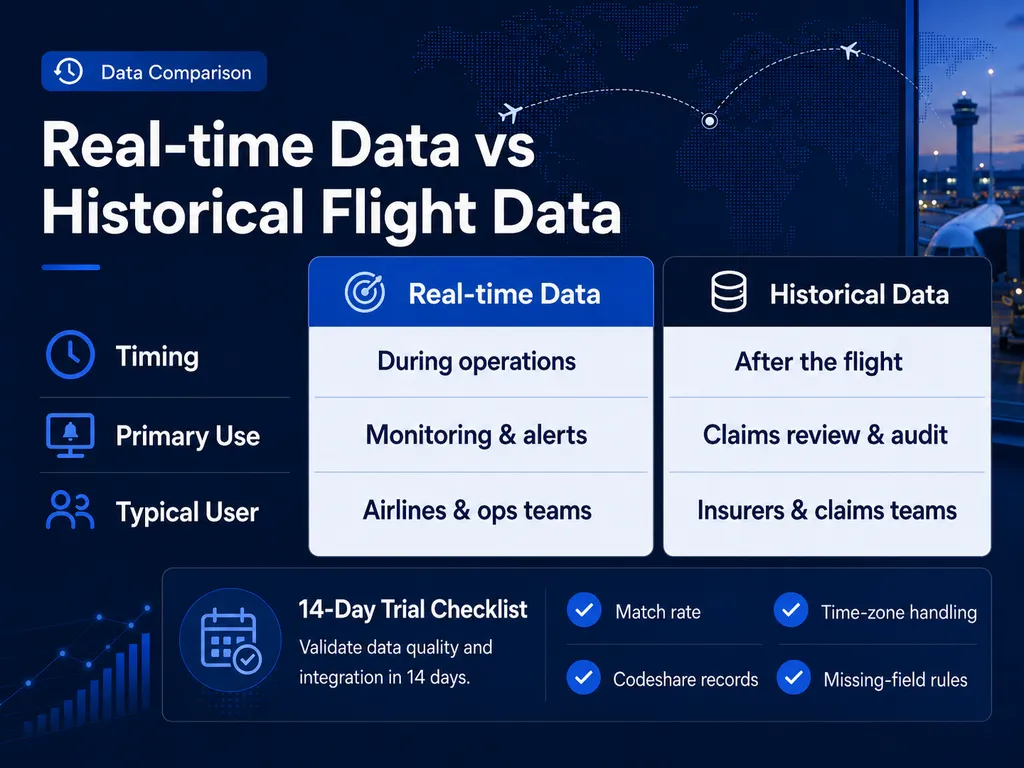
This distinction matters because insurance teams often need both layers. Real-time data can feed alerting and monitoring workflows. Historical data can support retrospective verification, dispute handling and batch checks.
| Workflow need | Real-time data | Historical data |
|---|---|---|
| Monitoring insured flights | Primary use | Not applicable |
| Triggering disruption alerts | Primary use | Not applicable |
| Reviewing claims after travel | Only if previously archived | Primary use |
| Retrospective batch checks | Limited | Primary use |
| Audit and dispute support | Supports event timelines if stored | Supports retrospective verification |
A common implementation approach uses real-time data for monitoring and historical data for evidence review. The customer’s claim platform connects both layers to its own policy and audit logic.
What Should Insurers Test During a 14-Day Historical Data Trial?
A historical flight data trial should test whether the data fits real claims operations. A simple endpoint check is not enough for insurance use cases.
| Trial check | What to verify |
|---|---|
| Supported query methods | Flight number, airline, date, route and airport-based lookup where available |
| Historical match rate | Whether claim records match the correct historical flight records |
| Date range availability | Whether the historical period fits the insurer’s claim review window |
| Time-zone handling | Whether scheduled and actual times are interpreted consistently |
| Actual time fields | Actual departure and arrival times where available |
| Status classification | Delay, cancellation, diversion, return, departure and arrival handling |
| Codeshare records | Marketing and operating flight number matching |
| Batch usability | API or export-based delivery for historical claim review |
| Missing-field rules | How unavailable fields are routed to manual review |
Teams should define missing-field rules before launch. A missing actual arrival time or unclear codeshare match should not become an automatic claim outcome.
Testing with a representative sample of real historical claims is more informative than evaluating API responses alone. This is most true for codeshares, cancellations, diversions, and incomplete records.
Why Use VariFlight DataWorks for Historical Claims Verification?
VariFlight DataWorks Historical Flight Status Data provides past flight status, delay records, actual departure and arrival times, and route context through structured data access.
| Capability | VariFlight DataWorks |
|---|---|
| Commercial flight coverage | 97% of commercial flights |
| Airline coverage | 1,200+ airlines |
| Airport coverage | 10,000+ airports |
| Historical depth | More than a decade of historical flight records |
| Delivery | API and export-based access |
| Key insurance fields | Scheduled and actual times, delay, cancellation, diversion, return and route context |
| Codeshare handling | Marketing and operating flight numbers where available |
VariFlight DataWorks Insurance solutions support flight disruption monitoring and evidence-based claim review with real-time and historical aviation data. One practical option is to load past records into the insurer’s claims platform. The customer controls the claim rules and decisions there.
Historical Flight Data as Evidence for Insurance Claims
Historical flight data gives insurers a structured record of flight operations after travel, including delays, cancellations, diversions, returns and actual times. These records can support consistent claims verification while reducing reliance on manual searches across airline and airport websites.
When combined with the insurer’s booking, trip, and policy data, past aviation records can provide reliable proof.
You can use them in existing claims workflows.
FAQ
What flight data can be used to verify an insurance claim?
Useful flight data can include the flight number and airline.
It can include the flight date and the origin and destination airports.
It can include scheduled departure and arrival times.
It can include actual departure and arrival times.
It can include cancellation, diversion, and return status.
It can include codeshare details, when available.
How can insurers verify a historical flight delay?
Insurers can match the flight number, date, and route with past flight records. Then they can compare scheduled and actual times and review the disruption status.
Can historical flight data verify whether an airline cancelled a flight?
Yes. Historical flight data can provide recorded cancellation status and related flight information for retrospective claims verification.
How far back can you search historical flight data?
VariFlight DataWorks provides more than a decade of historical flight records. Confirm the required date range during trial testing, especially if the claims workflow needs older retrospective evidence.
Can historical flight data determine claim eligibility?
No. Historical flight data can support claims verification, but the insurer or claims platform determines eligibility, exclusions, fraud controls, approval, communication and payout.
Can DataWorks verify missed connections?
DataWorks can verify relevant flight events, such as delay, cancellation, actual arrival time or diversion. The insurer must use trip, booking, minimum connection, and policy information from its own systems. It uses this information to decide if a missed connection occurred under its rules.
Does DataWorks provide passenger or booking data?
No. DataWorks does not provide ticketing or booking data. It does not provide PNR or payment data.
It does not provide fare or flight cost data.
It does not provide passenger identity or traveller profile data.
It does not provide customer behaviour data. It does not provide claim documents.
How Can Insurance Teams Start Testing Historical Flight Data?
Start with a sample of closed and open claims. Include different airlines, routes, delay lengths, cancellations, diversions and codeshare records. Use the trial to check field matching, evidence quality, batch lookup and missing-field rules.
References
- VariFlight DataWorks internal aggregate query, global commercial passenger flights, January 1-June 30, 2026.
- VariFlight DataWorks Historical Flight Status Data: https://dataworks.variflight.com/products/flight-status-data/historical-flight-status-data-api/
- VariFlight DataWorks Insurance Solutions: https://dataworks.variflight.com/solutions/insurance/
- NAIC, Travel Insurance: https://content.naic.org/insurance-topics/travel-insurance