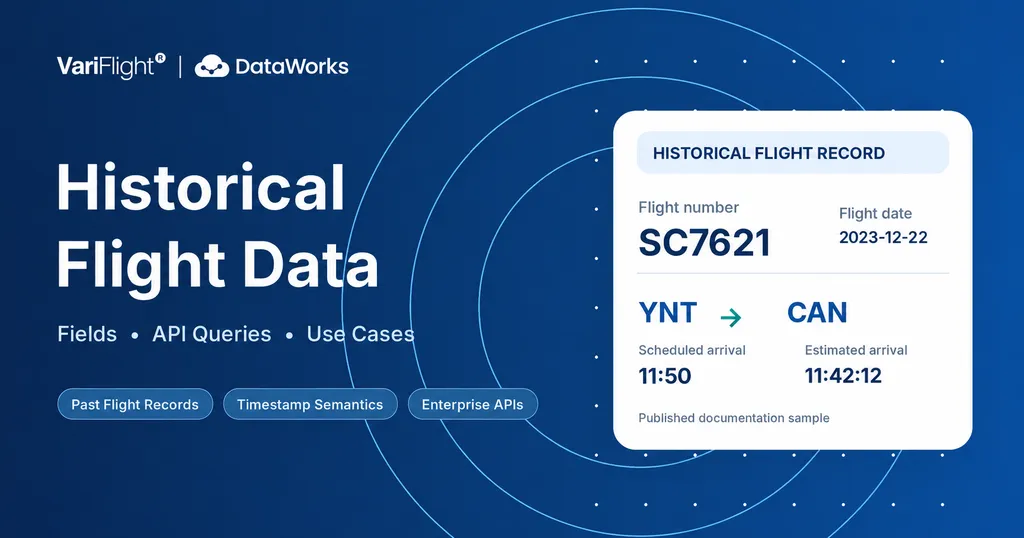
Historical flight data provides structured records of past flights, including flight identity, routes, scheduled departure and arrival times, estimated updates, actual operational milestones, and recorded flight status.
For online travel agencies (OTAs), travel management companies (TMCs), insurers, airlines, and technology platforms, these records help answer an important question: What actually happened to a specific flight on a given date?
Historical records can support flight delay verification, cancellation reviews, operational reporting, route reliability analysis, and other enterprise workflows. However, the value of the data depends on understanding which flight events and timestamps are being compared.
This guide explains what historical flight data includes, how its API fields are defined, how past flights can be queried, and what businesses should evaluate before integrating a historical flight status API.
What Is Historical Flight Data?
Historical flight data is a collection of records associated with flights whose scheduled departure dates have passed.
Unlike a flight schedule, which describes planned operations, historical flight data provides information about the recorded operation of a dated flight.
Depending on the available sources and historical period, a record may contain:
- Flight number, airline, origin, destination, and flight date
- Scheduled and original scheduled departure and arrival times
- Estimated departure and arrival updates
- Actual departure and arrival timestamps
- Off-block and on-block times
- Recorded cancellation, diversion, or return status
- Airport, terminal, gate, aircraft, and codeshare information
Historical data can help determine whether a flight was recorded as departed, arrived, cancelled, diverted, or returned.
However, it does not automatically explain why an event occurred or determine what action a business should take.
VariFlight DataWorks provides historical aviation records as a data layer. Customers integrate these records into their own reporting, verification, analytical, and operational systems.
What Information Does a Historical Flight Record Include?
A historical flight record connects operational information to a specific flight date and route.
The following table summarizes the main data categories.
| Data Group | Example Information | What the Record Can Establish |
|---|---|---|
| Flight Identity | Airline, flight number, flight date | Identifies the dated flight service |
| Route Information | Origin, destination, airport codes, stops | Identifies the planned or recorded flight segment |
| Scheduled Times | Scheduled departure and arrival; original schedule when available | Establishes the documented schedule baselines |
| Estimated Times | Estimated departure and arrival | Shows available operational estimates |
| Actual Times | Actual departure and arrival timestamps | Records the corresponding operational milestones |
| Ground Milestones | Off-block and on-block times | Identifies aircraft movement at parking positions |
| Flight Status | Departure, arrival, cancellation, diversion, return | Describes the recorded operational state |
| Airport Information | Terminal, gate, stand, baggage carousel | Provides available airport operational context |
| Aircraft Information | Aircraft type, registration-related information | Identifies associated aircraft details |
| Codeshare Information | Marketing flight identifiers, codeshare relationships | Supports matching of related flight records |
| Time Information | Local dates, times, time-zone context | Supports interpretation of timestamps |
Field availability varies by flight, airport, data source, and historical period.
For example, a flight record may contain an actual arrival time without a corresponding gate or stand value. A missing optional field should not automatically be interpreted as a failed query or a missing flight operation.
Enterprise systems should preserve the difference between unavailable data and confirmed operational events.
What Does a Historical Flight Status API Record Look Like?
VariFlight DataWorks publishes a Flight Status Query API V3.0 documentation page containing request parameters, response fields, authentication instructions, and JSON examples.
The following selected values come from the published response example for flight SC7621, associated with the Yantai (YNT) to Guangzhou (CAN) route on December 22, 2023.
| API Field | Documentation Example | Meaning |
|---|---|---|
FlightNo | SC7621 | Flight number |
FlightDepcode | YNT | Departure airport |
FlightArrcode | CAN | Arrival airport |
FlightDeptimePlanDate | 2023-12-22 08:20:00 | Scheduled departure |
FlightArrtimePlanDate | 2023-12-22 11:50:00 | Scheduled arrival |
FFlightArrtimePlanDate | 2023-12-22 10:35:00 | Original scheduled arrival |
FlightArrtimeReadyDate | 2023-12-22 11:42:12 | Official estimated arrival |
FlightArrtimeDate | 2023-12-22 11:43:00 | Actual arrival |
FlightIngateTime | 2023-12-22 11:57:00 | Actual on-block time |
These values demonstrate why different timestamps must remain separate.
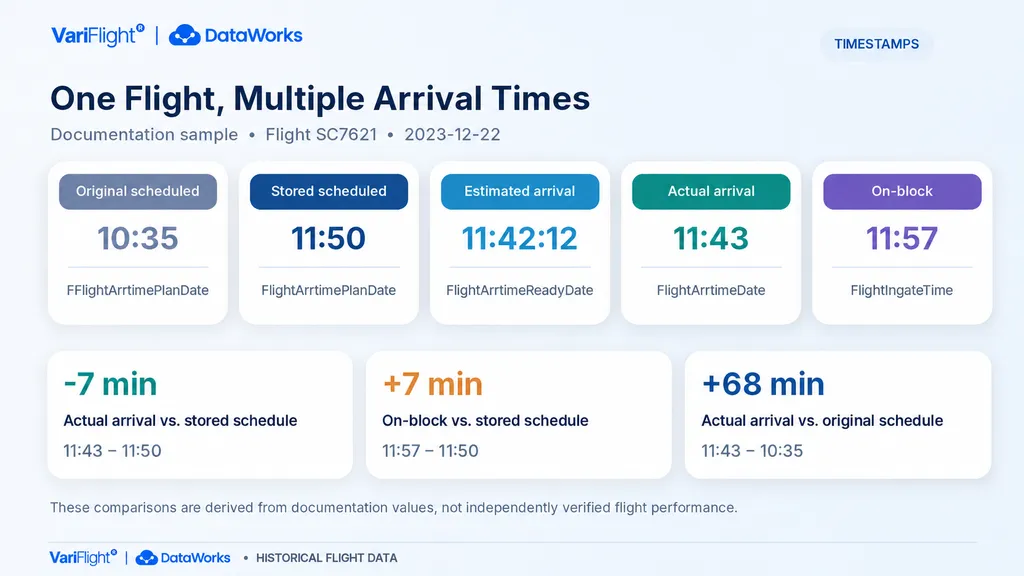
For example, the documented original scheduled arrival is 10:35, while the stored scheduled arrival is 11:50. Those are different baselines.
The actual arrival field and on-block field also represent different milestones.
Important: These values come from a published API documentation example. They illustrate field definitions and calculations; they should not be treated as independently verified flight performance data or a guarantee that every historical response contains the same fields.
Why Do Scheduled, Estimated, and Actual Flight Times Matter?
A historical record may contain several timestamps associated with the same flight.
Although they all describe the flight’s operation, they serve different purposes.
Scheduled Flight Times
Scheduled times describe the planned departure or arrival baseline stored in the record.
Some flight-status responses distinguish the stored scheduled time from an original scheduled time.
For example:
FlightArrtimePlanDate: scheduled arrival timeFFlightArrtimePlanDate: original scheduled arrival time
Businesses should not assume these fields are interchangeable.
When calculating a delay or assessing schedule changes, the selected baseline can materially affect the result.
Estimated Flight Times
Estimated times describe an expectation about when an operational milestone will occur.
For example, FlightArrtimeReadyDate represents the official estimated arrival time in the published VariFlight API documentation.
Estimated timestamps may change as operational information becomes available.
Historical records can include available estimated values, but a single retained estimate should not be assumed to represent the complete history of every estimate change.
Actual Flight Times
Actual timestamps describe recorded operational events.
The VariFlight documentation distinguishes:
FlightDeptimeDate: actual departure timeFlightArrtimeDate: actual arrival timeFlightOutgateTime: actual off-block timeFlightIngateTime: actual on-block time
An actual off-block time describes when an aircraft leaves its parking position.
An actual on-block time describes when it reaches its arrival parking position.
The documented FlightArrtimeDate field is labelled Actual Arrival Time. It should not automatically be interpreted as runway touchdown time unless that interpretation is explicitly confirmed by the data specification.
For a more detailed explanation, read When Has a Flight Really Arrived? Landing Time vs On-Block Time for OTAs.
How Can Businesses Calculate Flight Delays from Historical Data?
Historical flight data provides the timestamps needed to calculate operational time differences.
However, the customer must decide which scheduled baseline and actual milestone to compare.
A common calculation is:
Arrival time variance = Actual arrival time − Scheduled arrival time
Using the published API documentation example:
| Comparison | Calculation | Result |
|---|---|---|
| Actual arrival vs. stored scheduled arrival | 11:43 − 11:50 | −7 minutes |
| On-block vs. stored scheduled arrival | 11:57 − 11:50 | +7 minutes |
| Actual arrival vs. original scheduled arrival | 11:43 − 10:35 | +68 minutes |
These comparisons produce different results because they use different timestamps or schedule baselines.
A negative variance indicates an event occurred earlier than the selected baseline. It should not be reported as a positive delay.
The on-block comparison also pairs an actual parking-position milestone with a scheduled arrival field, not a separately documented scheduled on-block timestamp. It is appropriate only when the customer’s reporting definition permits that comparison.
Before calculating delay, businesses should confirm:
- Which scheduled baseline is required.
- Whether actual arrival, departure, off-block, or on-block time is being measured.
- How local time zones, overnight flights, and date changes are handled.
- How missing timestamps are treated.
- Whether cancellations, diversions, and returns require separate handling.
- Whether the methodology matches the customer’s reporting, insurance, or contractual definition.
VariFlight DataWorks supplies the underlying timestamps when available. Customers apply their own calculations and business rules.
How Can Developers Query Historical Flight Data Through an API?
Historical flight data can be retrieved using supported identifiers such as flight numbers, dates, routes, or airport codes.
The published VariFlight DataWorks Flight Status Query API V3.0 documentation describes several query methods.
Supported Flight Status API Query Methods
| Query Method | Key Parameters | Typical Use |
|---|---|---|
| Flight Number + Date | fnum, date | Retrieve records for a specific dated flight |
| Airport Route + Date | dep, arr, date | Find flights operating between two airports |
| City Pair + Date | depcity, arrcity, date | Find flights between two cities |
| Flight Number + Route + Date | fnum, dep, arr, date | Identify a flight using more specific route information |
| Arrival-Date Query | fnum or route identifiers, arrDate | Retrieve supported flights using an arrival-date criterion |
| Airport Arrivals or Departures | airport, status, date | Retrieve arrival or departure records for an airport |
| Airport Time-Range Query | airport, date, startAt, endAt | Retrieve supported airport flight records within a defined time period |
The documentation also specifies pagination parameters, including page and perpage, for applicable query modes.
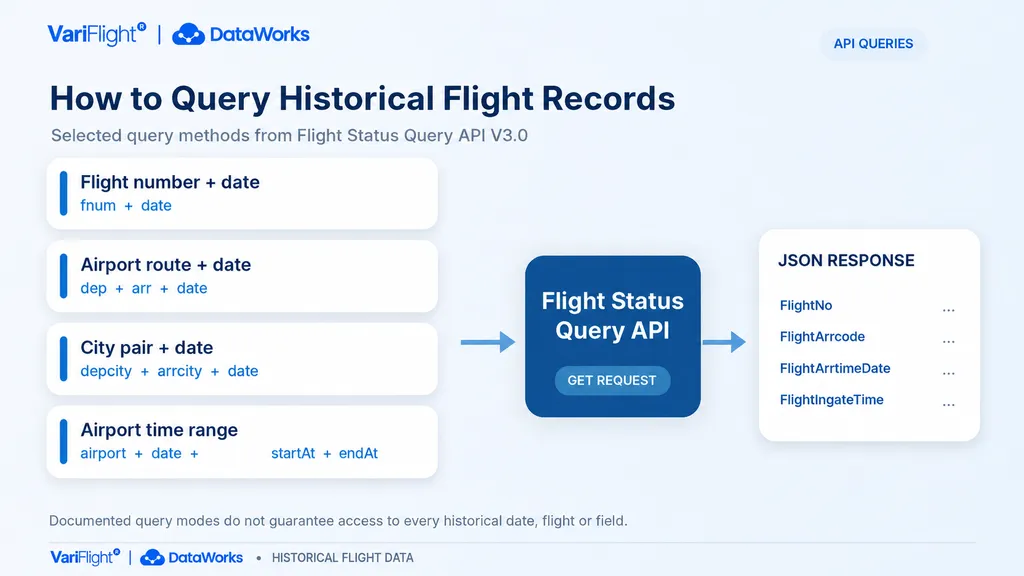
For airport-based paginated queries, the documented maximum is 100 records per page.
Example: Querying a Flight by Number and Date
A travel platform reviewing a past customer itinerary may need to identify a flight using:
- Flight number:
GX8915 - Flight date:
2023-02-24
The API documentation describes a request mode using fnum and date, together with the required authentication parameters.
A different application may need to review all supported arrivals at an airport during a specified date or time interval.
In that case, the airport-based query modes provide a more suitable starting point.
The published interface uses HTTP GET requests, JSON responses, token-based authentication, and an authorized IP allowlist.
These are documented query capabilities, not a guarantee that every account can access every historical date, route, or field. Historical coverage, interface permissions, and access volume should be confirmed for the intended service scope.
The documentation does not list aircraft registration or tail number as a standalone search parameter for this flight-status query interface, even though aircraft-related values may be included in responses.
Developers can review the complete Flight Status Query API documentation for parameter requirements, response fields, pagination, error codes, and authentication details.
Evaluate Historical Flight Data for Your Application
Need to verify past flight records, compare scheduled and actual times, or test historical coverage for specific routes?
Explore the VariFlight DataWorks Historical Flight Status Data API and request a 14-day free data trial to evaluate the service against your requirements.
How Is Historical Flight Data Different from Real-Time Flight Status?
Historical flight data and real-time flight status describe related parts of an aircraft’s operation, but they answer different questions.
| Business Question | Real-Time Flight Status | Historical Flight Data |
|---|---|---|
| What is happening to a flight now? | Primary use | Not its primary purpose |
| What was scheduled? | Current scheduled baseline | Recorded past schedule information |
| What is the estimated arrival? | Available operational estimate | Retained estimate when available |
| What actually happened? | Actual events as they become available | Recorded past operational events |
| How is the data accessed? | Supported queries and update services | Historical queries or agreed exports |
| What is the business purpose? | Live monitoring and disruption response | Verification, reporting, and retrospective analysis |
For example, an OTA may use real-time flight status data to display updates during a customer’s trip.
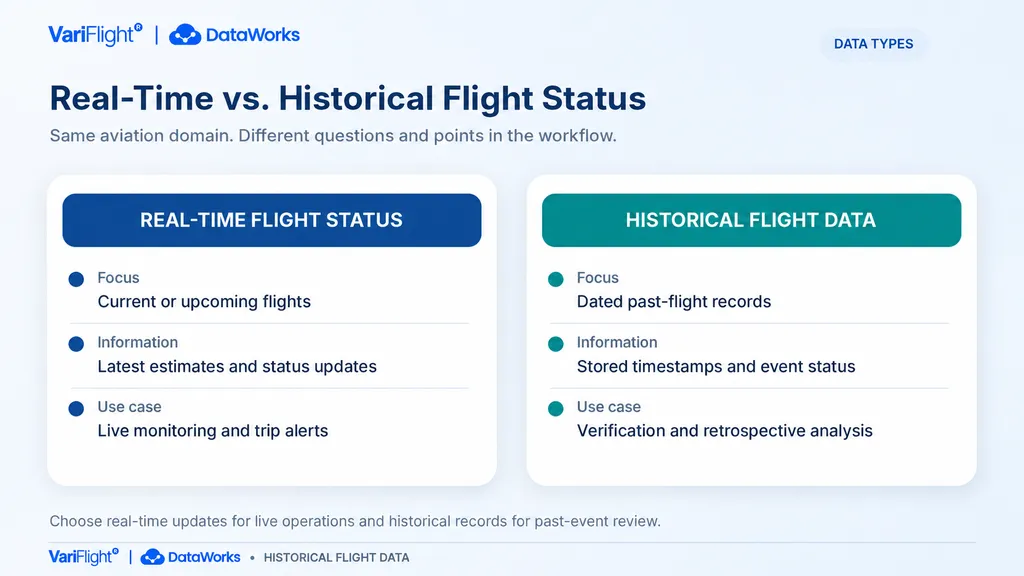
After the flight, the same OTA may retrieve historical information to review a reported delay or reconstruct an operational timeline.
Historical and real-time records can therefore support different stages of the same business workflow without replacing one another.
For a broader explanation of live operational records, see What Is Flight Status Data? How It Works, Fields and Enterprise Uses.
What Past Flight Events Can Historical Data Verify?
Historical flight records can help businesses verify recorded operational events.
Depending on the available fields, the records may establish:
- Whether a flight was recorded as departed or arrived
- Whether it was cancelled, diverted, or returned
- Its scheduled and actual departure or arrival timestamps
- Its planned and recorded operating route
- Its airline, flight number, and airport identifiers
- Available aircraft, airport, or codeshare context
However, verification must remain within the scope of the available data.
A cancellation status does not automatically establish the reason for cancellation.
An actual arrival timestamp does not confirm when passengers disembarked.
A flight record cannot independently prove whether a specific passenger boarded, missed a connection, received baggage, or was eligible for compensation.
In insurance, customer service, or contractual reviews, flight records can support verification of aircraft-operation facts. Passenger information, booking records, policy terms, and legal requirements must be evaluated separately.
How Do Codeshare Flights Affect Historical Flight Matching?
Codeshare arrangements can create additional complexity when identifying past flight operations.
A marketing flight number and an operating flight number may refer to the same physical flight.
An application that searches or counts only marketing flight numbers could duplicate an operation or fail to identify the underlying operated service.
A historical flight-matching workflow may need to consider:
- Flight date and local departure date
- Departure and arrival airports
- Marketing carrier and flight number
- Operating-flight relationships, when available
- Scheduled departure time
- Segment or stop information
- Available codeshare identifiers
The customer should establish whether its analysis counts marketed services, physical flight operations, or both.
This distinction matters when combining historical flight records with bookings, reporting on route activity, or evaluating airline performance.
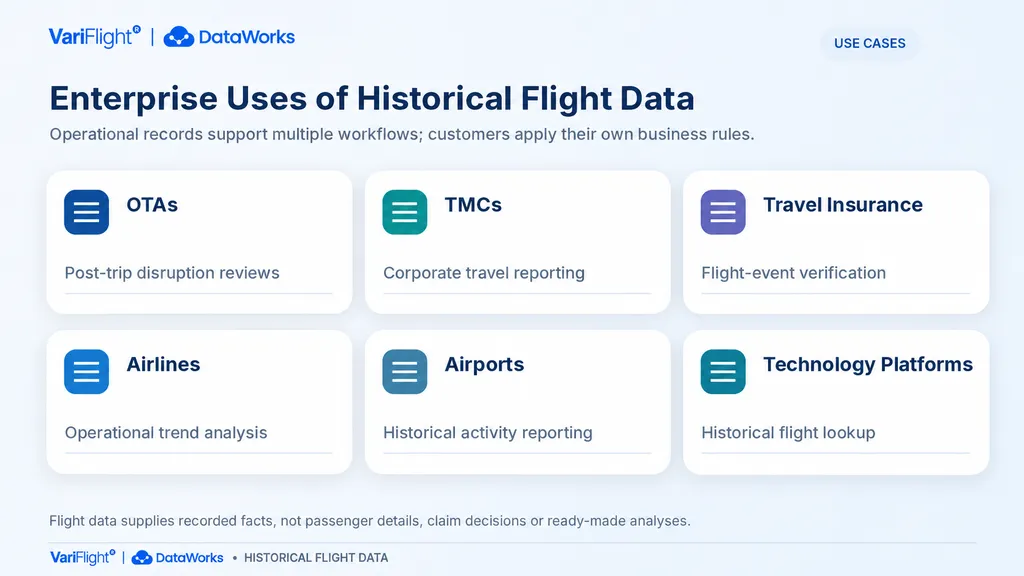
Who Uses Historical Flight Data?
Historical flight records can support multiple business applications. The underlying aviation data may be similar, but the customer determines how it is used.
| Industry | Historical Flight Data Use Case |
|---|---|
| Online Travel Agencies (OTAs) | Review past flight disruptions and support post-trip customer service |
| Travel Management Companies (TMCs) | Reconstruct flight events for corporate travel reporting and duty-of-care reviews |
| Travel Insurance | Verify recorded delays, cancellations, and diversions against reported claims |
| Airlines | Analyze operational performance and historical disruption patterns |
| Airports | Support internal performance analysis and historical operational reporting |
| Aviation Analytics | Evaluate route, airport, and airline performance over defined periods |
| Technology Platforms | Integrate historical flight lookup into customer-facing or internal applications |
Historical Flight Data for Travel Insurance
Travel insurers can compare reported flight disruptions with recorded flight-operation information.
For example, an insurer might use actual arrival data and a defined scheduled baseline to evaluate whether a reported delay meets a policy’s time threshold.
However, historical flight data does not determine insurance eligibility or approve compensation.
The insurer must apply its own coverage conditions, passenger evidence, policy rules, and claims procedures.
Read more: How Historical Flight Data Supports Travel Insurance Claims Verification.
Historical Flight Data for Airline and Route Analysis
Airlines and aviation analysts can use historical flight records to compare operational outcomes across routes, airports, airlines, and time periods.
Depending on the dataset and methodology, analysis may include:
- Arrival and departure punctuality
- Recorded delay frequency and duration
- Cancellation and diversion patterns
- Route-level operational consistency
- Seasonal differences in flight performance
These are calculations performed using the supplied records, not automatic conclusions contained in each individual flight response.
For related examples, explore Flight Operations Data for Route Performance Analysis.
What Are the Limitations of Historical Flight Data?
Historical flight records describe aircraft operations, not every aspect of a passenger journey or commercial transaction.
They do not inherently include:
- Passenger names or identity information
- Passenger Name Records (PNRs) or booking confirmations
- Airfares, ticket values, or refund amounts
- Proof that a specific passenger boarded or missed a flight
- Confirmation of baggage delivery or border clearance
- A guaranteed explanation of the cause of every disruption
- Insurance eligibility decisions or payout calculations
- Ready-made operational recommendations or business conclusions
Historical flight-status data also does not replace a standalone future flight timetable database.
A past flight record may contain scheduled timestamps, but those timestamps form part of that dated operational record rather than a separate timetable product.
These boundaries are important when designing enterprise integrations. A flight data API supplies aviation information; the receiving application provides the business context and decision logic.
How Is Historical Flight Data Delivered?
Historical flight data can be delivered through an API or an agreed data export, depending on the customer’s technical architecture and project requirements.
API-Based Access
An API is suitable for applications that need to retrieve selected historical records using supported flight identifiers, airport codes, routes, or dates.
VariFlight DataWorks documents structured JSON responses for its Flight Status Query API.
Applications can use the returned information within their own verification processes, customer service systems, or internal reporting tools.
Export-Based Delivery
For larger historical analyses, a customer may require data covering multiple routes, airlines, airports, or years.
VariFlight DataWorks also offers export-based delivery for supported historical flight data projects.
The available file format, delivery arrangements, historical scope, and update requirements should be agreed upon before implementation.
The published product information does not specify a universal export format or transfer protocol for every project.
Data Access and Retention
Regardless of the delivery method, enterprise customers should define:
- The required historical period
- Routes, airlines, and airports in scope
- Required fields and acceptable missing values
- Expected query volume or export size
- Data storage and retention requirements
- Treatment of corrected or updated records
- Permitted internal and downstream uses
Data access rights and retention periods depend on the applicable commercial agreement.
What Should Businesses Evaluate Before Choosing a Historical Flight Data Provider?
Selecting a historical flight data provider requires more than checking a headline coverage percentage.
A representative technical evaluation should test the records and query workflows that the customer’s actual application requires.
| Evaluation Area | Questions to Ask |
|---|---|
| Historical Coverage | Are the required dates, routes, airlines, and airports available? |
| Flight Matching | Can records be reliably associated with the intended flight and segment? |
| Timestamp Definitions | Are scheduled, original scheduled, estimated, and actual times clearly distinguished? |
| Disruption Records | Are cancellations, diversions, and returns represented where available? |
| Time Zones | Can local times and overnight operations be interpreted correctly? |
| Codeshares | Can related marketing and operating flight records be handled consistently? |
| Missing Fields | Can unavailable optional information be distinguished from confirmed events? |
| API Queries | Do documented query modes support the intended application? |
| Data Delivery | Are API responses or agreed exports suitable for the required workload? |
| Documentation | Are authentication, parameters, response fields, and errors explained? |
| Licensing | Do the terms support the intended storage, reuse, and business application? |
A useful evaluation should include ordinary flights, irregular operations, and cases involving incomplete or changing information.
Coverage claims are a starting point, not a substitute for testing against a representative sample.
How Does VariFlight DataWorks Provide Historical Flight Data?
VariFlight DataWorks is the enterprise aviation data brand of VariFlight, providing aviation data APIs and datasets for business applications worldwide.
Its Historical Flight Status Data API supports access to past flight-operation records through structured API responses and agreed export-based delivery.
According to the published product information, the service offers:
- Historical records from January 1, 2014 onward
- Coverage of more than 97% of global commercial flights
- Data spanning 1,200+ airlines and 10,000+ airports
- Structured JSON API access and export-based delivery
- A 14-day free data trial for evaluation
Available data may include flight identity, route information, scheduled and actual timestamps, flight status, airport information, and other supported operational fields.
Actual availability depends on the requested flight, historical date, geographic coverage, data source, and service permissions.
VariFlight DataWorks supplies historical aviation data. Customers apply their own calculations, analytical methods, workflow rules, and business decisions.
Explore the Historical Flight Status Data API to review the service and request a 14-day free trial.
Frequently Asked Questions
What is historical flight data?
Historical flight data is structured information about flights whose scheduled departure dates have passed. It can include flight identity, route, scheduled times, available estimates, actual operational timestamps, and recorded flight status.
How far back does historical flight data go?
Historical coverage depends on the provider and contracted scope.
VariFlight DataWorks states that its historical flight records are currently available from January 1, 2014 onward. Availability for a particular flight or field should be checked against the intended dataset.
Can I query historical flight data by flight number and date?
Yes. The published VariFlight Flight Status Query API documentation includes a query mode using fnum and date.
Other documented modes support airport routes, city pairs, arrival dates, and airport arrival or departure queries.
Access to specific historical records remains subject to service permissions and data availability.
Can historical flight data be used to calculate delays?
Yes. Scheduled and actual timestamps can be used to calculate time differences.
However, users must select the appropriate scheduled baseline and operational milestone. Different combinations may produce different results, so the calculation method must be clearly defined.
Is actual arrival time the same as landing time?
Not necessarily.
The documented FlightArrtimeDate field is labelled Actual Arrival Time, while FlightIngateTime is labelled On-Block Actual Time.
An actual arrival field should not be assumed to represent runway touchdown without an explicit definition confirming that milestone.
Can historical flight data identify why a flight was cancelled?
A historical record can provide a cancellation status and may include additional operational context where supported.
However, the recorded status alone does not establish the definitive cause of cancellation. Any cause-based determination requires appropriately sourced and validated information.
Does historical flight data contain passenger or booking information?
No. VariFlight DataWorks historical flight-status records describe aircraft operations rather than passenger identity, PNRs, ticket values, or booking ownership.
Businesses must combine the flight data with their own authorized passenger or booking information where necessary.
Can historical flight data be exported for analysis?
Yes. VariFlight DataWorks offers export-based historical data delivery for applicable enterprise projects.
Specific file formats, historical scope, delivery arrangements, and licensing requirements should be confirmed for the project.
Can historical flight data support travel insurance claims?
Yes. It can support verification of recorded flight events such as delays, cancellations, or diversions.
It does not independently determine passenger eligibility, contractual liability, compensation amounts, or claim approval.
Is historical flight data the same as a flight schedule database?
No. Historical flight-status records contain available scheduled timestamps alongside operational information for dated flights.
They should not be treated as a standalone future timetable database.
Related Guides and Resources
- What Is Flight Status Data? How It Works, Fields and Enterprise Uses
- When Has a Flight Really Arrived? Landing Time vs On-Block Time for OTAs
- How Historical Flight Data Supports Travel Insurance Claims Verification
- How to Analyze China-Germany Flight Reliability with Historical Flight Status Data
- Flight Status Query API V3.0 Documentation
- VariFlight DataWorks API Download Zone
Build With Historical Flight Data
Historical flight records can support verification, reporting, and enterprise applications when their fields, query methods, and limitations are clearly understood.
Whether your organization needs past flight status, actual arrival times, disruption records, or route-level operational history, VariFlight DataWorks provides aviation data that can be integrated into your own business systems.
Explore Historical Flight Status Data API & Request a 14-Day Free Trial