

What is a Flight Status API and Why is it Critical for Modern Airport Transfer Solutions?
In the competitive landscape of premium ground transportation, a Flight Status API is no longer a luxury; it is the foundational data infrastructure for operational efficiency. At its core, a flight data API provides real-time updates on aircraft movements, schedule changes, and gate assignments, allowing airport transfer solutions to move from reactive to proactive service models.
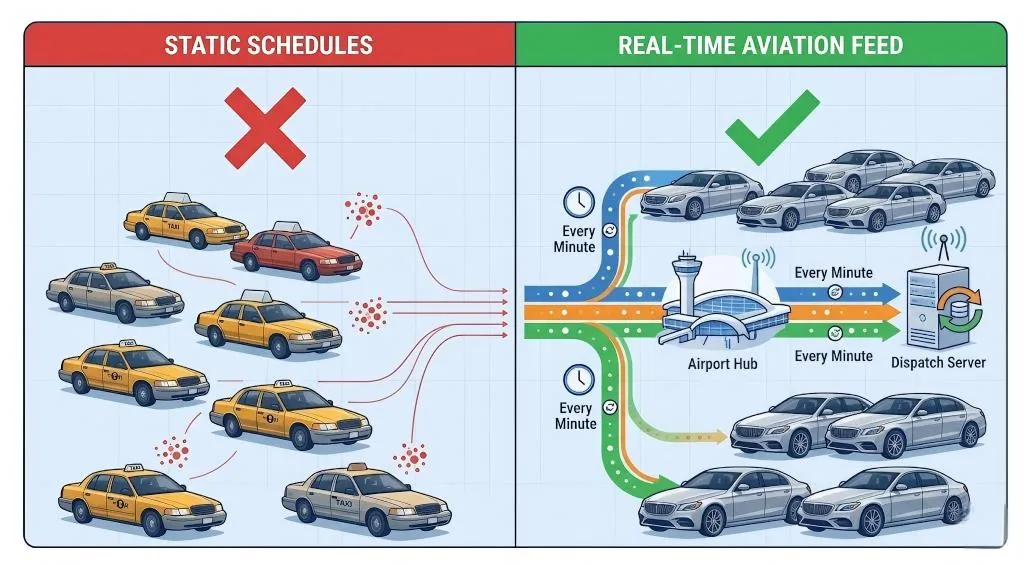
For companies managing a chauffeur dispatch system, relying on static schedules or manual tracking is a recipe for high idle costs and service failures. A professional-grade aviation data feed delivers a sub-minute refresh rate for the majority of commercial flights globally. This level of granular visibility is essential for synchronizing the complex “air-to-ground” handoff, ensuring that drivers are positioned precisely when passengers exit the terminal.
Flight Status API Features: What Should Your Fleet Look For?
Choosing the right flight information API depends on the level of precision and the specific use case of your airport transfer solution. While basic feeds exist, a robust system requires deep integration with official airline and ATC sources.
| Feature | Standard Flight Status API | Premium Aviation Data Feed |
|---|---|---|
| Primary Data Source | Aggregated Consumer Feeds | Direct Airline & ATC Integration |
| Update Frequency | Every 15–30 Minutes | Real-time (Sub-minute) |
| Key Fields | Basic ETA, Status | Actual Takeoff, On-block, Terminal, Carousel |
| Best Use Case | General Travel Apps | Automated Chauffeur Dispatching |
| Global Coverage | Limited Regional Data | 97% of Global Commercial Flights |
For a high-performance chauffeur dispatch system, the Flight Status API must provide more than just arrival times; it needs to deliver the specific operational milestones that trigger ground-side actions.
What Flight Data is Required to Automate a Professional Chauffeur Dispatch System?
When integrating a real-time flight API into your dispatch workflow, satisfying search intent requires understanding which specific data fields drive automation. Many operators struggle because they focus only on “Landing Time,” ignoring the sub-signals that define the actual passenger exit window.
To build a resilient airport transportation management system, your API should provide the following mandatory fields (based on the VariFlight DataWorks Dictionary):
| API Field | Type | Purpose for Dispatch Automation |
|---|---|---|
flight number | Core | The primary key for tracking specific client itineraries. |
actual takeoff/landing time | Core | The “hard signal” to trigger vehicle staging and pre-heating. |
flight duration | Path | Used to calculate a refined ETA, bypassing ground delays. |
terminal | Location | Identifies the correct pickup area and exit for arriving passengers. |
real-time status | Status | Monitors for Arrival, Delay, or Diversion to prevent wasted trips. |
on-block/off-block time | Operational | Confirms aircraft has docked at the gate; triggers “Driver Arrival.” |
baggage carousel | Auxiliary | Coordinates the “Meet & Greet” location in the terminal. |
How do Real-Time Flight Status APIs Solve the “De-Icing Delay” Problem in Winter Operations?
One of the most severe challenges for winter logistics automation is the “De-icing Black Hole.” According to official FAA (Federal Aviation Administration) reports, aircraft de-icing (Type I and Type IV application) typically adds 15–45 minutes to the departure sequence (FAA Winter Operations Guidance).
A standard flight status feed that only provides an “Estimated Landing Time” often fails to account for this pre-takeoff delay. However, by using a flight data API to monitor the actual takeoff/landing time field (the moment the wheels leave the ground), your system can effectively “zero out” these ground delays. The automation logic ignores the scheduled departure and only triggers the chauffeur’s dispatch once the aircraft is officially in the air. This ensures that the driver isn’t sitting in a staging area for 45 minutes of unproductive time.
How do Flight Status APIs Enable Automated Vehicle Pre-Conditioning?
In extreme -20°C environments, the “Frozen Shuffle”—where a VIP guest stands in a snowstorm searching for their car—is a critical failure for premium airport transfer solutions. To prevent this, luxury fleets use flight status data to trigger vehicle pre-conditioning remotely.
The logic-driven ROI is supported by cross-industry environmental studies:
- Fuel Consumption: According to Natural Resources Canada, a luxury vehicle idling at -20°C consumes significantly more fuel than at standard temperatures, often reaching 1.5 to 2.5 liters per hour for larger engines (Natural Resources Canada Idling Data).
- EV Efficiency: Data from the AAA and the U.S. Department of Energy (DOE) indicates that EVs can lose up to 41% of their driving range in extreme cold when the cabin heater is used (AAA EV Range Study). Prolonged idling in sub-zero conditions to maintain a comfortable cabin temperature can significantly reduce available battery capacity (U.S. DOE Fuel Economy in Cold Weather).
By integrating vehicle pre-heating automation with the actual takeoff + duration formula found in a flight status API, a dispatch system can activate HVAC exactly 20 minutes before the refined ETA. This hits the target 72°F (22°C) cabin temperature right as the passenger walks out, eliminating the need for hours of wasteful idling.
Which Flight Data APIs Are Recommended for Airport Transfer Solutions?
To fully optimize your airport transfer solution, a tiered approach using specialized aviation API products is recommended:
- Real-time Flight Status API: The primary source for schedule updates, delays, and global commercial flight coverage. Additionally, provides terminal coordinates,
terminalidentification, and baggage carousel assignments for precise driver positioning. - Historical Flight Data API: Used for “Risk Assessment” to identify which specific routes are chronically delayed during winter peak periods.
- Aviation Webhook Service: Pushes immediate updates for events like
actual takeoff/landing timeoron-blockstatus directly to your dispatch server.
Example Workflow: Automating an Airport Pickup in Helsinki (HEL)
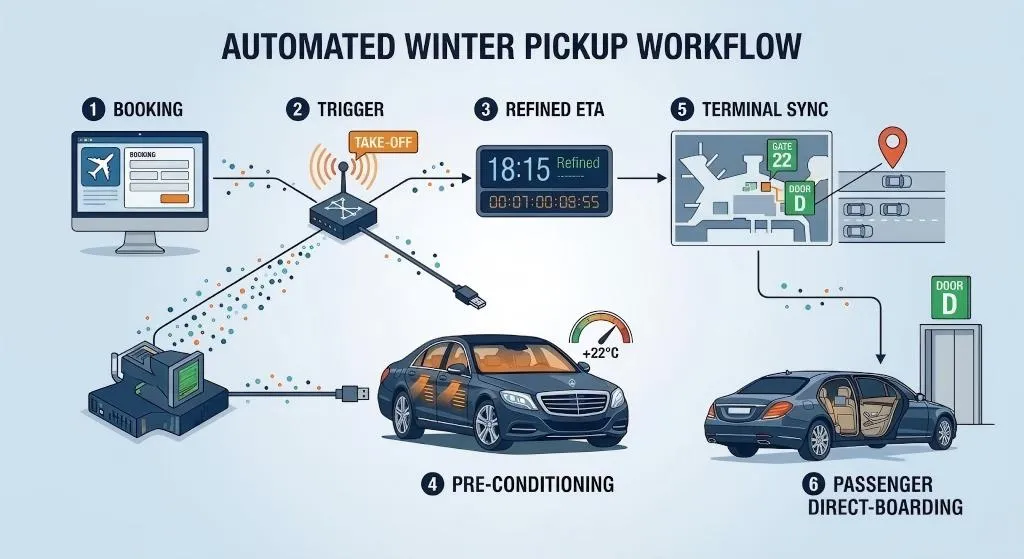
To visualize how a flight status API transforms operations, consider this automated sequence for a winter pickup at Helsinki Airport:
- Booking: Passenger books a luxury transfer; the system binds the
flight numberto the reservation. - Monitoring: The aviation data feed begins monitoring the flight 4 hours before scheduled departure.
- Takeoff Trigger: The system receives the
actual takeoffevent (captured via theactual takeoff/landing timefield). - ETA Refinement: The dispatch engine recalculates the landing window using the
flight durationfield. - Pre-Conditioning: 20 minutes before the refined ETA, the system triggers the vehicle’s HVAC via OEM API.
- Staging: Chauffeur is dispatched to the airport staging area.
- Gate Arrival: The
on-blockevent confirms the aircraft has docked at the gate. - Terminal Sync: The system updates the driver with the specific
terminaland baggage belt information. - Passenger Exit: The traveler walks from the terminal directly into a pre-heated, 22°C cabin.
- Completion: Driver completes the trip with zero idle-time waste.
FAQ: How do Airport Transfer Companies Best Manage Flight Data in Winter?
Q: How accurate are flight status APIs in winter weather?
A: A professional-grade flight status API provides high accuracy for actual takeoff/landing events, ensuring that even during snowstorms, dispatch data is grounded in physical reality rather than airline estimates.
Q: Can flight APIs detect de-icing delays?
A: While APIs do not monitor the de-icing equipment directly, the actual takeoff/landing time field effectively captures the delay’s duration, as the status will not shift to “Takeoff” until the procedure is complete.
Q: What is the best trigger for airport pickup automation?
A: The most reliable trigger is a combination of actual takeoff + flight duration. This provides a stable landing window that bypasses departure gate friction.
Q: Why use a terminal information API for pickups?
A: An airport terminal API identifies the correct pickup zone and exit. During winter, knowing the exact terminal door reduces the time passengers spend exposed to the elements.
About VariFlight DataWorks
VariFlight DataWorks provides flight status, flight tracking, airport, and historical aviation datasets used by airlines, OTAs, TMCs, airport transfer providers, and travel technology platforms worldwide. Coverage includes more than 66,000 daily flights and over 10,000 airports globally, supported by a CMMI5-certified technical team and IDSA membership.