
A connection-risk workflow should not treat every delay as the same event; instead, it should compare each itinerary against its own connection window and operational constraints. For a passenger with a three-hour layover, it may require no action. For a traveler facing a 45-minute international connection, it may trigger rebooking research, support intervention, and ground-service changes.
That is why OTA, TMC, and travel technology platforms need more than a flight delay alert. A delay alert tells someone what happened. A connection workflow decides what should happen next.
Flight connection management is the operational process of assessing whether a traveler can still make the next leg after a flight changes status. For travel platforms, the business risk is practical: missed connections, late rebooking, support tickets, service-desk congestion, and ground transport disruption.
Research on delay propagation has identified passenger and crew connectivity as a key internal factor in how delays spread through an airport network. That is why connection management needs structured flight data, not a single ETA field. It needs scheduled time, estimated time, actual movement time, terminal context, route structure, and downstream service fields in one operational model.
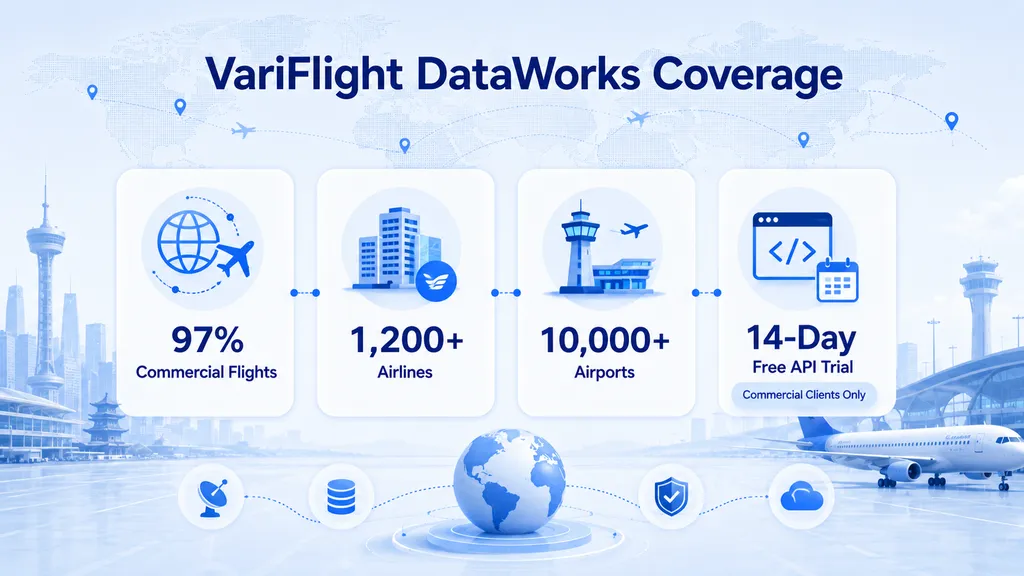
VariFlight DataWorks provides real-time and historical flight status data sourced from airlines and airports, covering 10,000+ airports and 1,200+ airlines. In a connection-management workflow, DataWorks provides the operational data layer that supports transfer-risk assessment and downstream decisions.
How Does a Flight Status API Turn Flight Events into Connection-Risk Decisions?
A flight status API supports connection management by turning flight status, timing, route, and airport service fields into structured inputs for transfer-risk logic. The API does not need to make the final rebooking or dispatch decision. It supplies the data that customer systems use to decide whether to watch, notify, escalate, or prepare alternatives.
The mechanism starts with a flight identity and schedule baseline. The system reads the flight number, airline, origin and destination (OD) airport codes, scheduled time, and route structure. It then compares the baseline against real-time status, official estimated time, and actual takeoff or landing time.
A practical example is a traveler connecting through Dubai from Beijing to Europe. If the inbound flight is marked as “arrived” but its actual landing time is later than scheduled, the OTA should not assume that the passenger is already ready to transfer.
Landing time does not necessarily mean that the aircraft has reached the gate or that the passenger has entered the terminal. The platform should compare actual landing time, arrival terminal, next segment terminal, and minimum transfer logic before showing a missed-connection warning.
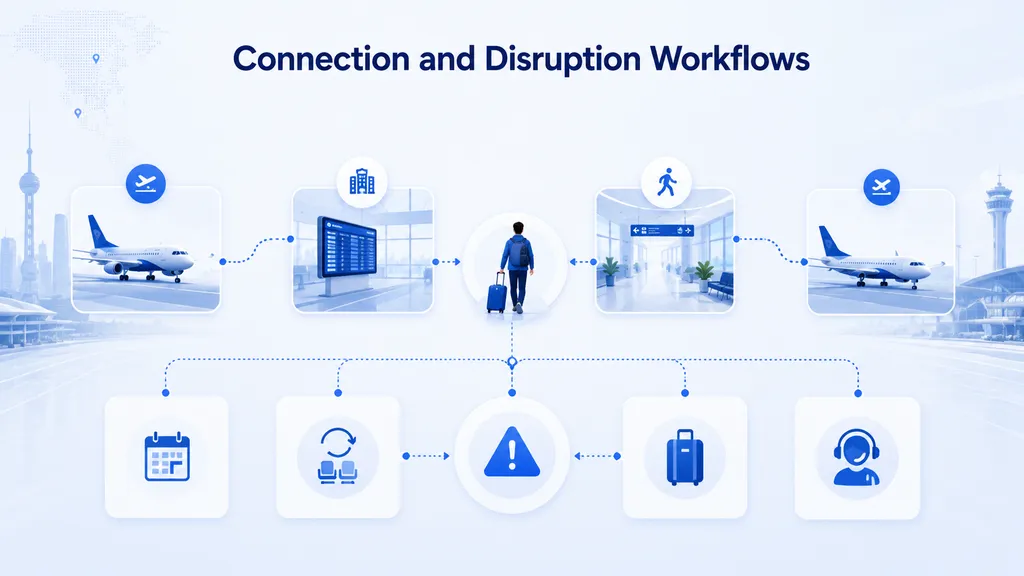
The business impact is clear: connection management reduces avoidable service tickets, late rebooking, counter congestion, and passenger confusion. It also gives enterprise systems a shared operational truth instead of separate teams interpreting flight changes from different screens.
Which Flight Status API Fields Matter for Missed-Connection Risk?
Missed-connection risk is the probability that the remaining operational window is not enough for a passenger, bag, crew member, or service process to reach the next required step. The most important fields are not only delay minutes. They are the fields that explain where the flight is in the journey.
The core fields are:
- Scheduled departure and arrival time
- Real-time departure, arrival, delay, cancellation, return, and diversion status
- Official estimated departure and arrival time
- Actual takeoff and landing time
- Flight number and airline name
- Origin and destination airport codes
The mechanism is a timeline comparison. Scheduled time defines the contract. Estimated time shows the latest operational expectation. Actual takeoff and landing time confirms what has happened. Real-time status explains whether the flight is delayed, canceled, returned, diverted, or arrived.
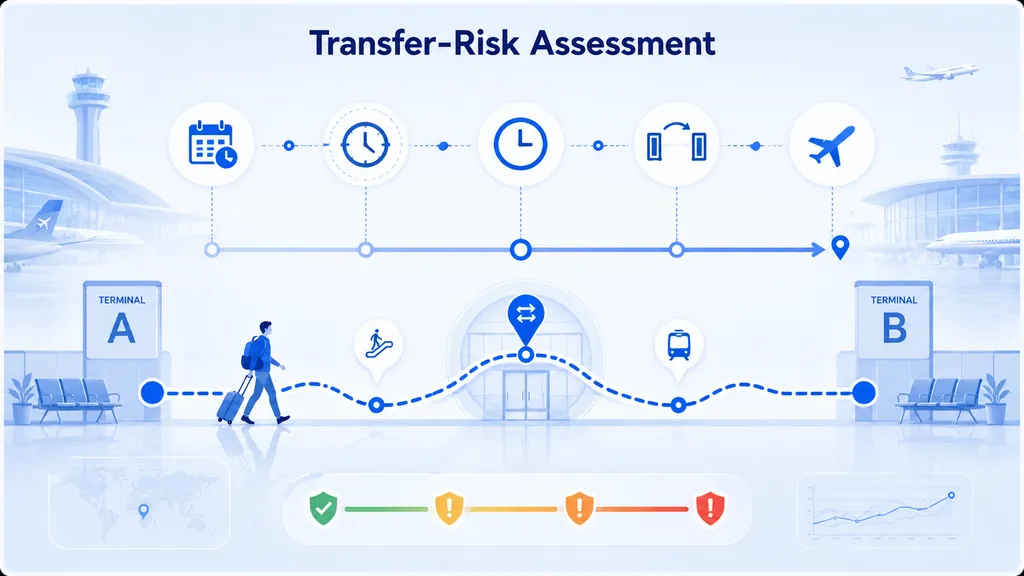
For example, a TMC monitoring an executive itinerary should not treat a 35-minute delay the same way on every route. A 35-minute delay before a three-hour layover may only require a watch state. The same delay before a 45-minute international connection may trigger rebooking research and internal duty-of-care review.
Example transfer-risk input:
| Input | Value |
|---|---|
| Scheduled inbound arrival | 14:10 |
| Official estimated arrival | 14:42 |
| Outbound departure | 15:25 |
| Terminal movement | T1 to T2 |
| Workflow result | Move itinerary from “watch” to “high risk” |
The commercial value comes from prioritization. Instead of opening cases for every delayed flight, the platform can rank disruption by connection exposure.
How Do Terminals, Gates, and Baggage Fields Change the Decision?
Terminal, gate, and baggage fields describe the airport-side path after a flight changes status. They convert a time problem into a movement problem.
The mechanism is location-aware assessment. A system reads terminal data as a stable routing signal. When gate or baggage carousel data is available, it adds more granular airport context. The workflow can then separate a simple same-terminal transfer from a cross-terminal transfer that needs passenger guidance, baggage monitoring, or ground staff intervention.
Consider an arriving passenger whose flight lands only 20 minutes late. The delay looks manageable if the next flight departs from the same terminal. It becomes more serious if the arrival terminal is T1, the next segment departs from T2, and baggage must be reclaimed before re-check.
Travel-platform examples include:
- OTA apps updating terminal instructions after arrival
- TMC platforms preparing support tasks for high-risk business travelers
- Travel apps suppressing duplicate delay alerts after actual landing is confirmed
- Airport transfer partners adjusting pickup logic when arrival and terminal data changes
The business impact is fewer blind spots. A system that combines time, terminal, route, and service fields can identify the passengers and bags that need action first.
How Should OTAs and TMCs Build the Connection Workflow?
An OTA or TMC connection workflow is a rule-based process that watches itinerary legs, compares each leg with real-time flight movement, and triggers the next action only when the risk crosses a defined threshold.
The mechanism usually has four layers:
- Normalize each flight leg with flight number, airline, OD airport codes, scheduled time, and segment flag.
- Poll or receive flight status updates for estimated time, actual time, and disruption status.
- Compare the inbound arrival state with the outbound departure window.
- Use customer-side rules to trigger the correct action: watch, notify, suggest alternatives, open a support case, or suppress duplicate alerts.
This matters because stale status creates bad service behavior. If the first update says “delayed” and the next update shows the aircraft has already landed, the traveler should not receive a late generic warning.
A real-world TMC example is a corporate traveler with a meeting after arrival. The system can use real-time arrival status, actual landing time, and terminal data to decide whether to notify the traveler, the travel manager, and the ground transport vendor. The same data can also support a duty-of-care record after the trip.
The ROI is not only reduced manual work. The larger gain is operational consistency: every traveler, agent, and partner system sees the same state transition.
Building a connection-risk or disruption-management workflow? Explore VariFlight DataWorks Flight Status API to access real-time status, estimated and actual times, terminals, airline names, OD airport codes, and route information through one integration.
Why Use VariFlight DataWorks for Connection and Disruption Workflows?
VariFlight DataWorks is built for enterprise systems that require operational flight data beyond basic consumer-facing flight lookup. For connection and disruption workflows, a key advantage is the breadth of fields available across the flight timeline.
DataWorks combines multiple airline, airport, and operational data sources to provide a more complete view of each movement. Enterprises can access scheduled, estimated, and actual timestamps together with disruption status, terminals, OD airport codes, route structure, and available airport service fields through one integration.
This distinction matters for OTAs, TMCs, and travel platforms. A generic flight status feed may show that a flight is delayed. A stronger operational data layer helps the platform understand whether that delay affects a short connection, a cross-terminal transfer, or a downstream service commitment.
Historical and real-time data can also be used together. Real-time fields support live monitoring, while historical records help product teams tune thresholds, review false positives, and identify routes where transfer risk appears more often.
The business impact is faster product deployment. Instead of integrating multiple providers for core schedule, status, route, and available airport-service fields, teams can build connection and disruption workflows on a more unified aviation data foundation.
What API Architecture Keeps Connection Decisions Reliable?
A reliable connection management system needs an event model, a data-refresh strategy based on the delivery methods supported by the provider, a cache policy, and an idempotent alert layer. Without those controls, real-time data can create duplicate messages.
The mechanism should treat flight updates as state changes, not isolated messages. Each update should be stored with flight identity, timestamp, status, estimated time, actual time, and source priority.
A practical architecture looks like this:
- Flight watchlist: stores active itinerary legs and monitored flight numbers.
- Status sync layer: fetches or receives real-time flight updates.
- State engine: compares scheduled, estimated, actual, and disruption status.
- Connection rule engine: calculates risk using customer-defined route, segment, terminal, and time-window logic.
- Action layer: sends alerts, creates support tasks, or updates partner systems.
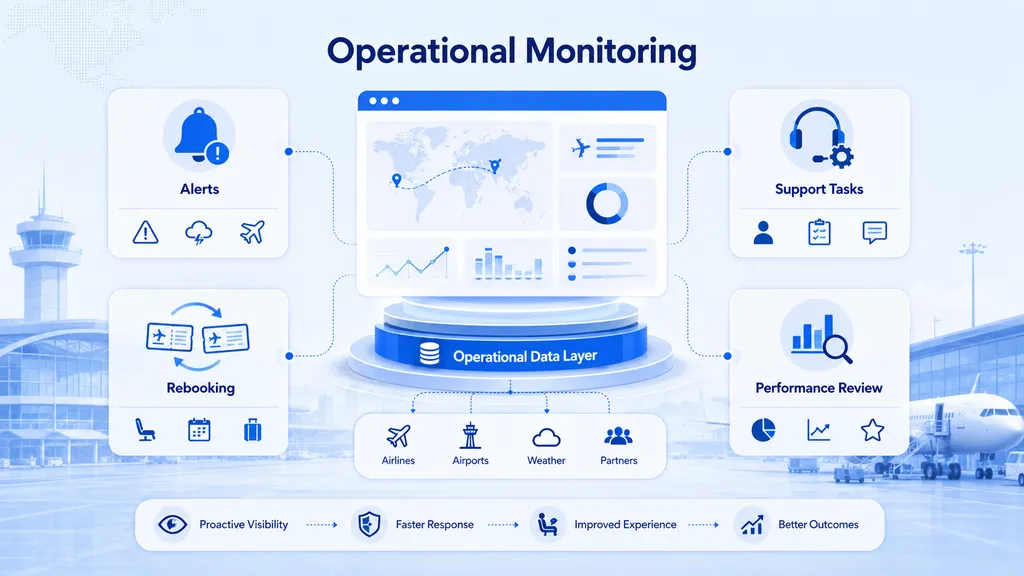
The most common mistake is sending every data change directly to the end user. A better approach is to separate internal sync from external messaging.
The commercial value is trust. Travelers ignore noisy alerts, and agents distrust dashboards that change without context.
What Should Enterprises Measure After Integration?
Connection and disruption management performance should be measured by operational outcomes, not API calls alone.
Useful metrics include:
- Percentage of disrupted itineraries detected before passenger contact
- Average time from flight status change to support case creation
- Duplicate alert rate
- Manual intervention rate per disrupted itinerary
- Rebooking research time
- Connection-risk cases resolved before arrival
The mechanism is post-event reconciliation. Historical flight records can compare the final actual arrival state with the alerts, cases, and actions that the system produced.
The business impact is continuous improvement. The first API integration creates visibility; the second phase turns visibility into measurable operating discipline.
For teams evaluating flight status API providers, this measurement layer also supports vendor comparison. The right data partner should help the platform reduce stale alerts, detect high-risk itineraries earlier, and build repeatable disruption workflows across routes.
FAQ
Is flight connection management the same as flight delay alerts?
No. Flight delay alerts report a status change. Connection management evaluates the downstream impact of that change on connecting travelers, support teams, and partner workflows.
Which field is most important for connection decisions?
No single field is enough. Reliable decisions require scheduled time, official estimated time, actual takeoff or landing time, real-time status, route structure, and airport context such as terminal data.
Should every flight status update trigger a passenger notification?
No. Systems should separate data synchronization from user messaging. Many updates are useful for internal state management but too noisy for passengers.
Where does DataWorks fit in the workflow?
VariFlight DataWorks provides the structured flight status, timing, route, airline, airport, and operational service fields that enterprise systems need to build their own connection-risk logic, disruption queues, and automated travel workflows.
Can OTAs and TMCs test this before a full integration?
Yes. Teams can use a 14-day API trial to test selected routes, monitor real-time status changes, compare estimated and actual timestamps, and evaluate how the data fits their current support or disruption workflow.
What data should teams test during an API trial?
Teams should test representative routes, short and long connection windows, terminal changes, delayed arrivals, cancellations, and flights with estimated and actual time updates. This helps verify field availability, update behavior, and compatibility with existing disruption rules.
Start Testing Connection-Risk Workflows
Test connection-risk workflows using your own routes and itineraries. Access scheduled, estimated, and actual timestamps together with real-time flight status, terminal, airline, and origin-destination data. Contact us to get your 14-day free API Trial.
References
- EUROCONTROL/IATA delay-code context is relevant because airline delay reporting includes passenger/load connection and aircraft rotation categories: https://www.eurocontrol.int/publication/all-causes-delay-and-cancellations-air-transport-europe-q3-2019
- EU passenger-rights context: Regulation (EC) No 261/2004, official text: https://eur-lex.europa.eu/eli/reg/2004/261/oj
- Delay-propagation research: Fleurquin, Ramasco, and Eguiluz, “Systemic delay propagation in the US airport network”: https://arxiv.org/abs/1301.1136
- Connection prediction research: Guimaraes, Soares, and Ventura, “Decision Support Models for Predicting and Explaining Airport Passenger Connectivity from Data”: https://arxiv.org/abs/2111.01915