
Airport transfer and chauffeur service companies face daily operational challenges caused by flight uncertainty. Unlike other travel services, airport pickups are tightly bound to the actual arrival of specific flights, and even small deviations can cascade into idle vehicles, driver misalignment, and frustrated passengers.
Structured flight status data enables transfer operations to become predictive, scalable, and data-driven, linking operational decisions directly to flight events.

Operational Pain Points from Flight Uncertainty
Vehicle and Driver Idle Time
Dispatching based on scheduled flight times often leads to vehicles and drivers waiting unnecessarily. At scale, idle time reduces fleet efficiency and increases operational costs.
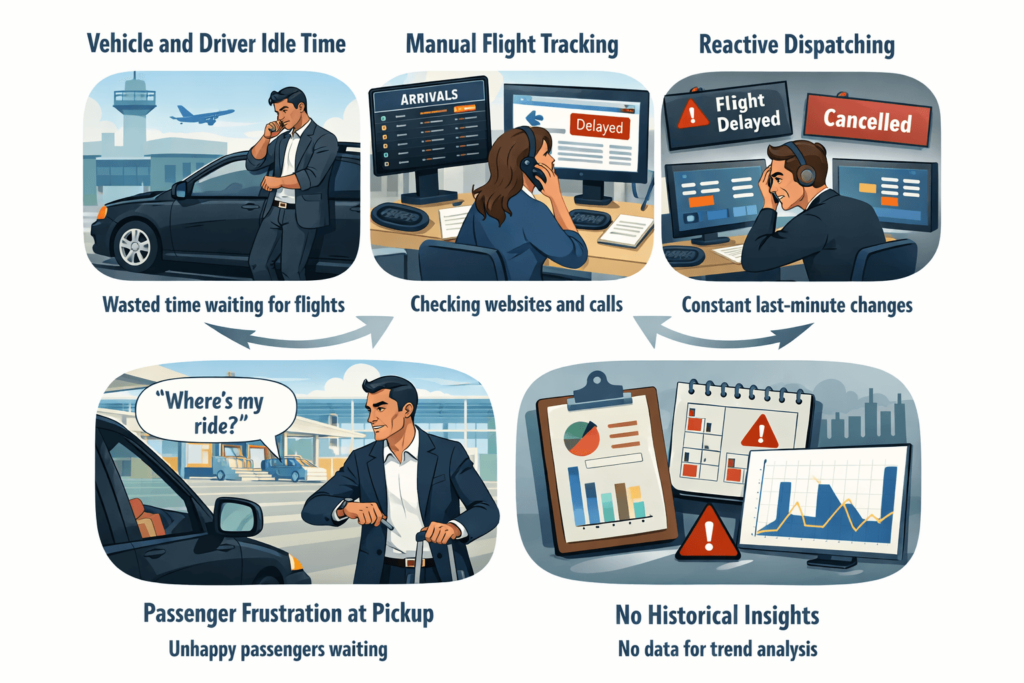
Manual Flight Tracking Does Not Scale
Many operators still rely on airline websites, airport arrival boards, or passenger calls. This becomes unmanageable when handling multiple airports, international arrivals, or irregular schedules, creating information lag.
Reactive Dispatching
Without real-time insights, dispatch teams constantly react to delays, cancellations, or diversions rather than planning proactively, increasing overtime and operational stress.
Passenger Frustration at Pickup
Passengers expect their vehicle when they exit the terminal. Any mismatch between expected and actual arrival time leads to a perception of poor service, even if the delay originates with the airline.
Lack of Historical Insights for Planning
Without structured historical data, it is difficult to understand patterns such as which airports or airlines have recurring delays, seasonal volatility, or peak arrival windows, making long-term planning reactive rather than data-informed.
Data-Driven Solutions with Flight Status Data
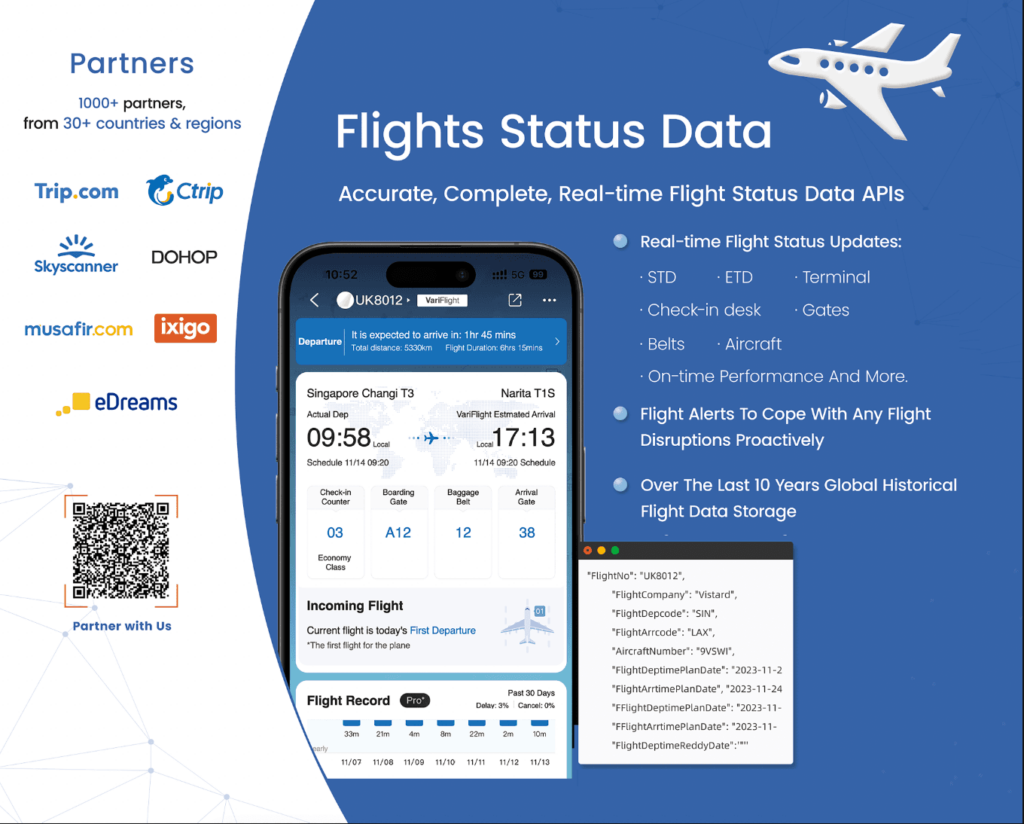
The Flight Status Data API provides machine-readable, real-time, and historical flight information that can be integrated into airport transfer operations. Below is how the data addresses operational challenges:
1. Dynamic Pickup Timing
Problem: Drivers arrive too early or too late, causing idle time and passenger dissatisfaction.
Data Fields Used:
Real-time Estimated Time of Arrival (ETA)
Actual landing time
Taxi-in and gate arrival status
How Data Solves It:
Automatically adjusts pickup timing as ETAs (estimated time of arrival) change
Reduces driver idle time and passenger wait
Minimizes manual rescheduling by dispatch teams
2. Proactive Exception Handling
Problem:Unexpected delays, cancellations, or diversions force reactive decision-making.
Data Fields Used:
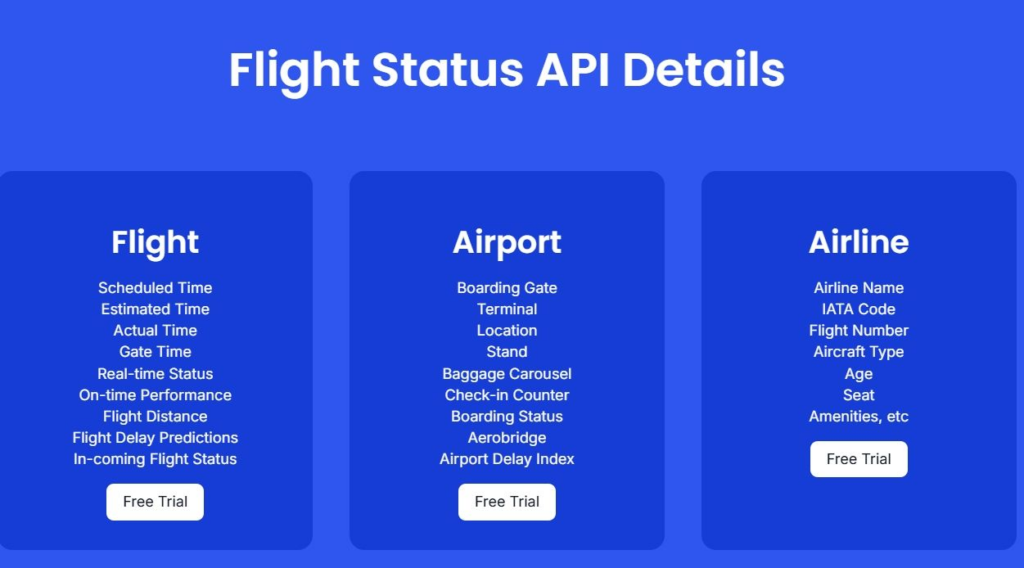
Flight status indicators (Delayed, Cancelled, Diverted, Returned)
Updated departure and arrival times
Terminal and baggage carousel assignments
How Data Solves It:
Detects long delays and cancellations in advance
Enables automated driver reassignment or dispatch delay
Sends proactive notifications to passengers
Why Flight Number Matters as Much as Status
A flight status feed is only actionable if it is correctly bound to a booking, and that binding happens through the flight number. Combined with the departure date, the flight number is the exact parameter used to subscribe to real-time status updates — it is the identifier that links a passenger’s reservation to a specific physical aircraft.
This matters because industry-wide delay and cancellation volumes are not trivial. China’s Civil Aviation Weekly Report for June 1–7, 2026 recorded a flight execution rate of just 71.2% and a departure delay rate of 10.1% — meaning over 28% of flights that week faced cancellations or severe schedule adjustments. Delay exposure also varies significantly by carrier: the same reporting period showed Shenzhen Airlines at a 22.4% departure delay rate and Donghai Airlines at 24.7%.
Without a reliable flight-number-to-status mapping, dispatch systems risk “blind-dispatching” drivers toward flights that are quietly cancelled or replaced — the so-called “ghost flight” scenario. Tracking by flight number enables an orphaned booking interception protocol: when the API reports a cancellation against a tracked flight number, the system automatically releases the assigned driver back to the available pool rather than leaving them idling at a curb for a flight that will never land.
This same flight-number-and-status logic scales globally — the underlying data pipeline normalizes ADS-B signals, radar feeds, and ATC updates into one schema, so the same dispatch rules apply consistently whether the arrival airport is Chicago O’Hare (ORD), London Heathrow (LHR), Munich, or Shanghai.

3. Dispatch and Resource Optimization
Problem:Overlapping arrivals and poor vehicle allocation reduce fleet utilization and schedule reliability.
Data Fields Used:
Real-time arrival sequencing across multiple flights
Terminal and baggage carousel information
Historical punctuality data
How Data Solves It:
Sequences pickups accurately to prevent conflicts
Allocates backup vehicles only when necessary
Improves fleet utilization and predictability of operations
From Concept to Execution: A Three-Tier Dispatch Logic
Turning flight status data into pickup timing decisions requires more than a raw data feed — it requires a clear rules layer. A typical implementation breaks down into three tiers:
| Tier | System Responsibility | Core Trigger / Action |
|---|---|---|
| 1. Monitoring | Maintains an active watchlist of the day’s booked flights | Tracks each flight number from booking creation onward |
| 2. Event Capture | Ingests real-time status milestones | Reacts to events such as “On-Blocks” (gate arrival) or “Diverted” |
| 3. Predictive Dispatch | Calculates a Curb-Side ETA, not just a landing ETA | Adds a dynamic buffer to gate-arrival time — typically +20 minutes for domestic flights and +45 minutes for international flights, to account for taxiing, deplaning, and baggage claim |
This buffer logic matters because a passenger’s actual curb-side readiness — not the aircraft’s touchdown — is what a driver should be timed against. Without it, fleets fall into the “Cell Phone Lot” problem: drivers wait in remote staging areas and, even after a flight lands, still add 10–15 minutes of avoidable curb-side wait because dispatch wasn’t triggered until too late.
Quantifying the impact: Even a modest 15-minute reduction in idle time per pickup compounds quickly at scale. For an operation running 100 pickups a day, that is roughly 25 hours of recovered vehicle and driver time daily — capacity that can be redeployed to additional trips rather than lost to waiting.
4. Long-Term Operational Planning
Problem:Staffing, buffer times, and fleet allocation rely on guesswork without historical patterns.
Data Fields Used:
Historical flight arrival times
Airline-specific on-time performance
Seasonal and route-specific delay patterns
How Data Solves It:
Informs buffer time rules and shift scheduling
Supports evidence-based fleet allocation across airports
Enables proactive operational planning for recurring challenges
Trusted by AVIS and Didi, Start Free Trial Here
Flight status data APIs are available for free trial, enabling operators to:
Test real-time arrival updates
Validate delay and exception handling logic
Assess impact on dispatch efficiency

Typical partners are AVIS and Didi. They show how global rental and ride-hailing companies use flight data. This helps make airport transfers more predictable and efficient.
Quick Reference Q&A
Q1: Why is scheduled arrival time insufficient for airport transfers?
A: It does not reflect real-time taxiing, gate availability, or air traffic delays.
Q2: What flight data is most valuable for dispatch teams?
A: Real-time ETA, landing status, delay/cancellation signals, and terminal/gate information.
Q3: Does flight data only help large fleets?
A: No. Even small or mid-sized operators benefit from reduced manual tracking and fewer exceptions.
Q4: Is flight data difficult to integrate?
A: Flight status APIs are designed for system-level integration into booking, dispatch, and mobility platforms.

About the Author
Name: Belle Chen
Title: Digital Marketing Manager, VariFlight
Contact: https://www.linkedin.com/in/bellechen1220/
Belle Chen is Digital Marketing Manager at VariFlight, promoting aviation data solutions and 14-day Flight API trials for OTAs, TMCs, insurers, and travel tech partners to unlock real-time, data-driven travel intelligence.