
During the week of Dec 1–7, 2025, China’s civil aviation market showed stable passenger demand and flight activity, while domestic fares and RASK saw slight declines. VariFlight DataWorks provides weekly insights on flights, passenger traffic, aircraft utilization, and major airline operations.
Passenger Transport Overview
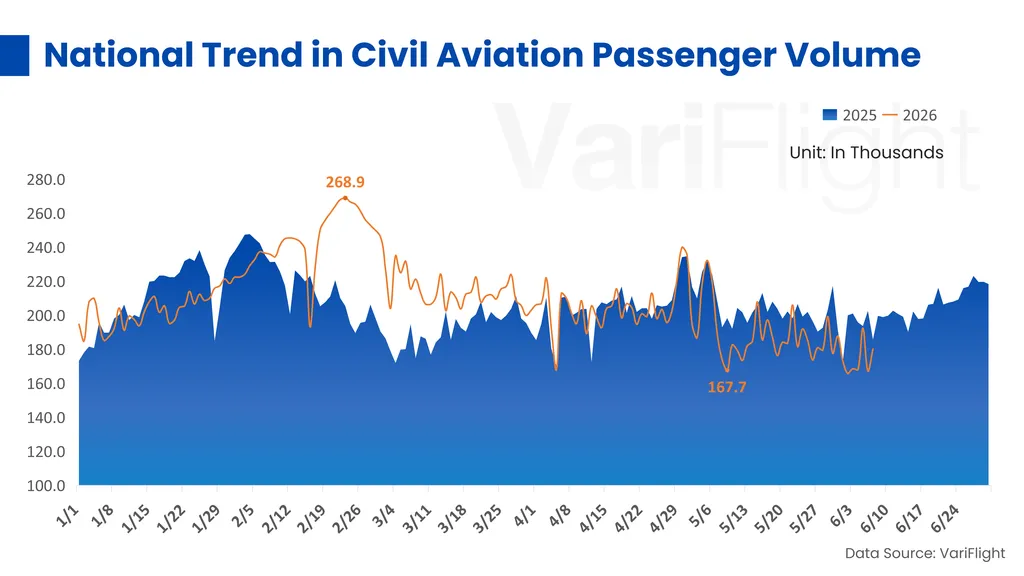
During the week of December 1–7, 2025, China’s civil aviation market saw stable passenger demand.
A total of 96,000 passenger flights were operated nationwide, averaging 13,800 flights per day. This represented a 1 percent decrease compared with the previous week. Flight volume increased 3 percent year-on-year and 6 percent compared with 2019.
Total passenger volume reached 13.555 million for the week, averaging 1.936 million per day. Passenger numbers fell 3 percent week-on-week, but increased 7 percent compared with 2024 and 15 percent compared with 2019.
The flight completion rate was 81.4 percent, down 1 percentage point from last week. The average load factor was 83.6 percent, also decreasing by 1 percentage point week-on-week.
Domestic Fare and RASK Overview
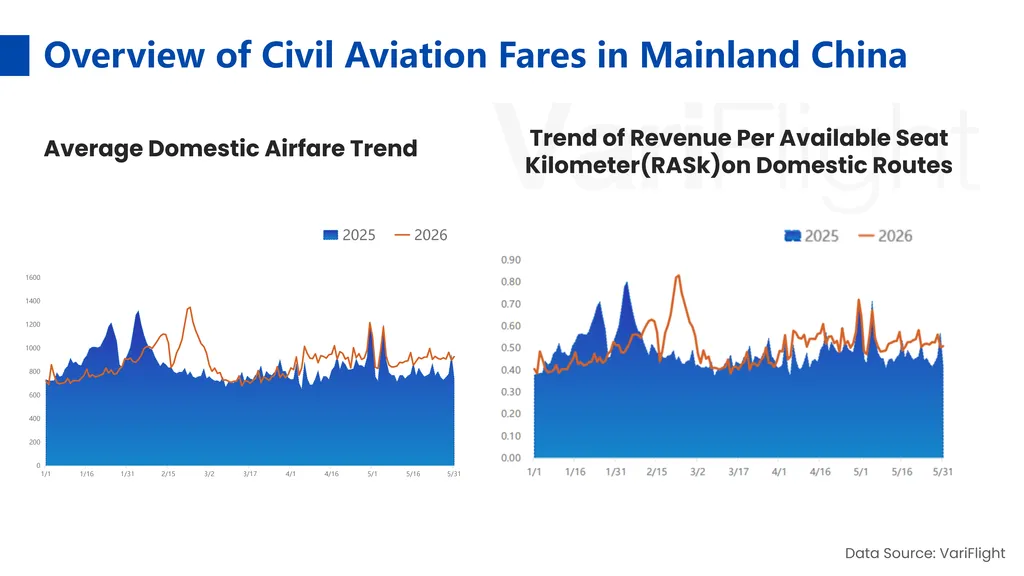
The average all-inclusive domestic airfare was RMB 716.4, down 1 percent week-on-week and 4 percent compared with 2024.
The domestic revenue per available seat kilometer (RASK) was RMB 0.411, a 2 percent decline from the previous week and 3 percent lower than last year.
Aircraft Utilization
From December 1–7, 2025, domestic aircraft recorded an average utilization of 8.81 hours per day, a decrease of 1.60 percentage points week-on-week.
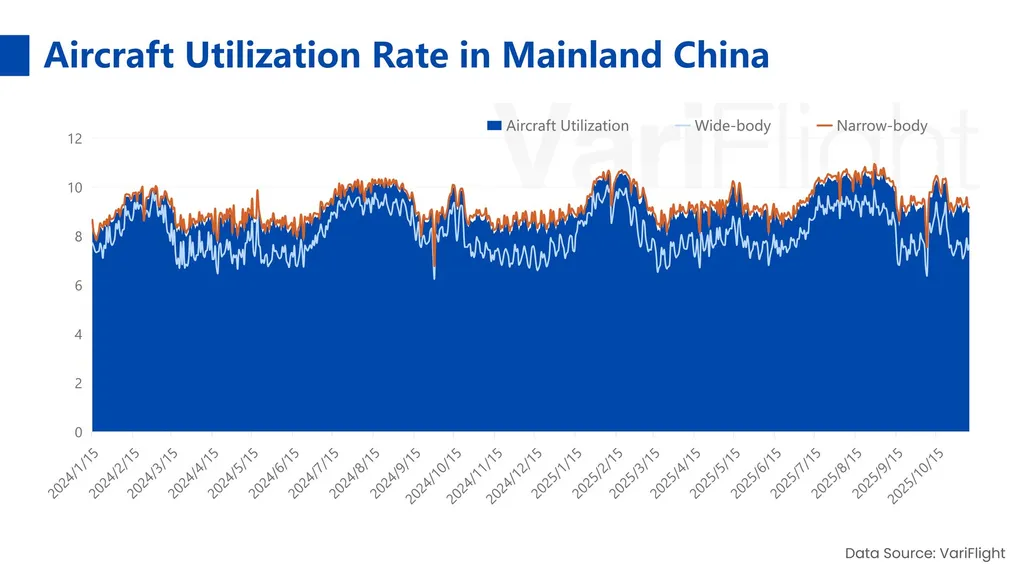
Wide-body aircraft averaged 7.33 hours per day, down 1.71 percentage points.
Narrow-body aircraft averaged 9.04 hours per day, down 1.56 percentage points.
Major Airport Passenger Traffic
Guangzhou, Shanghai Pudong, and Beijing Capital handled the highest passenger volumes this week.
Among airports with annual passenger traffic above ten million, Urumqi, Changchun, and Harbin recorded slight week-on-week increases. Most other major airports showed varying degrees of decline. Guiyang decreased 8 percent, Kunming decreased 7 percent, and Qingdao decreased 6 percent.
Compared with last year, Shijiazhuang increased 25 percent, Urumqi grew 18 percent, and Nanning rose 16 percent, leading year-on-year growth.
Airline Flight Volume
China Eastern Airlines, China Southern Airlines, and Air China operated the highest number of flights this week.
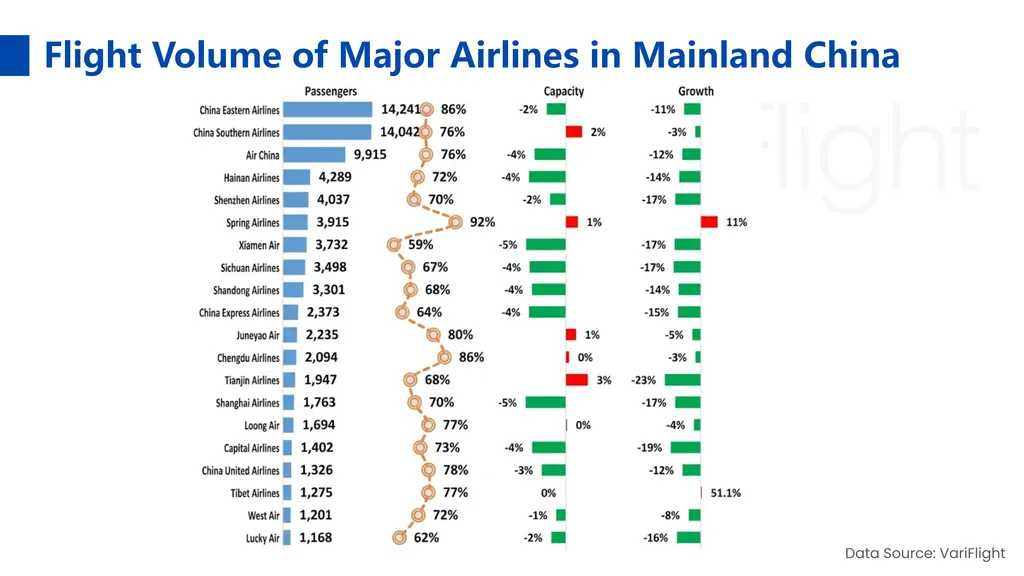
Among the top 20 airlines, Loong Air decreased 12 percent week-on-week, Xiamen Airlines decreased 7 percent, and Shandong Airlines decreased 3 percent.
Year-on-year growth was led by Tibet Airlines at 14 percent, Shandong Airlines at 13 percent, and Spring Airlines at 12 percent.
About VariFlight DataWorks
DataWorks, Sub-brand of VariFlight provides aviation data, flight operations information, and civil aviation reporting for mainland China and global markets.
Founded in 2005, VariFlight operates one of the most complete flight data networks in China. The system covers more than 1,200 airlines and 10,000 airports, supported by a nationwide ADS-B network, airport operational data, multi-source verification, and high-frequency event monitoring.
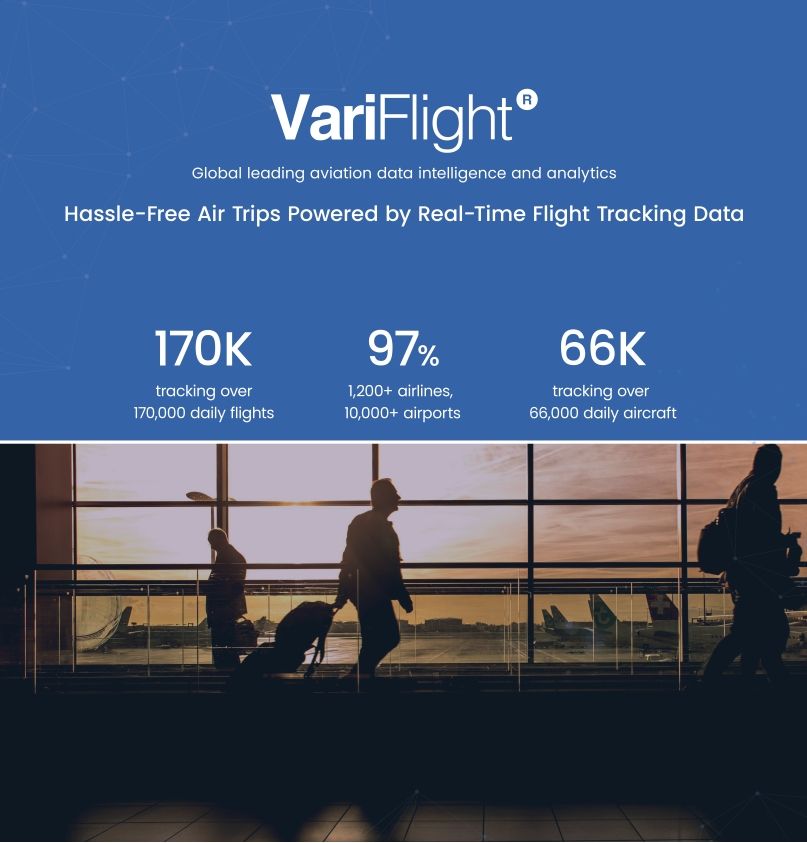
With long-term data accumulation and localized infrastructure, VariFlight delivers accurate and timely datasets used in analytics, operational platforms, digital travel applications, financial services, and AI systems.
For more information and free API trial
About VariFlight DataWorks
VariFlight DataWorks, the sub-brand of VariFlight, provides aviation data, flight operations information, and civil aviation reporting for mainland China and global markets.
VariFlight’s data infrastructure has been built over two decades:
- 2005 — Public Service Phase: Authorized by Chinese aviation authorities to process flight data for public accessibility
- 2010 — Marketization: Launched commercial aviation data products for airlines and travel platforms
- 2015 — Data Expansion: Added flight comfort scores, ticket pricing trends, aircraft type detail, and operational frequency data
- 2017 — Internationalization: Expanded globally through partnerships and self-operated base station infrastructure
- 2023 — Data Assetization: Shifted focus toward enterprise data ownership and structured aviation data assets
VariFlight is CMMI-5 certified and also operates FeiChangZhun, a consumer-facing flight tracking app that generates real-world behavioral data used to validate and enrich the B2B datasets behind reports like this one — covering over 99% of flights in China, including domestic routes and international flights connecting to the country.
How This Data Is Used
The metrics in this report (passenger volumes, load factor, RASK, airfare, aircraft utilization) feed directly into several real-world business use cases:
- OTAs & TMCs use route-level capacity and pricing trends to optimize inventory display and dynamic pricing
- Insurance companies incorporate load factor and delay-probability data into route-specific underwriting and claims models
- Corporate travel managers use route reliability metrics to reduce employee travel disruptions
- Airlines and mobility/research firms use city-pair demand trends like those above to identify underserved routes and evaluate network expansion opportunities