From Flight Misery Index to Flight Happiness Index: Measuring Passenger Experience in the Travel Industry
bc
Introduction
Air travel can be a rollercoaster of experiences. Delays, cancellations, and lost luggage can turn what should be a smooth journey into a frustrating ordeal.
For many years, the aviation industry and travel experts have tracked these problems. They use a measure called the Flight Misery Index. This index measures negative travel experiences by looking at delays, cancellations, and passenger complaints, providing insight into operational challenges that affect traveler satisfaction.

These metrics provide helpful insights on areas for improvement. However, they mainly focus on problems and overlook what makes a flight enjoyable.
Recognizing this gap, the industry created the Flight Happiness Index (FHI)—a holistic measure of passenger experience quality. Airlines, corporate travel managers, and online travel agencies (OTAs) use FHI more and more. They want to make smart choices. These choices help improve passenger satisfaction and make operations run better.
Understanding the Flight Misery Index
The Flight Misery Index tracks operational pain points:
- Frequent Delays: Percentage of delayed flights and average delay duration.
- Cancellations: Proportion of flights canceled due to operational or environmental factors.
- Baggage Issues: Lost, delayed, or mishandled luggage.
- Passenger Complaints: Grievances related to service quality, ticketing, delays, cancellations, and in-flight issues.
This index helps airlines and corporate travel managers anticipate disruption risks and improve operational reliability. However, it does not capture the positive aspects that contribute to a satisfying travel experience.
Introducing the Flight Happiness Index (FHI)
The Flight Happiness Index (FHI) measures passenger experience holistically. It combines operational data, service quality, and passenger feedback to produce a single, actionable score.

FHI allows stakeholders to see not only potential issues but also what drives positive travel experiences. It is valuable for:
- Airlines optimizing operations and enhancing loyalty.
- OTAs providing transparent, comparative insights.
- Corporate travel managers improving employee comfort and productivity.
- Airport operators enhancing facilities and overall service quality.
Key Metrics of the Flight Happiness Index
FHI combines five core dimensions:
1. On-Time Performance
Definition: Punctuality and reliability of flights.
Data Sources: Historical flight records, real-time ETA/ETD updates, predictive delay models.
2. Cabin Comfort & Service
Definition: Seat comfort, legroom, in-flight amenities, and crew service.
Data Sources: Passenger feedback surveys, review platforms, airline internal ratings.
3. Baggage Handling Efficiency
Definition: Speed, accuracy, and safety of luggage delivery.
Data Sources: Airline tracking logs, customer service reports.
4. Airport Facilities & Services
Definition: Terminal amenities including lounges, dining, security, and environment.
Data Sources: Passenger surveys, airport operational data.
5. Information & Notifications
Definition: Effectiveness of real-time updates, notifications, and communications.
Data Sources: Airline communication systems, mobile apps, messaging platforms.
The system aggregates scores for each metric into a composite FHI score for flights, routes, airlines, or airports. This allows benchmarking, comparison, and identification of areas for improvement.
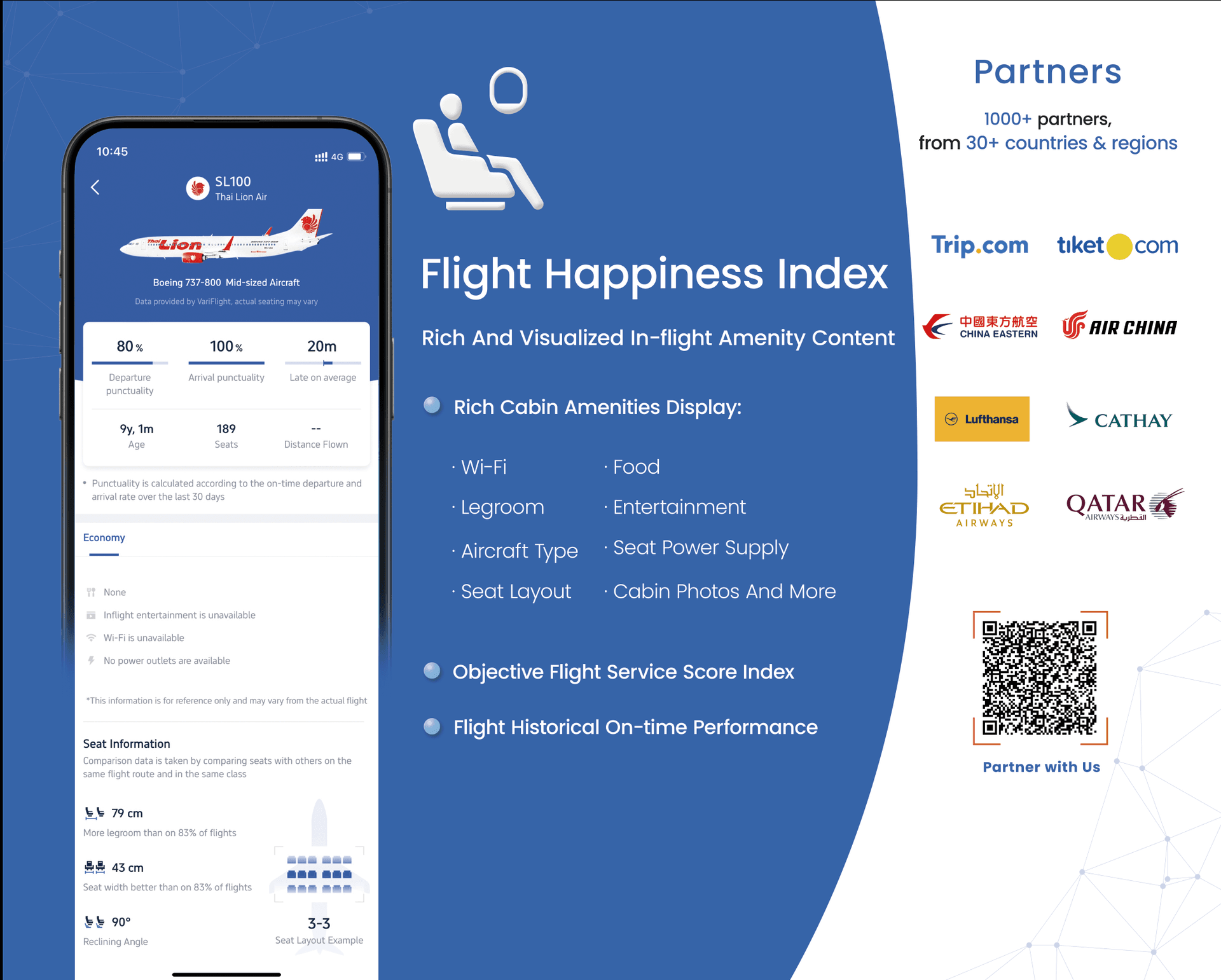
Data Sources and Methodologies
FHI leverages:
- Flight Operations Data: ETA/ETD records, historical on-time performance, route stability.
- Passenger Feedback: Surveys, ratings, and qualitative feedback.
- Predictive Analytics: Machine learning models combine data to predict potential issues and quantify satisfaction.
- Composite Scoring: Weighted aggregation generates a comparable FHI score.
Unlike traditional misery metrics, FHI helps airlines and travel managers proactively enhance passenger experience.
Applications for B2B Stakeholders
Corporate Travel Management
Companies use FHI to select flights with the highest satisfaction, reducing employee fatigue and improving productivity.
Customer Testimonial – Trip.com:
"VariFlight's FHI standard has helped us stand out. It shows our unique in-flight features. This drives more upgrades and boosts revenue." A game-changer for staying competitive in the market.Online Travel Agencies (OTAs)
OTAs highlight flights with higher FHI scores, helping travelers make informed decisions and increasing engagement.
Customer Testimonial – Greater Bay Airlines:
"With FHI, we've elevated our brand visibility and easily managed our in-flight offerings across multiple channels. Now, we can streamline our merchandising and expand our reach to a broader audience."
Airlines and Airport Management
Airlines integrate FHI into dashboards to monitor service quality and optimize schedules, enhancing retention and reputation. Airport operators use FHI scores to improve terminals, streamline security, and enhance lounges, focusing on traveler happiness.
Benefits of the Flight Happiness Index
- Comprehensive Measurement: Captures the full travel experience, not just failures.
- Data-Driven Decisions: Provides actionable insights for airlines, OTAs, and corporate managers.
- Enhances Passenger Satisfaction: Identifies strengths and weaknesses across the journey.
- Predictive Insights: Anticipates potential disruptions before impacting travelers.
FHI offers a forward-looking, strategic approach, complementing traditional misery metrics.

Conclusion
The Flight Happiness Index (FHI) redefines passenger experience measurement. By combining operational metrics and qualitative factors, it offers a comprehensive, actionable, and forward-looking view of travel satisfaction.
For B2B stakeholders, FHI provides insights that go beyond delays and cancellations. This helps organizations optimize flights. It also improves service quality. As a result, every passenger can enjoy a comfortable and reliable travel experience.
In today’s world, business travel affects productivity and employee satisfaction. FHI is more than a number—it is a strategic tool for decision-making and service excellence.
Try VariFlight’s Flight Happiness Index Data for Free: https://dataworks.variflight.com/about-us/contact
About the Author
Name: Belle Chen
Title: Digital Marketing Manager, VariFlight
Contact: https://www.linkedin.com/in/bellechen1220/
Belle Chen is Digital Marketing Manager at VariFlight, promoting aviation data solutions and 14-day Flight API trials for OTAs, TMCs, insurers, and travel tech partners to unlock real-time, data-driven travel intelligence.